Overcoming Challenging Obstacles

Excerpts from, Overcoming Challenging Obstacles by Twinkle VanFleet below.

The past few years have been a test of strength, endurance, and possibilities amidst constant setbacks to overcome. 5 years after the injury that led to my CRPS, I did go back to school for a degree in Corporate Publishing. At the end of 2006 I took leave to have my permanent Spinal Cord Stimulator implanted and I returned approximately 10 weeks later. Due to not being able to drive any longer, my husband took me and picked me up in between his own full-time work schedule. By 2007, I wasn’t able to keep up any longer. My grandson was born in 2006, too. My husbands first heart attack when he was 37, 2 stent placements, his Diabetes diagnosis, he only used accumulated vacation time for it and returned to work in a weeks time. In 2007, we bought or first home, but he also lost his 13 year career and stability when his company C.S.A.A. (AAA) relocated out of California. I continued to raise awareness for chronic pain, met Trudy Thomas, became a leader at MD Junction’s RSD Support and remained for 3 years. My own support group which I began on My Space in 2003 was moved to Facebook, yet I didn’t move the members with it. I like for people to find us rather than to send out invites or notify. I met Barby through Trudy. My son had a traumatic brain injury in August of 2011 and my husband had a second heart attack within a year. I stayed in the PICU with Ozra for 10 days. In December of 2012 I stayed at the hospital with my husband for the entire 9 days during his quadruple bypass surgery, the first few days I slept in the van. In 2012, I had Gall bladder surgery and in 2013 I had another Gall bladder surgery which included the removal of part of my liver and multiple hemangioma’s. https://rsdadvisory.com/2013/07/17/gall-bladder-fiasco-continued-and-hopefully-the-final-chapter/

2014 my daughters liver disease, our sons birth defect diagnosis from Shriners Children’s Hospital unrelated to his TBI and my surgery to have my SCS battery replaced. Piece of cake, mostly. 2015 started with a bang and 3 weeks of hard Cymbalta, Zonegran, and Clonazapam withdrawal due to WC delaying Rx refills. The other 2 weren’t filled either, but really no effects from them as much as the other 3. I no longer take Clonazapam or get the Lidoderm. It hasn’t been easy, especially when Clonazapam did help and pain management medication was and is already at the lowest minimum. I already do all that I can to minimize my own agony and I practice these coping strategies each and every day. My husband just had surgery to repair a torn shoulder a few months ago and we just learned by MRI he has another tear in his knee. We’re still learning all we can at Stanford for our daughter. Rikki is managing well. My purpose is in helping others, it’s all I’ve ever done one way or another, but it isn’t my passion. I’ve come to realize it can’t be. It’s not the fire flickering about the dancing flames that motivates my spirit to fly. My bucket-list goal survives all this. It’s not writing, I have that. It’s not policy, POP gave me that opportunity again. It’s much deeper than that, at least for me. Our son and oldest daughter are moving in together on the 1st. My man and I will have our home to ourselves. January 26th begins my 16th year. I’m not sure where 2016 will take us, I just know I take a lickin’ and keep on tickin’ … for mine.


Overcoming Challenging Obstacles

“Pain isn’t in our head, but it is in our brain, and our minds. Pain is sent from the spinal cord, sending messages to our brain, back to our spinal cord and up and down those nerve pathways. Pain signals reach our endorphins, limbic system, https://www.dartmouth.edu/~rswenson/NeuroSci/chapter_9.html hypothalamus, where they then affect our emotions and other bodily functions. http://www.medicinenet.com/script/main/art.asp?articlekey=10812

Functional restoration afforded me lessons and insight to be able to push on. Sometimes we already realize these lessons for someone else, but when it’s us, we don’t recognize it the same, we change, unless we change us back.

It’s a daily process to overcome additional challenges brought on by chronic or intractable pain. It’s moment by moment at times. Having to stop something suddenly to practice breathing exercises to decrease a stress situation brought on by either emotion or a spike in pain, bring a rise in blood pressure down, use focal points, imagery or going to my “happy place” in my mind to ease myself.

“I will walk, when I cannot walk I will carry myself, when I cannot carry myself, I will fly” ©2009-2015 Twinkle VanFleet/@rsdcrpsfire Written while attending Compass Center for Functional Restoration
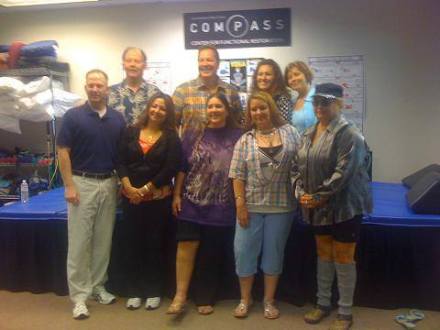
John C. Thomas, PhD, Rick Wurster MSG, MPT, ABP, BCIAC, Leticia Camarena M. A., Tatyana Yatsenko, Larry Lane, Patient, Patient, Twinkle VanFleet, Patient. Compass Center for Functional Restoration Graduation July 17, 2009

I began recording both my P & E. I tracked my “pain” level and my “emotional” level using the same Numeric Rating Scale. The 11 point 0 – 10 scale where 0 represents “no pain” and 10 represents “worse pain imaginable”, “as bad as I can imagine” or unimaginable. I don’t do this anymore because I’ve learned to have the awareness without tracking, but for example at the moment I logged, my E/emotions/stress was an 8 and my P/pain/physical was a 5, I would eventually learn that my pain level would most likely rise anytime. I had to use my cognitive tools right away to reduce my stressors in order to manage the physical pain. I discussed this concept at MDJunction.com when I was a group leader in the RSD Support Forum in 2009.

Life itself can be hard, add pain to it, and it’s even harder. It can be managed with the right tools. It’s never going to be perfect, but we can make it as comfortable or as tolerable as possible for ourselves. Removing or decreasing triggers that instigate pain have eased me. I can’t watch the internet all day. It’s not because I don’t love or care for everyone. It’s because there are pain triggers everywhere. When we see images, graphics, memes of illness or disease scrolling by, especially our own, a trigger can occur. I’ve learned over the years to recognize this. I have the awareness to understand that I can be a contributing factor in my own discomfort.

I never went to preschool and Kindergarten was only for a week or two. I started school in the first grade. I was taught at home and I was reading at advanced levels by the age of 5. My comprehension and spelling ability was always above average. While I either suppressed it or just didn’t care to acknowledge it, I did go to special classes in the first and second grade because I couldn’t pronounce the letter’s S and T in words and sentences properly. I was a critical thinker immediately in life. http://www.criticalthinking.org/pages/defining-critical-thinking/766

By the time I got to my 4th elementary school in the middle of the school year in the second grade, I didn’t have to tell anyone I went to the classes with the special ones. Those new kids and that neighborhood became the ones I grew up with until I left Sacramento in October of the 9th grade to move to L.A. County for my dad’s job. The rest of that year carried with it a bit of insecurity. I started Drama at my new high school and as a Junior I was in second year advanced drama, speech, debate and thespian clubs, involved in school plays, in chamber singers for a while, I swirled the baton too, but chose my priorities and kept to the one’s I still use today. By the middle of the 11th grade I was off to the high desert where my parents bought a home. I’ve been in 4 high schools, 2 Junior high’s due to the district split and several elementary. I learned to adapt young. I may not like it, but I do it fairly well. I’m a survivor of repeated childhood molestation and indirect physical and emotional abuse.

I’ve been an Empath http://themindunleashed.org/2013/10/30-traits-of-empath.html for as long as I can remember. I can vividly still remember leaving my teething ring on the back metal bumper edge of my dad’s best friend’s pickup truck and them driving away with it. I’m hypersensitive to people, places and things sometimes to my own detriment, yet I’m also a no-nonsense girl. I’m inclined to the natural order of things, including man and woman, but I’m not a doormat. I love my crazy and he does, too! Why? Because it’s really not all that crazy, I just like to have it appear so in the midst all the uncertainty in life. Laughing is the best medicine of all. If I can make you laugh, give you something to laugh at even if it’s at my own expense, I’m thrilled to have been of service.”

Empathy Vs Sympathy

http://www.diffen.com/difference/Empathy_vs_Sympathy

Sure there are times I think “Dang, no one gets it!” I don’t mean in everyday situations, I mean in my critical thinking. Those who are on the same page fear agreeing openly until my thought, reasoning, even an educated statement that I make is validated by someone with high education, authority or status. By that time I really don’t need the care, concern or acknowledgment. I might have needed it when I was no one to be acknowledged for. No one will ever know in these situations because I’ll not ever treat them any different and there isn’t any animosity, but there is recall. Why? Because everything we do or don’t do to another person makes an impact on them. Those impacts influence the rest of their lives by accumulation in decisions and choices. This includes my interaction with other people.

By the time I was in the 4th grade I was in the MGM program. At that time called Mentally Gifted Minds. My 9-year-old grandson is currently in the Gifted and Talented Education Program (G.A.T.E.).

During the 4th to 6th grade 2 of my class periods were reserved for tutoring the NES (Non English Speaking) students who just joined our Country from Vietnam, and other Southeast Asian communities. I was 8 years old when I began the 4th grade. These years were 1975-1977/78. Due to being bright enough to be a student teacher at such a young age, I missed normal class subject time; I began to fall behind in math studies. My mathematical education is only that of general knowledge. I held enough that I was promoted to General Manager for a Restaurant by the time I was 24.

I started college when I was 15 in the high desert of California. Law and Acting. I studied both Fundamentals of Crime and Delinquency and Theory and Practice of Acting. I loved being a minor, non-adult, in an adult law class. I loved that my mind was evolving, but it was at a pace others couldn’t keep up with. I loved learning by law enforcement mentors and the few things I participated in to grow and develop lifetime strategies for. I’ve been fond of the Law, Sociology, Philosophy, Theology, Theosophy, The Human Mind, Psychology, Enlightenment, Consciousness. Alternative Lifestyles, Natural Order and the last decade or so Pain Psychology. I like various other topics relating to each of these, too. When I indulge in a book these are the things I enlighten myself in.”  Excerpts from, Overcoming Challenging Obstacles by Twinkle VanFleet (Currently unpublished in its entirety) ©2015 Twinkle VanFleet, Overcoming Challenging Obstacles. All rights reserved.

(Several paragraphs have been removed from the original for this share)


It really is a multi-disciplinary approach to pain care and taking an active role in our own overall well-being that makes the difference between making it or breaking it. Even if we have to fake it to make it to get there.

~Twinkle

Review – West Coast Pain Summit: Advocacy, Access to Care and Neuromodulation

November 18, 2015

The West Coast Pain Summit was held on November 14, 2015 at the Elk Grove Public Library Conference Room. In attendance was Lynn Green – Pain Therapist, Medtronic INC (Medtronic.com), Jacie Tourart – PA-C, Spine & Nerve Diagnostic Center (spinenerve.com), MarLeice Hyde – Erasing Pain (erasingpain.com) and Michael Connors, LVN. Harmony Home Care (harmonycareathome.com). We had local and out-of-town attendee’s join us. Our Power of Pain Foundation Delegates Erik and Kharisma VanFleet assisted as needed and 9-year-old ‘Tai Howard offered a friendly smile and a well-behaved demeanor.

Lynn Green, Twinkle VanFleet, Jacie Touart #popwcps #NERVEmber November 14, 2015 POPF 1

Mr. Clete Dodson won our Power of Pain Long Sleeve Shirt chosen from the in person drawing. Monique Maxwell was chosen for our #NERVEmber silent drawing.

My presentation included, but was not limited to:

<Begin>

Welcome to the First Annual West Coast Pain Forum hosted by the Power of Pain Foundation.

This year hosted and sponsored by both the Power of Pain Foundation and Medtronic Neuromodulation.

Our topics today include Access to Care, Advocacy and Neuromodulation with Medtronic Pain Therapies from Medtronic.com and TameThePain.com

Access to Care

Patient Rights

There are 8 key areas to the Patients’ Bill of Rights

  1. You have the right to accurate and easily understood information about your health plan, healthcare professionals, and health care facilities.
  2. You have the right to your choice of providers and plans.


  1. You have the right to emergency services. (Emergency department, urgent care)


  1. You have the right to take part in treatment decisions.


  1. You have the right to respect and non-discrimination


  1. You have the right to confidentiality. (Privacy of healthcare information)


  1. You have the right to file complaints and appeals.


  1. You have the right to your consumer responsibilities. (Take an active role in your own health and well-being. Doctors are only a tool, too. )

Patient Communication

Understand your symptoms

Communicate with caregivers and healthcare professionals

Communication is essential.

Become an expert in your pain

Be prepared when attending your doctor’s visit.

Keep a pain journal.

Write down your questions.

Do you have concerns about your medication, or treatments?

Take notes.

Have a shared understanding of your pain and symptoms.

Get emotions under control.

Be assertive, but listen to others.

Describe your pain. (Don’t just say its pain. Does it burn, stab, pinch, tingle. Does it feel like cutting, aches, or throbbing? Is it localized or all over? Is it instigated by stress, depression, emotions?) Your doctor can’t help you if you’re not able to communicate.

Take someone with you to your appointments.

Take responsibility in reaching goals.


Twinkle V - #popwcps #NERVEmber November 14, 2015 POPFCaregivers: Be mindful and assertive in caregiving. According to the Department of Pain Medicine and Palliative Care at Beth Israel Hospital in New York, a family caregiver is “anyone who provides any type of physical and or emotional care for an ill or disabled loved one at home”. For this definition, “family” refers to a nonprofessional who is called “family” by the person who is sick. Sometimes, family is whoever shows up to help. (IN the FACE of PAIN, 5th edition, page 40)
Patients

Be easy on your caregiver without them you might not have any one to care for you. If you’re both a patient and a caregiver, be easy on each other. No one knows better than both of you.

Reducing Conflicts

Keep one network of physicians. One primary care provider, let referrals be given by only him or her.

Use only one pharmacy. Have medications sent to the same location. Pick them up from that location.

Don’t allow more than one physician to prescribe you an opioid pain medication.

The PDMP/ Prescription Drug Monitoring Program contains records of your prescribing history and is maintained and reviewed for changes in your habits.

When visiting ED’s describe your pain on the 0 – 10 NRS or Numeric Rating Scale which is most commonly recognized in emergency care. The NRS Scale for pain measures the intensity of your pain. It’s the 11 point numeric scale with 0 representing “no pain” and 10 representing “the worse pain imaginable”, “as bad as you can imagine” or unimaginable and unspeakable pain”.

Don’t tell the doctor your pain is an 11 or 20. You may be found unbelievable and your access to timely and proper care may be delayed, or in some instances even denied. You want them ready and willing to assist and care for you without second guessing.

*Adherence

Medications don’t work if we don’t take them. They’re prescribed to be taken as directed. Not doing so can lead to flare ups, increased pain, adverse reactions, withdrawal and misuse.

Examples of non-adherence

Not filling prescriptions

Not picking up filled prescriptions from the pharmacy

Skipping doses

Stopping medication before instructions say you should

Taking more than instructed or at the wrong time of day

*(IN the FACE of PAIN, 5th edition, page 16)

Potential setbacks

Many patients, including myself, have a severe Vitamin D deficiency in addition to the dystrophy caused by their diseases, or syndromes. Dystrophy is defined as – a disorder in which an organ or tissue of the body wastes away. This includes the bone and tissue in the mouth, jaw, teeth, and gums. Access to care can be a setback when our teeth decay, break away, or we’ve lost them as a result. Lacking dental insurance is an issue of its own. Judgement regarding addiction, misuse and drug seeking can hinder care until each time we prove otherwise. Additionally, BiPAP and CPAP use can contribute to dry mouth and decay. Moisture removed from the mouth is another price we pay just to breathe.

AB 374

The California Legislature approved a bill (Assembly Bill 374) the second week of September. Step Therapy required that a patient try and fail (fail first) a medication before being allowed to take the one their physician would have otherwise prescribed for them. AB 374 now allows providers in California to fill out a form to bypass step therapy requirements.

 The PA Shuffle: Prior Authorization; information on our efforts can be found at our table, next to our ADF Policy efforts.


An energy assistance program is available through SMUD for qualifying patients who use specific medical devices. You can request the Medical Assistance Program Application by calling the Residential Inquiries number located on your bill.

Each of the above can assist in access and care. ( 7 min ) ^

Introduce

Pain Clinic (15 mins)

Break, meet and greet, #painPOP info

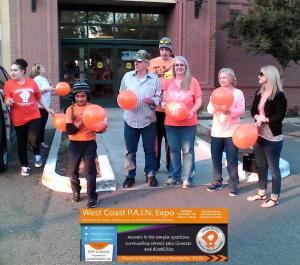
We’d love to have you take part in our #painPOP in the parking lot after the conference for photos and a bit of fun in raising awareness for National Reflex Sympathetic Dystrophy/Complex Regional Pain Syndrome Month. Our #painPOP campaign is participate or donate. Accept a challenge or donate to our cause.. I challenge all of you to raise awareness for the painful, debilitating and often progressive Neuro autoimmune illness that desperately needs a cure, an understanding for better quality of care, early diagnosis for stabilization or remission, and continued education and support materials, programs, free public educational events and conferences that we provide free to patients, caregivers, the healthcare community and the general public. We can’t do it without the help of awareness and funding. If you didn’t receive your raffle ticket joining us today, ask for one. Check NERVEmber.org tomorrow to see if you’ve got the winning numbers. You’ll be contacted to be sent your prize. Medtronic is up next with a demo, overview and a Q & A session.  Enjoy each other!

Introduce

Medtronic

 –

Advocacy

 The Power of Pain Foundation Co-Sponsored SB 623 ( Abuse-deterrent Opioid Analgesics ) with Assemblyman Jim Wood and attended the live press conference held at the California State Capital on March 24, 2015. We will continue to support this bill in 2016. The bill will provide a safer alternative option to opioid medications by deterring several non-swallowing ways opioids can be abused.

Getting involved

You can join our international Delegates team by visiting:  powerofpain.org/delegates-of-popf

We’re always looking for committed local volunteer advocates to support our legislative and policy efforts. The Power of Pain Foundation is a member of:

The Consumer Pain Advocacy Task Force (CPATF) which is comprised of national leaders and decision-makers from 16 consumer-nonprofit organizations that are dedicated to patient well-being and supporting the use of effective methods for pain treatment. The State Pain Policy Advocacy Network (SPPAN) first convened these leaders in March 2014 to organize a collective action effort to benefit people with pain.  consumerpainadvocacy.org

SPPAN is an association of leaders, representing a variety of health care and consumer organizations and individuals, who work together in a cooperative and coordinated fashion to effect positive pain policy on the state level—policy that guarantees access to comprehensive and effective pain care for all people living with pain. Power of Pain Foundation is one of the original SPPAN partners. sppan.aapainmanage.org/

As POP Advocacy Director (POP 2011-12) and a SPPAN leader since 2013, locals would be working with me, as needed, to attend and represent us at the Capital.

We thank you all for attending today. We look forward to seeing you again next year. Please visit powerofpain.org for our education, awareness, advocacy and access to care missions.

<End>

#painPOP

#painPOP #popwcps #NERVEmber November 14, 2015 POPF


#painPOP #popwcps #NERVEmber November 14, 2015 3After the conference we popped the pain out of ’em! #painPOP

#painPOP with attendees from WCPS

Published on Nov 14, 2015

#painPOP with some of the attendees from the POP’s West Coast Pain Summit 2015 for neuropathy awareness in #‎NERVEmber #‎ihavethenervetobeheard #‎doyouhavethenervetobeheard #‎powerofpain
http://PowerofPain.org/conditions #‎ShareAndMakeAware #‎ParticipateAndOrDonate


Additional photos can be found on the Power of Pain Foundation’s Facebook Page at facebook.com/powerofpain in the 2015 POP Events Album.

Twinkle VanFleet, Lynn Green, Jacie Touart #popwcps #NERVEmber November 14, 2015 POPF 2Lynn Green Medtronic, Twinkle VanFleet #popwcps #NERVEmber November 14, 2015 POPFLynn Green – Pain Therapist, Medtronic INC (Medtronic.com), Twinkle VanFleet – Advocacy Director (powerofpain.org) and Jacie Tourart – PA-C, Spine & Nerve Diagnostic Center (spinenerve.com).


POPFLogoEmailThe 8 key areas of the Patient’s Bill of Rights
Information for patients

You have the right to accurate and easily understood information about your health plan, health care professionals, and health care facilities. If you speak another language, have a physical or mental disability, or just don’t understand something, help should be given so you can make informed health care decisions.

Choice of providers and plans

You have the right to choose health care providers who can give you high-quality health care when you need it.

Access to emergency services

If you have severe pain, an injury, or sudden illness that makes you believe that your health is in danger, you have the right to be screened and stabilized using emergency services. You should be able to use these services whenever and wherever you need them, without needing to wait for authorization and without any financial penalty.

Taking part in treatment decisions

You have the right to know your treatment options and take part in decisions about your care. Parents, guardians, family members, or others that you choose can speak for you if you cannot make your own decisions.

Respect and non-discrimination

You have a right to considerate, respectful care from your doctor’s, health plan representatives, and other health care providers that does not discriminate against you.

Confidentiality (privacy) of health information

You have the right to talk privately with health care providers and to have your health care information protected. You also have the right to read and copy your own medical record. You have the right to ask that your doctor change your record if it is not correct, relevant, or complete.

Complaints and appeals

You have the right to a fair, fast, and objective review of any complaint you have against your health plan, doctors, hospitals or other health care personnel. This includes complaints about waiting times, operating hours, the actions of health care personnel, and the adequacy of health care facilities.

Consumer responsibilities

In a health care system that protects consumer or patients’ rights, patients should expect to take on some responsibilities to get well and/or stay well (for instance, exercising and not using tobacco). Patients are expected to do things like treat health care workers and other patients with respect, try to pay their medical bills, and follow the rules and benefits of their health plan coverage. Having patients involved in their care increases the chance of the best possible outcomes and helps support a high quality, cost-conscious health care system.

According to the presentation at the POPF Midwest PAIN Expo attendee’s learn the importance of the of the “Patient Bill of Rights”  (“Patient Rights” 3). (et al.) 


We look forward to seeing you next year!

Twinkle VanFleet, Sacramento resident and pain patient. Executive Board Member and Advocacy Director, Power of Pain Foundation.


Living with HOPE Radio Show: Re-Airs Live- NERVEmber 19, 2015

Living with HOPE - Trudy Thomas Radio Show LogoThe Living with HOPE Radio Show with Host Trudy Thomas will re air live NERVEmber 19th, 2015 on the Body, Mind, and Spirit Network. Due to health reasons she took leave in January and has been working toward returning.

I’ll be re-joining Trudy as co-host each Thursday at 2:30 p.m PST/5:30 p.m EST with a 30 minute guest speaker, or to review, or to discuss current affairs. The chat room will be available for your combination of listening and chatting pleasure. The call in number for the show is (929) 477-3203.

Please stay on the line to listen live or press 1 to speak to the host.

Living With Hope: Guest Twinkle Van Fleet

Together, we’ll bring you a diverse array of treatment options, healing essentials, technology, inspiration, activities, and living with hope.

Since 2007, Trudy’s mission has been to promote awareness for the millions of people who struggle with chronic or intractable pain. To let people know that they are not alone in their journey and that there is life after diagnosis. Trudy discusses various therapies and the emotional struggles that can arise with a chronic incurable condition such as RSD/CRPS and coming out on the other side. She strives to empower, inform and educate.

If you have a topic of interest or would like to request guest consideration and have any questions, Please, contact Trudy at: goldfield_nv@hotmail.com

With “Topic of interest” in the subject line to propose a topic. “Guest speaker” to be considered as a guest and “Question” to ask your question. Please provide your proposal or question for either. This helps filter email and requests to better serve you.

Hope to see you there!


In Memory of Mary LaBree – An Original RSD Advocate

One of our original RSDS Advocates, Mary LaBree, passed away on October 15, 2015 due to complications from Reflex Sympathetic Dystrophy (RSD). Mary exemplified commitment to the RSD community for over 3 decades. As the Director of the New England RSDS Coalition since 1990, Mary sought to educate and bring awareness to the public and private sectors for the disease that was virtually unheard of back then. Originally from Leicester, Massachusetts, she was formally educated at Worcester State University in Worcester, Massachusetts.


Mary secured the JULY Proclamation for RSDS To urge all of the citizens of the Commonwealth to take cognizance of this event and participate fittingly in its observance. Given at the Executive Chamber in Boston, the twenty-fourth of June in the year two thousand and eleven, and of the Independence of the United States of America, the two hundred and thirty forth.” Massachusetts Bill # 5938


She worked both locally in Massachusetts and Nationally.


Mary formed and lead seminars, attended others, developed awareness events, distributed information and educational materials. She spoke with patients, caregivers, physicians, hospitals, insurance companies, fellow educators, universities, other peer groups, and those with an interest to learn about Reflex Sympathetic Dystrophy. She was involved with grants, research and fundraising.


When Mary LaBree began advocating for RSD in the 1980’s the term Complex Regional Pain Syndrome hadn’t been created. While other names had been used previously to describe Reflex Sympathetic Dystrophy (Syndrome) it was most often referred to as RSDS.


In 2012, she reached out to me and a friendship formed. We shared phone calls, messages and correspondence by snail mail. Mary sent me a copy of the photo of she and other’s of the original signing of her proclamation and a copy of the verbiage used to secure her proclamations. I’m privileged to know what Mary looks like. For now, I’ll not share those, nor have I ever. She shared with me 30+ years of everything. How she started, how she educated, how other RSD organizations began, her children, grandchildren, colleagues, the strength it takes to endure; not just in living with pain, but being a part of it.


If you pray, why worry…  If you worry, why pray?  


I had plans to meet her in person twice. The first time she had to return home early. I was supposed to meet her again toward the end of October or into mid-November. I had just spoken to her less than a week before her passing.


  • October 8

10/8, 4:04pm

Mary LaBree

I was in the hospital yesterday, I had an accident with my wheelchair when I tried to back it up ( standing in front of it. ) (Stupid me )when I pushed the button to back it up.. I pushed it the wrong way..And ran over my LEDs from the ankles to the knees. I was really blessed when the ER Dr. Asked what other problems did I have, & when I explained CRPS He said oh Chronic Regional Pain Syndrome , I said yes. He treated me with kindness & care. I’m going to send him a thank you card. He was really kind. You don’t always find a kind caring Dr..pls pray for me to recover. I have a lot of CRPS work to do. I will be leaving for CA in a few weeks. Ty.M

  • October 9

10/9, 5:22pm

Twinkle Wood-VanFleet

You’re always in my thoughts and prayers for your health, and your work, Mary. I do hope to meet you in November. xx

  • October 10

10/10, 10:07pm

Mary LaBree

Hi, Yes I’m looking forward to meeting you as well. I leave Oct 23 on. Friday. A lil less then 2 wks.I will call u sometime on the weekend after I arrive, hugs & lots of love.M

  • October 12

10/12, 7:04pm

Mary LaBree

I’m sorry I had a mistake that I didn’t want to have a group pls forgive me, as I pressed the wrong thing, & didn’t realize it until someone told me.


The next message on Oct 12, I missed due to being away and my IM being flooded and then she was gone. I was on the road to and from the Stanford Transplant Clinic for our daughter on the 15th and in the Emergency Department on the 16th due to my cervical spine. Trying to save the puppies life all in between.

The last message was in reference to an accidental group IM.

I had been wondering if she would want to make the plans to meet at the NERVEmber, West Coast Pain Forum for Power of Pain Foundation on November 14th. All I knew for certain is she planned to be here in Northern California on the 23rd of October and would call me.


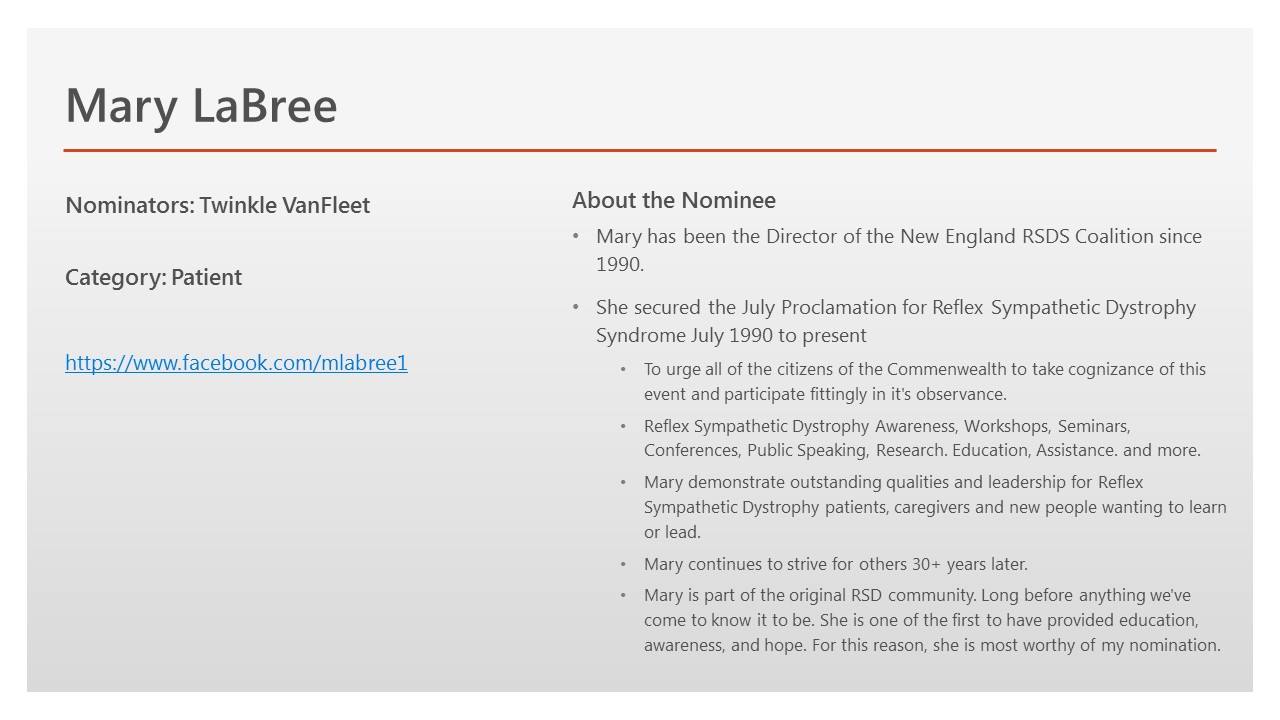
Mary LaBree Melanie McDowell Awareness and Advocacy Award Nomination 2015 Slide property of @powerofpain

Permission granted and sent from the Power of Pain Foundation to share in Mary’s memory. Melanie McDowell Awareness and Advocacy Award Nomination 2015


I wish she would have received more nominations, but mine was the only one for her.  She was most deserving.


We never know for certain where our conversations go even when we chit-chat on the phone or when we think they are in confidence. I don’t know what Mary ever spoke of me to others, but I know that she must have believed in me enough with what she did share with me to know I would keep it to me and if she didn’t know for sure when she told me she knew as time went on because I’ve never told it.

She asked me sometime in 2013 to consider being trained by her for her Coalition and new endeavors. While I was most honored, I respectfully declined as I was already committed to Power of Pain.

Our conversations also consisted of but weren’t limited to life, color, ethnicity, race, the olden days, differences, equality, change and today. She shared with me uncertainties about people, places and things, and I eased her in certain fear and prejudices. Please don’t misunderstand me, I’m not at all implying Mary was prejudice, in fact, she’s not, though conversations were simply sometimes deep. Mary listened and she learned. She watched, listened to gossip, dismissed it, listened more, read, picked it apart, put it together, and ultimately decided for herself. She wasn’t afraid to speak her mind or share a maybe, what if, what do you think or did you know.


I’m humbled to have been accepted, acknowledged, taught and even loved by her.


Mary was so proud of the New England RSDS Coalition, she was thrilled that the healthcare community was finally beginning to know what RSD (CRPS) is. She was pleased that patients had informational materials to seek out and be provided. She was happy that educational events were provided free to the public.


She told me the story behind July and why her proclamations are for the month of independence and not November. As I stated Mary began educating RSD over 30 years ago. July was chosen for freedom, freedom from pain. It wasn’t until many years later that a national color evolved, and then our month of recognition. Mary was grateful for her closest friends. I know she loved her beautiful friend, advocate and poet, Jane (Gonzales).


I prayed for her health and I prayed for her to achieve her life’s work, her mission to create awareness and educate on RSD, her purpose to continue doing so, and her hope for our future.


You did Mary! You really did! You achieved them all to the last breath.


And I thank you!


With gratitude, hugs and lots of love,


Miss you, won’t forget you,

~T


Mary’s Facebook page:    Pro image ML  https://www.facebook.com/messages/mlabree1


Lets not forget the ones who started the path that gave way for us to do what we do.  ~Twinkle V.


On behalf of all of us this one’s for you!


(Originally written at the end of October and updated today)


Reference to Mary’s favorite quote shared above. The above is shared the way she said it.


“If You Pray Don’t Worry… If You Worry Why Pray” sermon by Levi Wright


Pain Awareness Month 2015 – Feature 1 – The Faces and Limbs of Pain

The faces and limbs in these videos are many of the people you have crossed paths with over the years. They may be your friend, colleague, or acquaintance.  For other’s, you may not have realized what it is they endure. They’ve shared this part of themselves to educate and bring awareness to Reflex Sympathetic Dystrophy/Complex Regional Pain Syndrome. The faces you gaze upon seem fine, look well enough, perhaps not even a glimpse of pain, or discomfort. Such an illusion. The delusion lies less in the patient who complains than it does in the provider who doesn’t care to look beyond what initially seen.  You’ll then watch the limbs of people and if you make note, you’ll find that those faces …   live with more than just an ache.  To see it, you have to look beyond the faces.

It’s Pain Awareness Month. Share and make aware to continue the common mission of all of us everywhere who strive to make a difference in the lives of those suffering to survive.

Thank you for all you do!


Faces of Motivation 5 by Power of Pain Foundation –  http://youtu.be/y8-ngc–Bpw


Uploaded on Jan 22, 2012
This is the 5th Faces of Pain video by the Power of Pain Foundation. The video contains chronic care patients who
are dealing with an autoimmune condition which attacks the nervous system, immune system, muscle, bone and
sometimes organs. For more information on the POPF or RSD please visit www.powerofpain.org. The video was
produced by Twinkle VanFleet and Kurtis VanFleet. Background Image taken by Kurtis VanFleet. This video is
property of the POPF copyright 2012. All rights reserved. The Power of Pain Foundation is a 501(C)(3) Charity.
Music
“Little Wonders” by Rob Thomas (Google Play • iTunes • AmazonMP3)


RSD / CRPS Limbs Montage – http://youtu.be/nsFs3EHpi-A


Published on Jul 12, 2012
This video goes through pictures of RSD/CRPS patients who have visual symptoms of their extremities (hands, arms,
legs and feet). RSD is a Neuro-Autoimmune condition which affects many aspects of the body. For more information
visit Power of Pain Foundation. Special thanks to Twinkle and Kurtis VanFleet, and singer Page Jackson.


Faces of Pain Video 6 (In English and Spanish) – http://youtu.be/HAnmVUKVncM


Published on Aug 2, 2014
Faces of Pain Video – 6th edition for Power of Pain Foundation
Created by Twinkle VanFleet, Executive Board Member, Power of Pain Foundation
Spanish Translations by Vanessa Lara, California Representative, Power of Pain Foundation


POPF September is Pain Awareness Month


Nada hay más surreal que la realidad.

Making Complex Regional Pain Syndrome Simple For a Jury

MAKING COMPLEX REGIONAL PAIN SYNDROME SIMPLE FOR A JURY

A start-to-finish strategy for proving the chronic pain and resultant damages of CRPS

When God was testing the faith of Job, the worst punishment was physical pain…. He lost his lands and property, his family – but it was not until physical pain was inflicted that Job broke. (Job 16:6).

A case dealing with chronic pain can be difficult to prove due to the subjective nature of pain itself. This is especially true for Complex Regional Pain Syndrome cases (“CRPS”). CRPS, formerly known as Reflex Sympathetic Distrophy Syndrome (“RSD”), is an incurable chronic pain condition that is often debilitating. For trial lawyers and their clients, this disorder is especially troubling because of the controversy surrounding its diagnosis and treatment. As its very name implies, the disorder is “complex” in nature, is routinely misdiagnosed, and as such, is difficult to explain and prove to a jury.

Take a recent case that had a mixed diagnosis: Some doctors thought it was CRPS, while some did not. In the end, what mattered was our client had severe pain that would likely afflict him for the rest of his life. This was something the jury understood, whether we called it CRPS or not. The primary purpose of this article is to explain the basics of CRPS, highlight some of the challenges in dealing with a CRPS case, and discuss some useful strategies from a recent trial.

CRPS – WHAT IS IT?

CRPS is a chronic pain condition most often affecting one of the limbs (arms, legs, hands, or feet), in which the pain is out of proportion to thc injury. There are two designations of CRPS: Type I and II. Typc I, which this article will focus on, is a result of trauma. Type II stems from a specific injury to a nerve.

Some researchers have said CRPS is potentially the worst chronic pain disorder a human being could endure. Doctors describe the severe cases of CRPS as being higher on the pain scale than childbirth and amputation. However, over the years, pain management practitioners were overzealous in diagnosing chronic pain patients with CRPS. In the early 1990s, “RSD” cases were popping up everywhere, perhaps in part due to the unclear diagnostic criteria at the time. Now, after the hype has calmed and thorough research has flushed out a more clear understanding of the disorder, CRPS cases can and should command the same attention as other severe injuries such as brain and spinal cord injuries.

To begin with, CRPS arises typically after an injury or trauma to the affected limb. For example, a seemingly simple fracture to the ankle eventually causing a severe pain disorder in that limb. The most frightening aspect of the disease is that it often initially begins in an arm or a leg and often spreads throughout the body. In fact, according to the National Institute of Health, 92 percent of patients state that they have experienced a spread, and 35 percent of patients report symptoms in their whole body.

CRPS is characterized by prolonged or excessive pain and mild or dramatic changes in skin color, temperature, and/or swelling in the affected area. These signs can be subtle in nature, or dramatic, depending on the severity of the CRPS.

CRPS symptoms vary in severity and duration. The key symptom is prolonged pain that may be constant and, in some people, extremely uncomfortable or severe. The pain may feel like a burning or “pins and needles” sensation, or as if someone is squeezing the affected limb. The pain may spread to include the entire arm or leg, even though the precipitating injury might have been only to a finger or toe. Pain can sometimes even travel to the opposite extremity. There is often increased sensitivity in the affected area, such that even light touch or contact is painful (called allodynia).

People with CRPS also experience constant or intermittent changes in temperature, skin color, and swelling of the affected limb. An affected arm or leg may feel warmer or cooler compared to the opposite limb. The skin on the affected limb may change color, becoming blotchy, blue, purple, pale, or red. As discussed in more detail below, due to the complexity of the disorder, CRPS cases are often overlooked, misdiagnosed, and not properly worked up.

VETTING A CRPS CASE

As trial lawyers, we appreciate that many of our clients do not have the type of medical treatment and insurance required to get a complete medical workup and diagnosis. Often, an injury like a brain bleed or spinal fracture might go misdiagnosed. With a disorder such as CRPS, this is truly one of the injuries that often require an attorney’s eye and attention to appreciate the client’s dilemma.

The following are a few points to consider when interviewing a client to determine if he or she potentially has CRPS:

• An injury causing pain which is out of proportion to injury,

• Changes in skin texture on the affected area; it may appear shiny and thin,

• Abnormal sweating pattern in the affected area or surrounding areas,

• Changes in nail and hair growth patterns,

• Stiffness in affected joints,

• Problems coordinating muscle movement, with decreased ability to move the affected body part, and,

• Abnormal movement in the affected limb (most often fixed abnormal posture, or tremors of the affected limb).

For a full CRPS potential case checklist, please contact the author.

Find out more about:

What Causes CRPS?

CRPS Diagnosis and Prognosis

How to Deal with Conflicting CRPS Diagnoses

Voir Dire Tips in a Pain Trial

Experts: Get the Dream Team

Dealing with the Defense “Expert”

Making it Simple

via Making Complex Regional Pain Syndrome Simple For a Jury.

COMPLEX REGIONAL PAIN SYNDROME

THE RELENTLESS PURSUIT OF JUSTICE

Complex Regional Pain Syndrome: The Relentless Pursuit of Justice

Causes

Symptoms

Diagnosis and Risk Factors

Prognosis and Treatment

Lawsuits and Damages

Spencer Lucas is a trial lawyer at Panish Shea & Boyle and specializes in complex catastrophic personal injury, products liability and wrongful death cases.  He has extensive experience in cases involving traumatic brain injuries, spinal cord injuries, and chronic pain.

Panish Shea & Boyle, LLP

11111 Santa Monica Blvd #700, Los Angeles, CA 90025

PHONE 877.800.1700

FAX 310.477.1699

Treating Pain That Won’t Go Away – Ithaca Times : Family And Health

Posted: Thursday, December 4, 2014 12:03 pm

By Bill Chaisson

“There are two types of CRPS. Type 1, which accounts for 90 percent of documented cases, according to the Mayo Clinic, is marked by nerve pain when no nerve damage was involved in the initial injury. Type 2 is a more explicable development of regional pain after damage to the nerves.”

Read more-

via Treating Pain That Won’t Go Away – Ithaca Times : Family And Health.

Spinal Modulation Completes Enrollment of Its Landmark U.S. Pivotal Trial Evaluating the Axium Neurostimulator System for Chronic Pain | Business Wire

The ACCURATE study enrolled 152 patients at 22 centers throughout the United States. This represents the largest neuromodulation study to be conducted in patients suffering from nerve injuries (peripheral causalgia) or complex regional pain syndrome (CRPS, also known as RSD) to date.

“Approximately 10-50% of patients who undergo common procedures like hernia repair, knee surgery, and other lower limb surgeries will suffer from chronic pain resulting from nerve injury2. These conditions have historically been difficult to treat with currently available technology,” said Dr. Timothy Deer, co-study lead and CEO and President of the Center for Pain Relief in Charleston, West Virginia. “The ACCURATE trial is a landmark study that could change the way we treat these chronic pain conditions. Results from prior European studies have been promising, and we are hopeful that the ACCURATE trial will continue to substantiate the effectiveness of this therapy for our patients.”

Read more-

via Spinal Modulation Completes Enrollment of Its Landmark U.S. Pivotal Trial Evaluating the Axium Neurostimulator System for Chronic Pain | Business Wire.

Cause of Complex Regional Pain Syndrome Further Examined

Cause of Complex Regional Pain Syndrome Further Examined.

The researchers reported recent discoveries indicated there is an “autoimmune contribution,” to the condition, which often occurs after a small accident or surgery and causes pain that persists for several years.”

By Jacquelyn Gray | August 05, 2014

Click above for full article

(Pressed Post)

I shared a similar article a bit ago to my Facebook and related pages. This one is 2 days old. It is a reminder that there is hope!  ~T

3 Girls with RSD/CRPS

Megan 15, Tori 15, and Gracie 11.

Help These Girls Get the RSD/CRPS Treatment they need!

Megan Manuel (15)

http://www.gofundme.com/2f7l8g
Megan needs a Spinal Cord Stimulator

Tori Quinton (15)

http://www.gofundme.com/Help-Tori-get-better
Tori needs Calmare Therapy

Gracie (11)

http://www.gofundme.com/8wjinw
Gracie need to get to Dallas for CRPS Treatment

2 of the girls are 15 years old with RSD, one is only 11 with RSD.
Please consider helping them reach their fundraising goals or by sharing their pages so that they might have an extra opportunity for better exposure. The girls will be featured by the Power of Pain Foundation’s Patient Fundraiser Program August 2014.

As a CRPS/RSD patient myself, I would like to help their pages get noticed too, get  the care they need, even if in this small way, so that they might have a better quality of  life moving into their adult and teen years. They are each at a precious ages with school functions to look forward to, dances, activities to enjoy. Without pain relief  this will not be as possible as most take for granted. As adults it is hard enough, most of us have gone through life lessons to teach us strategies for survival. Adults can barely manage. I believe young ones have it much harder. They need life experiences, good memories to build on.

Their adult world comes soon enough.

Each parent will choose their child’s options, they may even decide on something else along the way…

Any recognition for Megan, Tori and Gracie is much appreciated.

Thank you!