In Memory of Mary LaBree – An Original RSD Advocate

One of our original RSDS Advocates, Mary LaBree, passed away on October 15, 2015 due to complications from Reflex Sympathetic Dystrophy (RSD). Mary exemplified commitment to the RSD community for over 3 decades. As the Director of the New England RSDS Coalition since 1990, Mary sought to educate and bring awareness to the public and private sectors for the disease that was virtually unheard of back then. Originally from Leicester, Massachusetts, she was formally educated at Worcester State University in Worcester, Massachusetts.


Mary secured the JULY Proclamation for RSDS To urge all of the citizens of the Commonwealth to take cognizance of this event and participate fittingly in its observance. Given at the Executive Chamber in Boston, the twenty-fourth of June in the year two thousand and eleven, and of the Independence of the United States of America, the two hundred and thirty forth.” Massachusetts Bill # 5938


She worked both locally in Massachusetts and Nationally.


Mary formed and lead seminars, attended others, developed awareness events, distributed information and educational materials. She spoke with patients, caregivers, physicians, hospitals, insurance companies, fellow educators, universities, other peer groups, and those with an interest to learn about Reflex Sympathetic Dystrophy. She was involved with grants, research and fundraising.


When Mary LaBree began advocating for RSD in the 1980’s the term Complex Regional Pain Syndrome hadn’t been created. While other names had been used previously to describe Reflex Sympathetic Dystrophy (Syndrome) it was most often referred to as RSDS.


In 2012, she reached out to me and a friendship formed. We shared phone calls, messages and correspondence by snail mail. Mary sent me a copy of the photo of she and other’s of the original signing of her proclamation and a copy of the verbiage used to secure her proclamations. I’m privileged to know what Mary looks like. For now, I’ll not share those, nor have I ever. She shared with me 30+ years of everything. How she started, how she educated, how other RSD organizations began, her children, grandchildren, colleagues, the strength it takes to endure; not just in living with pain, but being a part of it.


If you pray, why worry…  If you worry, why pray?  


I had plans to meet her in person twice. The first time she had to return home early. I was supposed to meet her again toward the end of October or into mid-November. I had just spoken to her less than a week before her passing.


  • October 8

10/8, 4:04pm

Mary LaBree

I was in the hospital yesterday, I had an accident with my wheelchair when I tried to back it up ( standing in front of it. ) (Stupid me )when I pushed the button to back it up.. I pushed it the wrong way..And ran over my LEDs from the ankles to the knees. I was really blessed when the ER Dr. Asked what other problems did I have, & when I explained CRPS He said oh Chronic Regional Pain Syndrome , I said yes. He treated me with kindness & care. I’m going to send him a thank you card. He was really kind. You don’t always find a kind caring Dr..pls pray for me to recover. I have a lot of CRPS work to do. I will be leaving for CA in a few weeks. Ty.M

  • October 9

10/9, 5:22pm

Twinkle Wood-VanFleet

You’re always in my thoughts and prayers for your health, and your work, Mary. I do hope to meet you in November. xx

  • October 10

10/10, 10:07pm

Mary LaBree

Hi, Yes I’m looking forward to meeting you as well. I leave Oct 23 on. Friday. A lil less then 2 wks.I will call u sometime on the weekend after I arrive, hugs & lots of love.M

  • October 12

10/12, 7:04pm

Mary LaBree

I’m sorry I had a mistake that I didn’t want to have a group pls forgive me, as I pressed the wrong thing, & didn’t realize it until someone told me.


The next message on Oct 12, I missed due to being away and my IM being flooded and then she was gone. I was on the road to and from the Stanford Transplant Clinic for our daughter on the 15th and in the Emergency Department on the 16th due to my cervical spine. Trying to save the puppies life all in between.

The last message was in reference to an accidental group IM.

I had been wondering if she would want to make the plans to meet at the NERVEmber, West Coast Pain Forum for Power of Pain Foundation on November 14th. All I knew for certain is she planned to be here in Northern California on the 23rd of October and would call me.
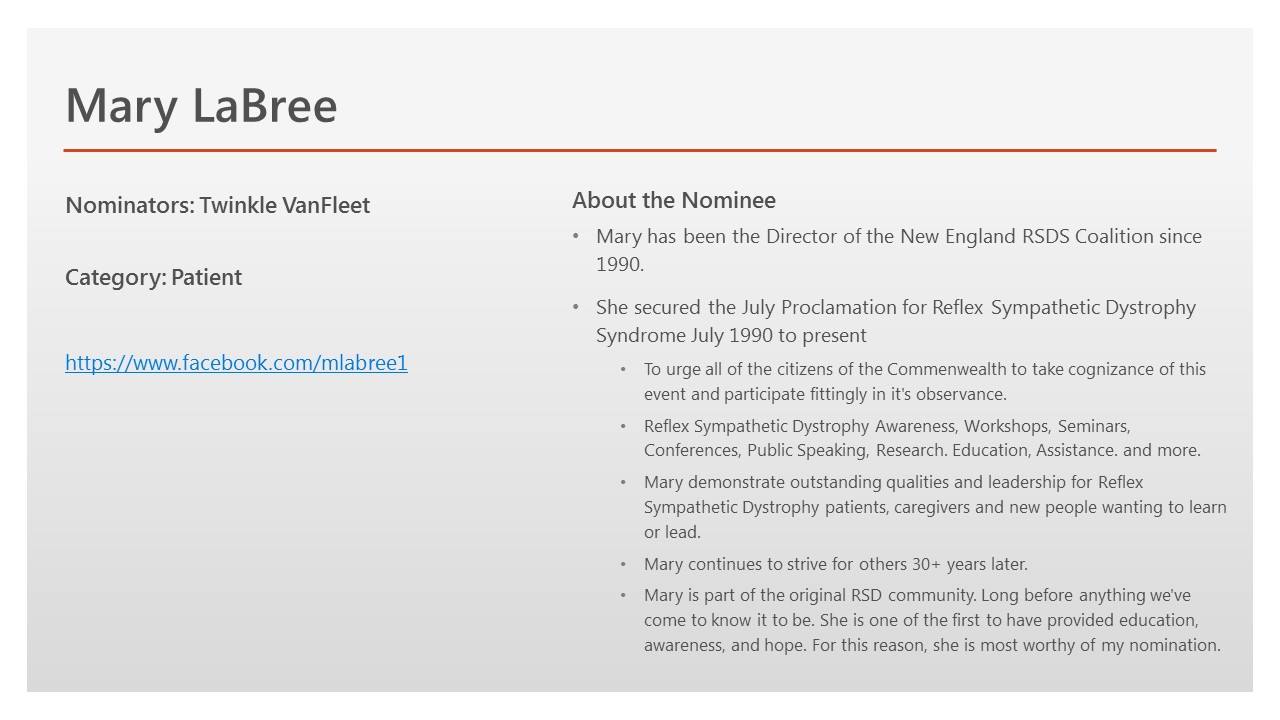
 

Mary LaBree Melanie McDowell Awareness and Advocacy Award Nomination 2015 Slide property of @powerofpain

Permission granted and sent from the Power of Pain Foundation to share in Mary’s memory. Melanie McDowell Awareness and Advocacy Award Nomination 2015


I wish she would have received more nominations, but mine was the only one for her.  She was most deserving.


We never know for certain where our conversations go even when we chit-chat on the phone or when we think they are in confidence. I don’t know what Mary ever spoke of me to others, but I know that she must have believed in me enough with what she did share with me to know I would keep it to me and if she didn’t know for sure when she told me she knew as time went on because I’ve never told it.

She asked me sometime in 2013 to consider being trained by her for her Coalition and new endeavors. While I was most honored, I respectfully declined as I was already committed to Power of Pain.

Our conversations also consisted of but weren’t limited to life, color, ethnicity, race, the olden days, differences, equality, change and today. She shared with me uncertainties about people, places and things, and I eased her in certain fear and prejudices. Please don’t misunderstand me, I’m not at all implying Mary was prejudice, in fact, she’s not, though conversations were simply sometimes deep. Mary listened and she learned. She watched, listened to gossip, dismissed it, listened more, read, picked it apart, put it together, and ultimately decided for herself. She wasn’t afraid to speak her mind or share a maybe, what if, what do you think or did you know.


I’m humbled to have been accepted, acknowledged, taught and even loved by her.


Mary was so proud of the New England RSDS Coalition, she was thrilled that the healthcare community was finally beginning to know what RSD (CRPS) is. She was pleased that patients had informational materials to seek out and be provided. She was happy that educational events were provided free to the public.


She told me the story behind July and why her proclamations are for the month of independence and not November. As I stated Mary began educating RSD over 30 years ago. July was chosen for freedom, freedom from pain. It wasn’t until many years later that a national color evolved, and then our month of recognition. Mary was grateful for her closest friends. I know she loved her beautiful friend, advocate and poet, Jane (Gonzales).


I prayed for her health and I prayed for her to achieve her life’s work, her mission to create awareness and educate on RSD, her purpose to continue doing so, and her hope for our future.


You did Mary! You really did! You achieved them all to the last breath.


And I thank you!


With gratitude, hugs and lots of love,


Miss you, won’t forget you,

~T


Mary’s Facebook page:    Pro image ML  https://www.facebook.com/messages/mlabree1


Lets not forget the ones who started the path that gave way for us to do what we do.  ~Twinkle V.


On behalf of all of us this one’s for you!


(Originally written at the end of October and updated today)


Reference to Mary’s favorite quote shared above. The above is shared the way she said it.


“If You Pray Don’t Worry… If You Worry Why Pray” sermon by Levi Wright


Pain Awareness Month 2015 – Mid Month Review with Feature 7- The ACPA- History of Pain Awareness Month

I wish I could share the goodness of the world with everyone. The people I’ve shared have been people who are making an impact in the lives of others despite their own complications. Illness, disability, pain, yet hope enough in their passion’s to keep going… for you.

Some of them I barely know in the sense of talking with them. A few of them, I’ve had less than an hour or so of combined time in conversation exchange. Having the gift of knowing and the ability to feel at higher levels than most, I was compelled to ask these people if I could share them, honor them, and feature them this month. Each one of them, by their own energy, gave me a piece of them, the part that let me show you who they are in spirit. It was by a glimpse of their own souls experiences that led me to reach out to them.

Review

Pain Awareness Month 2015 – Feature 1 – The Faces and Limbs of Pain

https://rsdadvisory.com/2015/08/31/pain-awareness-month-2015-feature-1-the-faces-and-limbs-of-pain/


Pain Awareness Month 2015 – Feature 2 – Trudy Thomas, Living with HOPE Radio Show

https://rsdadvisory.com/2015/09/03/pain-awareness-month-feature-2-trudy-thomas-living-with-hope-radio-show/


Pain Awareness Month 2015 – Feature 3 – Shane Schulz, Arisen Strength

https://rsdadvisory.com/2015/09/07/pain-awareness-month-2015-feature-3-shane-schulz-arisen-strength/


Pain Awareness Month 2015 – Feature 4 – Power of Pain Foundation

https://rsdadvisory.com/2015/09/12/pain-awareness-month-2015-feature-4-power-of-pain-foundation/


Pain Awareness Month 2015 – Feature 5 – Sheila Purcell – United Kentucky Pain Care Action Network

https://rsdadvisory.com/2015/09/15/pain-awareness-month-2015-feature-5-sheila-purcell-united-kentucky-pain-care-action-network/


Pain Awareness Month 2015 – Feature 6 – Epithelioid hemangioendothelioma (EHE)

https://rsdadvisory.com/2015/09/19/pain-awareness-month-2015-feature-6-epithelioid-hemangioendothelioma-ehe/


Pain Awareness Month 2015 – Feature 7 – American Chronic Pain Association

Have you ever wondered about the history of pain awareness month? The American Chronic Pain Association and Partners for Understanding Pain is your last feature share for September.

September is Pain Awareness Month
http://theacpa.org/September-is-Pain-Awareness-Month


Below you will find the history of pain awareness month in a timeline PDF document. Beginning in 2001 with a pain awareness campaign. Did you know? Please consider sharing so that others might learn also. Be sure to share in the documents original form.


Pain Awareness Month History

http://theacpa.org/uploads/Pain_Awareness_Month_History.pdf

For more information

The American Chronic Pain Association (ACPA)
http://theacpa.org/

The American Chronic Pain Association (ACPA)
Partners for Understanding Pain
http://theacpa.org/Partners-for-Understanding-Pain

Pain Awareness Toolkits
http://theacpa.org/Pain-Awareness-Toolkits

You can also find the American Chronic Pain Association on:

Facebook-
https://www.facebook.com/pages/The-American-Chronic-Pain-Association/113362482021895

Twitter-
https://twitter.com/TheACPA
@TheACPA

YouTube-
http://www.youtube.com/user/TheACPAChannel

Pinterest-
https://www.pinterest.com/theacpa/
The information provided is for pain awareness and educational purposes only. All rights reserved to The American Chronic Pain Association for their content.


I hope that I’ve proffered enough of myself this year for you and I wish you all the very best in your journeys to continue to make a difference in the lives of others. I pray each of you get all that you need in this life and give back all that you’re able to.

thank-you-

I wish you all well,

And enough.

~Twinkle V.

Te quiero más

Pain Awareness Month 2015 – Feature 5 – Sheila Purcell – United Kentucky Pain Care Action Network

Sheila Purcell


Sheila Purcell isn’t your average pain patient. She’s actively involved in reforming laws and regulations that directly impact’s the quality of life of those suffering from chronic, long term, intractable pain. Sheila endures pain everyday herself, the life threatening seizures leave her worn, yet she’s a fighter, a strong one.

As an advocate and spokesperson supporting medication management options, including opioid analgesics, she stresses how important that it is that these prescription pain relievers should not be withheld as an initial treatment plan or be removed from the course of treatment for patients who are already using them.

Sheila recognizes that controlled substances are needed to treat certain conditions and that removing them as options for treatment causes hardships that are sometimes irreversible. She’s dealt with denials, delays and dismissal’s herself and knows first hand the demise of quality of life. There is more risk in under treated pain and the direct or unintended consequences than there is in the stable regimen of prescribed pain management.


Sheila was featured on The Pain Nation show with Ken McKim – Episode 1

http://youtu.be/625fZH9xn6c?a


She’s the Founder of the United Kentucky Pain Care Action Network (UKPCAN) (Closed Group)
https://www.facebook.com/groups/FFPCANkentucky/

United Pain Care Action Network of Kentucky and Tennessee (Community)

https://m.facebook.com/profile.php?id=628656307243460

The mission:

“Kentucky Pain Care Action Network” is a network of people living with Chronic Intractable Pain, their caregivers and others who share the belief that people suffering with Chronic Pain, Cancer, Mental Illness or any other disease have the right to timely, appropriate and effective Pain Care Management and Medical Treatment.

“Kentucky has a major problem that needs to be addressed and we want to help change the negative stigma around to positive for those in pain.”

We educate people and teach them that suffering from pain is not acceptable!

We do this though active advocacy, education, letter writing campaigns to State and Local Representatives and Senators. E-mails, faxes, telephone calls to our elected officials. We comment on “our” elected officials Facebook pages, we write letters to the Editor of our newspapers, we comment on articles posted in the group. We take action and by doing so, we make our efforts known.

Therefore it is very important that each group member take an active role in these actions. It only takes a few minutes a day to make a comment or write a letter. Many members set aside 30 minutes of one day to do this. WE MUST DO THIS TO MAKE OUR CAUSE KNOWN!

We are a Open Group. All info in this group is private and CANNOT be used for any purpose other than what each member give’s permission for us to use it for. This includes your Name, City, and County in which you live Medical Conditions, and any treatments you are receiving or have received.

The more people that are involved the quicker we can make progress on bringing it to the attention of Kentucky’s law makers and make them understand that HB- 1 & HB- 217 needs to be re- written to protect the THOUSANDS OF PEOPLE SUFFERING as a result of these bills

They also need to be aware that this has hurt “TOURISM” and will continue to do so as NO one wants to vacation in a state were Medical Care is NOT something they would receive if they or a family member becomes ill or has an accident of any kind requiring, surgery or pain care.

Let’s get busy fellow Kentuckians and show the lawmakers we will not rest until HB-1 and HB-217 are repealed!

“Kentucky Pain Care Action Network”


Opposition to Kentucky HB 1-Reform HB 217 aka “Pill Mill Bill”

https://www.facebook.com/Opposition-to-Kentucky-HB-1-Reform-HB-217-aka-Pill-Mill-Bill-595049517218134/timeline/

Opposition to Kentucky HB 1-Reform HB 217 aka “Pill Mill Bill” (Community)
https://m.facebook.com/profile.php?id=595049517218134

Chronic pain patients that are trying to get Pill Mill Bill’s reformed ln EVERY STATE not just Kentucky! Please join the fight and cause. Thank you!

This page is dedicated to raising awareness for chronic pain patients, children with attention deficit disorder (ADD/ADHD), Cancer patients, HIV/AIDS patients, patients suffering from certain mental disorders, patients requiring Testosterone, and their families affected by the changing environment of the medical community whereby those in need of controlled substances are refused treatment or made to endure many hardships, unnecessary for their care, as a direct result of laws enacted by the state of Kentucky.

Through any peaceful means necessary, we seek to contact State and Community leaders, The American Medical Association, Pharmaceutical Vendors, the DEA, the FDA and local/national media sources.


Mission and information statements by Sheila Purcell.


Sheila is a Delegate for the Power of Pain Foundation, active in various groups and organizations throughout the States, and she continues to work on much-needed change for the thousands of people suffering from pain and the inadequate treatments they are receiving.

If you need a voice for Kentucky and Tennessee pain care rights, Sheila isn’t shy. Her vast knowledge is your benefit. Her leadership is your tool.  The information she provides is your education. Her strength is your willingness to take part in your own health challenges and I hope all of you get the proper and timely care you need to survive.


Sheila can be contacted at: sheliakim1251@gmail.com

Making Complex Regional Pain Syndrome Simple For a Jury

MAKING COMPLEX REGIONAL PAIN SYNDROME SIMPLE FOR A JURY

A start-to-finish strategy for proving the chronic pain and resultant damages of CRPS

When God was testing the faith of Job, the worst punishment was physical pain…. He lost his lands and property, his family – but it was not until physical pain was inflicted that Job broke. (Job 16:6).

A case dealing with chronic pain can be difficult to prove due to the subjective nature of pain itself. This is especially true for Complex Regional Pain Syndrome cases (“CRPS”). CRPS, formerly known as Reflex Sympathetic Distrophy Syndrome (“RSD”), is an incurable chronic pain condition that is often debilitating. For trial lawyers and their clients, this disorder is especially troubling because of the controversy surrounding its diagnosis and treatment. As its very name implies, the disorder is “complex” in nature, is routinely misdiagnosed, and as such, is difficult to explain and prove to a jury.

Take a recent case that had a mixed diagnosis: Some doctors thought it was CRPS, while some did not. In the end, what mattered was our client had severe pain that would likely afflict him for the rest of his life. This was something the jury understood, whether we called it CRPS or not. The primary purpose of this article is to explain the basics of CRPS, highlight some of the challenges in dealing with a CRPS case, and discuss some useful strategies from a recent trial.

CRPS – WHAT IS IT?

CRPS is a chronic pain condition most often affecting one of the limbs (arms, legs, hands, or feet), in which the pain is out of proportion to thc injury. There are two designations of CRPS: Type I and II. Typc I, which this article will focus on, is a result of trauma. Type II stems from a specific injury to a nerve.

Some researchers have said CRPS is potentially the worst chronic pain disorder a human being could endure. Doctors describe the severe cases of CRPS as being higher on the pain scale than childbirth and amputation. However, over the years, pain management practitioners were overzealous in diagnosing chronic pain patients with CRPS. In the early 1990s, “RSD” cases were popping up everywhere, perhaps in part due to the unclear diagnostic criteria at the time. Now, after the hype has calmed and thorough research has flushed out a more clear understanding of the disorder, CRPS cases can and should command the same attention as other severe injuries such as brain and spinal cord injuries.

To begin with, CRPS arises typically after an injury or trauma to the affected limb. For example, a seemingly simple fracture to the ankle eventually causing a severe pain disorder in that limb. The most frightening aspect of the disease is that it often initially begins in an arm or a leg and often spreads throughout the body. In fact, according to the National Institute of Health, 92 percent of patients state that they have experienced a spread, and 35 percent of patients report symptoms in their whole body.

CRPS is characterized by prolonged or excessive pain and mild or dramatic changes in skin color, temperature, and/or swelling in the affected area. These signs can be subtle in nature, or dramatic, depending on the severity of the CRPS.

CRPS symptoms vary in severity and duration. The key symptom is prolonged pain that may be constant and, in some people, extremely uncomfortable or severe. The pain may feel like a burning or “pins and needles” sensation, or as if someone is squeezing the affected limb. The pain may spread to include the entire arm or leg, even though the precipitating injury might have been only to a finger or toe. Pain can sometimes even travel to the opposite extremity. There is often increased sensitivity in the affected area, such that even light touch or contact is painful (called allodynia).

People with CRPS also experience constant or intermittent changes in temperature, skin color, and swelling of the affected limb. An affected arm or leg may feel warmer or cooler compared to the opposite limb. The skin on the affected limb may change color, becoming blotchy, blue, purple, pale, or red. As discussed in more detail below, due to the complexity of the disorder, CRPS cases are often overlooked, misdiagnosed, and not properly worked up.

VETTING A CRPS CASE

As trial lawyers, we appreciate that many of our clients do not have the type of medical treatment and insurance required to get a complete medical workup and diagnosis. Often, an injury like a brain bleed or spinal fracture might go misdiagnosed. With a disorder such as CRPS, this is truly one of the injuries that often require an attorney’s eye and attention to appreciate the client’s dilemma.

The following are a few points to consider when interviewing a client to determine if he or she potentially has CRPS:

• An injury causing pain which is out of proportion to injury,

• Changes in skin texture on the affected area; it may appear shiny and thin,

• Abnormal sweating pattern in the affected area or surrounding areas,

• Changes in nail and hair growth patterns,

• Stiffness in affected joints,

• Problems coordinating muscle movement, with decreased ability to move the affected body part, and,

• Abnormal movement in the affected limb (most often fixed abnormal posture, or tremors of the affected limb).

For a full CRPS potential case checklist, please contact the author.

Find out more about:

What Causes CRPS?

CRPS Diagnosis and Prognosis

How to Deal with Conflicting CRPS Diagnoses

Voir Dire Tips in a Pain Trial

Experts: Get the Dream Team

Dealing with the Defense “Expert”

Making it Simple

via Making Complex Regional Pain Syndrome Simple For a Jury.

COMPLEX REGIONAL PAIN SYNDROME

THE RELENTLESS PURSUIT OF JUSTICE

Complex Regional Pain Syndrome: The Relentless Pursuit of Justice

Causes

Symptoms

Diagnosis and Risk Factors

Prognosis and Treatment

Lawsuits and Damages

Spencer Lucas is a trial lawyer at Panish Shea & Boyle and specializes in complex catastrophic personal injury, products liability and wrongful death cases.  He has extensive experience in cases involving traumatic brain injuries, spinal cord injuries, and chronic pain.

Panish Shea & Boyle, LLP

11111 Santa Monica Blvd #700, Los Angeles, CA 90025

PHONE 877.800.1700

FAX 310.477.1699

How Can Mindfulness Help With Chronic Pain? | Stephanie Weaver

Does mindfulness practice help reduce pain, or help us cope with pain better?

Both. Mindfulness can help reduce pain because it removes the worry about it, which is the other layer. Emotional and mental tension can add to physical pain. I have seen chronic pain go away via mindfulness. With systemic pain that does have a cause, mindfulness helps people cope with it better. When people rate their quality of life after mindfulness training, their scores on happiness, life satisfaction, and often activity level go up, even though the objective pain hasn’t changed. One student said, “I used to be my pain. Now I’m much more.”

Can you explain the phrase “suffering is optional”? I find it one of the most challenging sayings in Buddhism, because it implies I want to be in pain.

I don’t like that phrase because it’s confusing. I prefer to think of it like this equation from Shinzen Young: suffering = pain X worry

We typically equate pain with suffering. Pain and suffering are two different things. Nobody likes pain. But just because something is unpleasant doesn’t mean we have to suffer or react against it. Think of a time when you had pain, but no suffering was involved, like getting a tattoo or giving birth.

If we put what is happening to us in a different perspective, we’re suddenly able to tolerate it. In the beginning it’s a little bit of a mind game. But when mindfulness students look at it, and start to investigate their own experience, it starts to change.

You talk about separating our experience of pain into three components: the physical sensation, the emotions we feel about it, and the meaning the pain has for us.

When you break it into parts, it helps make it more manageable. We work with where the suffering is the strongest.

Let’s start with the physical sensation of pain. How does mindfulness deal with that?

We start to see that the physical pain is separate from the emotions we feel about it. We describe the sensation. We label it. That awareness is what is helpful.

And the emotions surrounding it?

We don’t often look at how we feel about the pain. What emotion is connected to the pain? Are you feeling sad, angry, or another emotion about it?

And finally the meaning of pain? I especially related to this because I do this myself. I feel fear about what a migraine might mean for me in the future.

Much of the suffering is often in the story we tell ourselves about it. Are you running loops about the story in your head, and is that making it worse? We might be stuck in the past, for example: that surgery or accident messed me up. Or we obsess about the future: because I have this condition, I will never be able to do X. Mindfulness brings you into the present moment. Instead of ruminating or rehearsing, be present and see how you actually feel.

Where can someone look to find out more about using mindfulness practice to deal with chronic pain?

It’s very difficult to start a mindfulness practice without a teacher, so finding a local class that teaches MBSR is the best approach. I like Living Well with Chronic Pain and Disease by Vidyamala Birch. There is an eight-week program called Breathworks that may help. Or try a recorded guided meditation.

How has mindfulness practice changed you?

I’m an M.D. by background, but I teach mindfulness full time now. I think that says a lot. As a physician, I became impressed with how mindfulness training is able to relieve suffering on all levels. As a physician my job was to “fix” people. As a mindfulness instructor, I give them tools to heal themselves. That’s really different.

Christiane Wolf, M.D., Ph.D., is a physician turned mindfulness meditation teacher. She is coauthor of the book, The Clinician’s Guide to Teaching Mindfulness.

Read the full article-

via How Can Mindfulness Help With Chronic Pain? | Stephanie Weaver.

Microglia Activation Causes Depression, Anxiety in Chronic Pain

June 11, 2015

Brain inflammation from chronic pain increases microglia activation, which inhibits the release of dopamine and may lead to depression and anxiety, according to a study published in The Journal of Neuroscience.

Although more than half of chronic pain patients experience depression, anxiety, or substance abuse, scientists were unable to determine what caused this association until now. In this study, the researchers sought to test if chronic pain disrupted the transmission of dopamine.

The researchers demonstrated that the activation of microglia in mice with chronic pain inhibited the release of dopamine. These results shed light on why opioids, which stimulate a dopamine response, can be ineffective for chronic pain patients.

The researchers instead tested a drug that inhibited the activation of microglia. This, they found, restored normal dopamine release and reward-motivated behavior in the mice.

“For over 20 years, scientists have been trying to unlock the mechanisms at work that connect opioid use, pain relief, depression and addiction,” said Catherine Cahill, PhD, of the University of California, Irvine. “Our findings represent a paradigm shift which has broad implications that are not restricted to the problem of pain and may translate to other disorders.”­

In future studies, the researchers hope to explore if mood disorders are caused by similar brain alterations, regardless of the presence of chronic pain.

Read more-

via Microglia Activation Causes Depression, Anxiety in Chronic Pain.

Read the full article at:

The Journal of Neuroscience

Microglia Disrupt Mesolimbic Reward Circuitry in Chronic Pain

Overcoming the Stress Response

comtragcrpsa1The Sympathetic Nervous System is derived of 2 components. The Sympathetic Nervous System (SNS) and the Para-Sympathetic Nervous System (PSNS) both of which makes up the Autonomic Nervous System. The Sympathetic Nervous System is also known as Fight, Flight or Freeze. Stress and the Brain can be a serious issue for many individuals. Related or unrelated to various diagnosis’. Over the years I have lisened to thousands of individuals with a multitude of diagnoses.

Most of which touch on the the Stress Response. The stress response is “The Sympathetic Nervous System”. The Sympathetic Nervous System is the Stress Response. It is Fight, Flight or Freeze.

Having Complex Regional Pain Syndrome Type 2/Causalgia, I’ve had to take pause for an extra peek. Was there something there in my life at the time to cause my body to take this abnormal path. Has the stress and idea of not being able to heal kept me in this abnormal pattern. For me and only me, I cannot dismiss it. I cannot seem to find anything solid, but our minds don’t always work that way conclusively.

I refuse to give up, yet I fall to my own victimization in that I, at times, give up. It doesn’t matter if it is for 5 minutes or for a day. I have the awareness to know that by giving in, am I somehow reconditioning that stress response. I think it is possible. I use many of the alternative techniques available to me on a regular basis. That is how I survive. I also know that I succumb to fears of the future. Fear is anxiety. Anxiety is fear. Fear and anxiety is stress.  Add stress to chronic pain and you, or I, will always have a vicious cycle to endure.

Rarely do I focus on the physical decline of my being, I am aware. If I did, I would continue to re trigger the same event each and every day. I don’t focus on the look, or what I see. I do have trouble with the fact I can’t get out on my own. I have been trying to clear the secondary issue of depression. Many of us believe we are reasonably well. That is what we represent. My family fell to a hard decline a few years ago and since then it has been non stop. Surreal in some ways. A living dream. My personality type is to fix. My family is everything. My husband, children, and my grandchild.

If I can’t fix it, love it, make it right then it is wrong to me.

I have been taught not to show pain behaviors and not to guard. This is almost nature to me. For years now. Seldom if at all.

Perhaps there are times, yet they would be minimal.

I am on my way to getting better! You won’t be able to until you get rid of everything heavy you ever carried. Why? Because chronic pain has a way of bringing it all back. Heavier than it ever was. You will keep everything inside you. All thoughts, misconceptions, hurts, perceived hurts. You will! You have to let it go. And once you do, you will find peace not only in yourself, but in your pain.

~Twinkle VanFleet

Overview of the Autonomic Nervous System

http://www.merckmanuals.com/home/brain_spinal_cord_and_nerve_disorders/autonomic_nervous_system_disorders/overview_of_the_autonomic_nervous_system.html

The sympathetic division of the autonomic nervous system maintains internal organ homeostasis and initiates the stress response.

https://www.boundless.com/physiology/textbooks/boundless-anatomy-and-physiology-textbook/autonomic-nervous-system-ans-14/physiology-of-ans-142/sympathetic-responses-750-9204/

Fight, Flight or Freeze: The Stress Response

http://psychcentral.com/blog/archives/2014/07/31/fight-flight-or-freeze-the-stress-response/

What is the Stress Response?

What is the Stress Response

Stress Management

http://www.mayoclinic.org/healthy-living/stress-management/in-depth/stress/art-20046037

Chronic Stress Puts Your Health At Risk

http://www.mayoclinic.org/healthy-living/stress-management/in-depth/stress/art-20046037

Post Traumatic Stress Disorder (PTSD)

http://www.nimh.nih.gov/health/publications/post-traumatic-stress-disorder-ptsd/index.shtml

Systemic Complications of Complex Regional Pain Syndrome

Click to access Systemic-Complications-of-CRPS.pdf

WHAT IS YOUR CAKE? | Barby Ingle


WHAT IS YOUR CAKE?

Barby Ingle, President

Power of Pain Foundation

Author * Advocate * Motivational Speaker

480-882-1342  barbyingle@powerofpain.org


Movie Info:

http://cakemovie.net

https://twitter.com/CAKEtheMovie

https://www.facebook.com/cakemovie?ref=hl


What is CAKE? CAKE is something that you can’t do because you are in pain but wanted to accomplish. When I started to watch this movie, I came in with biases of people in the pain community saying how it was all about addiction and not much on chronic pain. Those people had not yet seen the film. So, I got out may paper and pen and decided to take notes. I thought this movie was a great representation of what I see and hear from millions of pain patients across the United States. This movie is one of the best, in-depth depictions of what we deal with on a daily basis as patients. Here is what I saw in the movie.

I saw the reality of what I have been living with since September 26, 2002 after an auto accident that led me to have no choice but to live with chronic pain. The main character, Claire shows the challenges of living with pain. Her symptoms matched many of the symptoms that I have dealt with on a daily basis. With not only showing the pain that sometimes makes you scream out. They also did a great job showing the loss of energy, balance -coordination issues, body temp regulation problems, depression & anger, dystonia, loss of appetite and vomiting, memory issues (reminders about reminders), and sleeping problems.

The movie also gives a great perspective on some of the treatment options that are available. Claire went through so much to get out of pain, but to no avail. She had to find ways to cope. They showed a wide variety from invasive surgery, medications (not just opioids) but other medication, and aqua therapy. They showed less invasive tools that can help with the coping of life with chronic pain; quiet/dark room or house, music therapy, and even turning to other substances like alcohol.

This movie shows a woman who is processing her own chronic pain from physical injuries, but takes it even further. The script writer was cleaver enough to have the character Claire use of her friend who committed suicide to help process the situation and tell her story (it was easier for us as viewers to follow verses a woman talking to herself, it put a face to the story of the person who committed suicides story). I can say for myself losing over 50 friends in the past 12 years who were living in pain I know how much of a struggle this is and how delicate it is to navigate with those of us still living and fighting this daily battle. We are in a way relieved that our friend is out of pain, but at the same time sad that we are here on earth – left behind. We see how great it would be to be out of pain for eternity, but know that we have a purpose here and it is not our time to go.

CAKE reminded me of a few important lessons. First, you can’t get better by working harder, you have to work smarter. We need to figure out how, where and on what we want to spend our energy pennies[i]. Second, people who don’t live in pain want to know how we do it. We typically say moment by moment, or I don’t know how I do it. We find a way. We negotiate with ourselves to do what must be done, what needs to be done. Does that mean we get to do all we want to be done? No. Does that make us less of a person? No. Thirdly, people in pain take less life for granted. The closet scene where she takes out only a little bit only to make a messy pile outside the closet. That was a step. That was an accomplishment in the daily life of a chronic pain patient. We are not asking for people to save us, we are working to save our energy pennies for what is important in life while still maintaining a life of whatever sort we can muster up.

Read more-

via WHAT IS YOUR CAKE? | Barby Ingle.

WHAT IS YOUR CAKE? | Barby Ingle


What is CAKE? CAKE is something that you can’t do because you are in pain but wanted to accomplish. When I started to watch this movie, I came in with biases of people in the pain community saying how it was all about addition and not much on chronic pain. Those people had not yet seen the film. So, I got out may paper and pen and decided to take notes. I thought this movie was a great representation of what I see and hear from millions of pain patients across the United States. This movie is one of the best, in-depth depictions of what we deal with on a daily basis as patients. Here is what I saw in the movie.


I saw the reality of what I have been living with since September 26, 2002 after an auto accident that led me to have no choice but to live with chronic pain. The main character, Claire shows the challenges of living with pain. Her symptoms matched many of the symptoms that I have dealt with on a daily basis. With not only showing the pain that sometimes makes you scream out. They also did a great job showing the loss of energy, balance -coordination issues, body temp regulation problems, depression & anger, dystonia, loss of appetite and vomiting, memory issues (reminders about reminders), and sleeping problems.


The movie also gives a great perspective on some of the treatment options that are available. Claire went through so much to get out of pain, but to no avail. She had to find ways to cope. They showed a wide variety from invasive surgery, medications (not just opioids) but other medication, and aqua therapy. They showed less invasive tools that can help with the coping of life with chronic pain; quiet/dark room or house, music therapy, and even turning to other substances like alcohol.


This movie shows a woman who is processing her own chronic pain from physical injuries, but takes it even further. The script writer was cleaver enough to use of her friend who committed suicide to help process and tell her story (it was easier for us as viewers to follow verses a woman talking to herself, it put a face to the story of the person who committed suicides story). I can say for myself losing over 50 friends in the past 12 years who were living in pain I know how much of a struggle this is and how delicate it is to navigate with those of us still living and fighting this daily battle. We are in a way relieved that our friend is out of pain, but at the same time sad that we are here on earth – left behind. We see how great it would be to be out of pain for eternity, but know that we have a purpose here and it is not our time to go.


CAKE reminded me of a few important lessons. First, you can’t get better by working harder, you have to work smarter. We need to figure out how, where and on what we want to spend our energy pennies[i]. Second, people who don’t live in pain want to know how we do it. We typically say moment by moment, or I don’t know how I do it. We find a way. We negotiate with ourselves to do what must be done, what needs to be done. Does that mean we get to do all we want to be done? No. Does that make us less of a person? No. Thirdly, people in pain take less life for granted. The closet scene where she takes out only a little bit only to make a messy pile outside the closet. That was a step. That was an accomplishment in the daily life of a chronic pain patient. We are not asking for people to save us, we are working to save our energy pennies for what is important in life while still maintaining a life of whatever sort we can muster up.

Read more-

via WHAT IS YOUR CAKE? | Barby Ingle.

Treating Pain That Won’t Go Away – Ithaca Times : Family And Health

Posted: Thursday, December 4, 2014 12:03 pm

By Bill Chaisson

“There are two types of CRPS. Type 1, which accounts for 90 percent of documented cases, according to the Mayo Clinic, is marked by nerve pain when no nerve damage was involved in the initial injury. Type 2 is a more explicable development of regional pain after damage to the nerves.”

Read more-

via Treating Pain That Won’t Go Away – Ithaca Times : Family And Health.