First Week of February 2016 – And in Memory of Jim Ingle


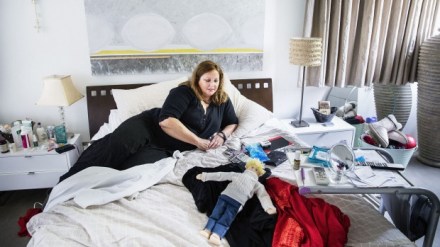
My block helped nearly 2 weeks. I had the Lumbar Sympathetic Nerve block on January 28, 2016.  I had a reduction from a really hard 8 going in for the procedure to a 4 until a couple of days ago when it started creeping back up. L3 and L4 this time instead of L2 and L4. I was so grateful for this. That’s 40-50 percent of reduced symptoms. When I left to receive that amazing award my medication had been delayed yet again. I was a week without already. My block only covered my right lower extremity so 4 means only that which was blocked. I’m still working on a post to share the Bakken Invitation Award experience. I almost left it all behind and I almost didn’t make it through once there, but I did, and I did. The block eased the flare I left in and came home with, allowed extra midnight snacks for the man, dinners, cleaning, sharing, a little catching up. That really is everything it could have been. I don’t count what I didn’t get from the block, I consider each symptom I get relief from. That allows me an over all number, fairly. I tend to be conservative with the pain scale. The time it lasted wasn’t what my insurance wants to approve it again, but it lasted long enough that I could catch my breath again. Since many don’t want anyone on pain reliever, options are minimal for most of us. Not every option is available in every area and not every option is covered by insurance, therefor, we’re stuck in a trap. I’ve already fallen twice in the last couple of weeks. Staying up on my legs is becoming a another risk. I take so much Ibuprofen for inflammation no wonder my liver is a mess and I need to water my kidney’s in excess to keep them flushed due to diminished function. I didn’t get back on my medication until the 10th day and the night after returning.  Had I not been in a flare, or medication delayed, my block may have helped better. The body trying to recover itself from a sudden change and in a sense shock. The inflammation and swelling was horrible. I had my mouth repaired soon after my block. Still a process there. I didn’t have the grafting done even though the bone damage in my face is an issue, too. I fell asleep 4 times today, just worn. I’m charging my SCS right now, so that I can give me a nice goose me up and numb me down.

Movie time.

February 4, 2016

I fell asleep before posting last evening and woke to learn of a heartbreaking loss.

It is with great sadness that Mr. Jim Ingle, Barby Ingle ‘s dad passed away this morning. Without Mr. Ingle, the International Pain Foundation (Power of Pain) wouldn’t exist. He lost his battle waiting on a kidney transplant and other life saving procedures. He fought for himself to the last second, reaching his son’s home in his own vehicle, even after crashing it, where he passed away with his son and first responders before ever reaching the hospital. Mr. Ingle didn’t have a phone to call for his own help, the family was trying to have it replaced promptly which also never happened in time.

Photo is Mr. Ingle presenting the Melanie McDowell Award to Dale Lehn 2008 recipient.

The Power of Pain Foundation (International Pain Foundation) presents the Melanie McDowell Pain Awareness and Advocacy Award annually. The recipient is a pain patient or provider who has demonstrated outstanding commitment to assisting and advocating for people with neuropathy pain conditions. Nominations are solicited in the pain community for people who are making a significant contribution within the field of research, education, awareness, or patient assistance. http://powerofpain.org/mcdowell-advocacy-award/

My heart breaks for Barby, and her siblings, who also lost their mom last year. I’m so grateful that I’ve been apart of IPF POP long enough to have been on conference calls with the man himself. Godspeed Sir. Thank you for all you’ve given, all you’ve fought for and for starting this organization in honor of his daughter Barby and memory of Melanie.


Jim Ingle preseting the 1st Melanie McDowell Award to Dale Lehn 2008 2016-02-04

Mr. Jim Ingle presenting the Melanie McDowell Pain Awareness and Advocacy Award to Dale Lehn, 2008 recipient.


I don’t generally solicit donations, but in honor of the man who not only brought “Power of Pain” to my life via his daughter, but ours, he’s worth it.

http://powerofpain.org/donate-ipain/   A gift can be made in his memory and/or honor – Jim Ingle

Thank you!

Live On. Give On | 2015 Bakken Invitation Honoree | Pre-Review

Week of January 11, 2016 (never shared)

As I get ready to fly to Kona, Hawaii for the Medtronic Bakken Awards, I’m trying to help myself overcome challenges related to traveling, weight bearing, pulmonary and sleep disorder issues. My breathing has been unstable this week, my head, neck, arms, and even female troubles have poked me in the side.

I had my appointment with my PMD yesterday to ask for considerations that might help me through as it’s becoming harder and harder to stay up on my own and maintain pain levels. I already put in for ADA assistance during the travel and at the hotel. Yet, I won’t allow myself to be confined to a wheelchair while there, so I’m carefully pacing myself so that my legs carry me. My Medtronic Spinal Cord Stimulator has been my pill for 10 years. I’ll be able to adjust for optimum relief, but to do so also means that I have to either not be on my legs/feet at that time or not raising my settings for added comfort. I learned a long time ago how to get the best out of it for me. I’ve also learned that there are times I have to trade relief for walking and I can’t always have both at the same time. I can set my stim to numb me, but because I am one of the lucky ones whose stimulation does reach the toes, increasing this setting can knock me off my legs. I reserve this for non weight bearing pain relief. This is not an adverse effect, but a plus and benefit that has to be noted and chosen to best fit my time and place.

My Auto Servo Ventilator is too big and quite heavy to carry, so I may have to go without it. Still working on that. Otherwise I’d be traveling with 2 medical devices and have little room for anything else.

At this time next week, we’ll have already landed and be apart of the meet and greet with each honoree, Medtronic and so many others. I’m looking forward to representing Power of Pain Foundation as the new International Pain Foundation, myself as honoree, each honoree for what they have also accomplished and given, advocacy, volunteering, my family, my closest friends, and Dr. Earl Bakken and Medtronic Philanthropy.

There are a few wonderful people and establishments I want to say thank you to for being apart of this with me.

The International Pain Foundation (IPF) #iPain – Previously known as the Power of Pain Foundation. http://powerofpain.org/

Sacramento Pain Clinic – Dr. Michael Levin – Since 2004. Not just a Pain Management Doctor, but a patient advocate going above and beyond his own job for his patients.)

http://www.sacpainclinic.com/sacpain.php

Jacob Chopourian, Therapy Representative, Pain Therapist, Medtronic Inc Neuromodulation, Sacramento, California. www.medtronic.com

(Jacob has been part of my surgical team. He’s also adjusted me as needed. When I had my 9 year battery replaced I donated back to Medtronic my carrying bag, handheld stim (my stim) case, charger, hip straps, antenna, and manuals so that someone who needed these items in whole or in part could have them. Jacob came to my home to pick it up. Amazing man.)

Katie Tamez, Clinical Specialist, Pain Therapy, Medtronic Inc
Neuromodulation. Sacramento, California. www.medtronic.com

(Katie has worked to fine tune me, too.) I’ve no longer needed the 3 programs I started with many years ago, sitting, walking, sleeping. I use a single program with pulse. Wonderful lady.)

Compass Center for Functional Restoration – (Dr. Michael Levin MD)  Rick Wurster MSG, MPT, BCIAC  http://www.sacpainclinic.com/compass.php

(The center that taught me all there is about pain, physically, emotionally and psychologically. How to live with it using the mind, spirit and body to overcome flareups and maintain a modicum of sanity. Because of them I’ve been able to teach others what they taught me and find some joy and laughter in pain.)

Western Dental – Elk Grove Florin Road, Elk Grove, California

Dr. Tooloei, Staff.

You did great. Thank you for trying before I left for Hawaii. Trying meant enough to me.

Trudy Thomas, Featured BlogTalkRadio Host of the Living with HOPE Radio show on the Body, Mind and Spirit Network.

http://www.blogtalkradio.com/thebodymindandspiritnetwork
So proud of you and all you’ve given, selflessly. Happy that we have each other and our friendship survives the things we can’t do anymore.
Honored to have been both your co-host and guest speaker and warmed that you will always be family. Thank you for being all that I can count on as honorific leader/admin of my group. I love you!

Roy, MD Junction – http://www.MDJunction.com (Honored to have lead your Reflex Sympathetic Dystrophy Support Group for years.

http://www.mdjunction.com/reflex-sympathetic-dystrophy

Glad to have lead the ADHD support group on behalf of the children and parents who needed someone to oversee it. Pleased to still be a Senior Member and
MDJ Advocate. Love you all!)

Barby Ingle, www.BarbyIngle.com
(Together we can! Together we will! And together we are! Through MDJ and Trudy we found each other. I’ll forever remember the ones who cherished me for cherishing them. All 3 of you! Onward I go with #iPain. I love you!)

My Mom and Dad(s) (I know my dad is watching over. Gone since I was 22. My mom and dad was married 25 years when I closed his eyes. My mom and dad have been married 20 years and dated prior to that. So Mr. Don Tresca has been my father just as long as my birth dad was. I pray I’ve honored them all evenly and fairly as their daughter. I love you!)

Erik, Kharisma, Rikki, Kurtis and De’Mantai (my 5 lights). (Awards and recognition is great but not if they are seemingly meaningless to those that it should have mattered most, too.
There’s so much I’ve advocated for on your behalf’s that you’ve never even seen. I know that it all gets stale at some point but if you only knew it was never more for someone else than it was for you. Seek and you shall find.  love you! Ohana.)

I’m so glad Daddy saw, felt, and knows now. Sometimes it takes a miracle and that miracle came. It’s all good. Ask him ~winks

Annie-Marie Garcia (30 years! Time in between where we had gaps because life does that with work and loss. We don’t want to add burden to those we love or stomp on someone else’s, okay. That’s what we tell ourselves at least. I’m glad I got you now in the illness you should have never ended up with. I wish I was there when you were first going through it and if only I had known. Lets never let anything separate us again. For you and I, we have something special, we can see each other every day, or have weeks, months or years go by, but we always know that when it comes down to it, we are the ride or die. I love you!)

Maryann Kupidlowski Stafford (My sister since our babies were babies. Young teen daughters. If we weren’t there together we would have never met. Your curiosity, my extended learning, teaching. We both did, and we both gave, mine was just for extending natural order A decade? 12, 13. Time flies. Here we are moving forward in light, love and tomorrow. I love you!)

PK Saint-Amour (Bruja, pain, strength and the sight. Light and the “F’off. I so love you for being courageous in all of it. I’m so glad that you’re my sister in knowledge and fight. I love you!) https://www.facebook.com/groups/InvisibleWarriors/

Eileen McCready (A long time now too, background, foreground, compassion and understanding beyond pain. Sister of mine, always. I love you!)

Saskia Hubelmeijer (My international sister who does all she can in the Netherlands despite pain and hardship, and for America, too. Who’s assisted in leading my group since 2011, as formal admin and informal I love you!)

Billy Rose (Thank you brother for leading light and love above pain and hurt for all people. You demonstrate what the world needs more of and you are providing the change needed to overcome it all again) I love you!

The Council (We are who we are and one day when the earth is over, or death takes us, we’ll still be us, together, teaching, giving, inspiring, awakening those asleep all in their own time) I love you all. http://www.councilofenlightened.org/

The Sacramento News & Review (For featuring my voice and passion over 20 years ago) November 17, 1994, Speaking Out Edition) https://rsdadvisory.com/2015/07/24/sacramento-news-review-november-17-1994-speaking-out/

https://www.newsreview.com/sacramento/home

ECV Chapter 3 (Clampers/widders) E. Clampus Vitus was established in 1849.

http://ecv3.net/    http://www.ecvgazette.com/

(In memory of IRJR http://www.irjr.com/, a great man, friend, Clamper, who many years ago when founded Widders Web honored me with his chat program instead of the one I was using for us, I used his to then honor what he started years previous to that. http://www.irjr.com/widderschat/  While the pages are currently not found and the chat needs updating, I wanted to thank him again. Mr. IRJR is no longer with us.

SPPAN (State Pain Policy Advocacy Network) (I hope we continue on)

RSD(S)-CRPS Advisories

(Founded by me, for you)

—————

Refer to December 27, 2015

https://rsdadvisory.com/2015/12/23/twinkle-vanfleet-2015-honoree/

To be continued!…

The best is yet to come.
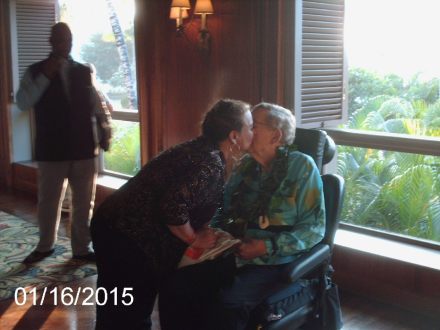
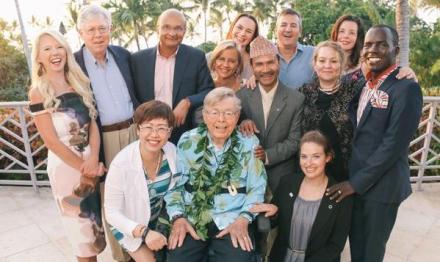
Dr.Bakken and Twinkle VanFleet2

Twinkle VanFleet, 2015 Bakken Invitaton Honoree, Sacramento CA, #iPain, with Dr. Earl Bakken Medtronic Co-Founder, Kona Hawaii. Awards reception. January 16, 2016.


http://bakkeninvitation.medtronic.com/honorees-winners/

http://bakkeninvitation.medtronic.com/honorees-winners/2015/twinkle-van-fleet/index.htm

http://newsroom.medtronic.com/phoenix.zhtml?c=251324&p=irol-newsArticle&ID=1822170

http://newsroom.medtronic.com/phoenix.zhtml?c=251324&p=irol-newsArticle&ID=2122319

http://www.nasdaq.com/press-release/the-medtronic-bakken-invitation-award-honors-12-patients-from-around-the-world-for-giving-back-20151214-00566.

http://www.otcmarkets.com/stock/MDT/news


Thar Pharmaceuticals drug to undergo phase 3 trial | Pittsburgh Post-Gazette – #CRPS

January 21, 2016

By Kris B. Mamula / Pittsburgh Post-Gazette

Thar Pharmaceuticals Inc. has received Food and Drug Administration approval for phase 3 clinical trials of its core product, dubbed T-121. Marketing of the oral drug, which will be used to treat severe, persistent pain, is expected by 2019, according to President and CEO Raymond Houck.“Getting to phase 3 is a big deal,” said Mr. Houck, 58.Phase 3 trials last up to four years. The test is intended to gauge a drug compound’s effectiveness, according to the FDA. Only 25 percent to 30 percent of drugs reach phase 3.Thar, which was founded in 2008 and employs seven people, is targeting complex regional pain syndrome, a condition that usually follows a bone fracture, serious burn or other trauma. About 70,000 people nationwide experience such pain, which can abate over time or become a disabling condition.There are no Food and Drug Administration-approved treatments for the pain. Thar developed the drug through the FDA’s orphan disease program, which allows for expedited review, tax credits and other competitive advantages for medications that help fewer than 200,000 people. Historically, big drug companies have shunned diseases that affect few people, focusing instead on making the next blockbuster statin, a medication taken by millions of people for high cholesterol.But Big Pharma has been increasingly paying attention to orphan disease treatments because of the potentially big paybacks for new prescription medications. Thar is not yet profitable and funding for operations has come from private investors.Thar’s focus is converting intravenously administered medications into ones that can be taken orally, preferred by health insurers because oral drugs are less costly to administer. Patients also tend to prefer oral drugs because administration is noninvasive.Thar’s T-121 is an oral version of Novartis’ intravenous-only zoledronic acid, which is sold under the Zometra brand name and prescribed to prevent or treat weakened bones and other conditions. Zometra’s safety record is expected to further speed FDA review of Thar’s oral version, Mr. Houck said.

Read the full article for more information:

Source: Thar Pharmaceuticals drug to undergo phase 3 trial | Pittsburgh Post-Gazette

Mid Metatarsal Separation | Lis Franc Separation


“Lisfranc joint injuries are rare, complex and often misdiagnosed. Typical signs and symptoms include pain, swelling and the inability to bear weight. Clinically, these injuries vary from mild sprains to fracture-dislocations. On physical examination, swelling is found primarily over the midfoot region. Pain is elicited with palpation along the tarsometatarsal articulations, and force applied to this area may elicit medial or lateral pain. Radiographs showing diastasis of the normal architecture confirm the presence of a severe sprain and possible dislocation. Negative standard and weight-bearing radiographs do not rule out a mild (grade I) or moderate (grade II) sprain. Reevaluation may be necessary if pain and swelling continue for 10 days after the injury. Proper treatment of a mild to moderate Lisfranc injury improves the chance of successful healing and reduces the likelihood of complications. Patients with fractures and fracture-dislocations should be referred for surgical management.

The Lisfranc joint, or tarsometatarsal articulation of the foot, is named for Jacques Lisfranc (1790–1847), a field surgeon in Napoleon’s army. Lisfranc described an amputation performed through this joint because of gangrene that developed after an injury incurred when a soldier fell off a horse with his foot caught in the stirrup.1,2 The incidence of Lisfranc joint fracture–dislocations is one case per 55,000 persons each year.2,3 Thus, these injuries account for fewer than 1 percent of all fractures.2,3 As many as 20 percent of Lisfranc joint injuries are missed on initial anteroposterior and oblique radiographs.2–4

Lisfranc joint fracture–dislocations and sprains can be caused by high-energy forces in motor vehicle crashes, industrial accidents and falls from high places.1–3 Occasionally, these injuries result from a less stressful mechanism, such as a twisting fall. Since Lisfranc joint fracture–dislocations and sprains carry a high risk of chronic secondary disability,2 physicians should maintain a high index of suspicion for these injuries in patients with foot injuries characterized by marked swelling, tarsometatarsal joint tenderness and the inability to bear weight.” Lisfranc Injury of the Foot: A Commonly Missed Diagnosis (Para 1, 2, 3) http://www.aafp.org/afp/1998/0701/p118.html

CRPSRSD Awareness Twinkle V. @rsdcrpsfire - R Foot Nov 10, 15_1

Twinkle V. CRPS 2 November 10, 2015 DOI 1/26/2001

From misdiagnosed to a hell ride I’m still on, I’ve managed to find a glimpse of heaven in it all because I do work with me so that I’m not a total disappointment on myself or society. A bit over a week ago I was banned from Facebook. I had to provide documentation of proof of identity to return. I could have declined, but I was in a tight spot having a group there. Facebook’s policy is that everyone is to use the name they are known as offline, on Facebook, so that others know who they are. Sure we might say well if I’m known as this or that I should be able to use this or that. I hope people stay off me now. I’m me and I’m tired of having to prove it. We all know how many incognito accounts are on there. How many fake names, symbolism. People who have more than 3 accounts of various sorts. I have one account, I’ve never had another. Ever! I’ve always used my name. Once I was blocked, I had to verify me before being allowed full account privileges again. I was temporarily granted access back once I sent the document.

I’m Twinkle, I’m verified, (and proven myself yet again) and I hope that now that I have, who ever reported me, and each of you who want to refer to me as something different will either leave me be or respect that I haven’t ask you the same, or violated your privacy, or attempted to humiliate you, but instead realize that your actions have impacts.

Perhaps I should ask for your identification online and in person.

Between the diagnosis’ obstacles, I still manage to put in a few hours a month volunteering because it’s important that we find consistent tasks and daily agendas. When I’m not doing those things, I’m inclined to spend time in creative arts, things that have nothing to do with chats, Facebook, or social media until which time I might either post to share or keep to myself for another day. I love music and words and I love pieces and parts of all of it. I know the time is coming I won’t be able to stay up on my own anymore. Doze off all day long because you have the excessive daytime sleepiness and narcoleptic episodes, but you don’t sleep at night because you have the complex apnea, your brain doesn’t even send the signal for you to breathe, and your machine forces you to breathe all night long. None of which counts the numerous times you wake too because your spine has deteriorated, your legs are CRPS crazy, your arms fail you, and you just want to get comfortable. You have at least 10 + other diagnosis (internal and organ) and refuse to be beaten!

Each time the foot reaches the ground, pain isn’t just pain, you’re immediately in your head (coping), no reason to whine or complain. It certainly isn’t a reason to want to use pain medication, but it’s the very reason I know pain, understand it, and feel it for others beyond what I knew prior. It’s the very reason I do what I do. Remove the survival, you remove the very reason for living. Only so much can be done solo.

So when I say I did that first near 9 months of intense PT just to have “learned” to walk again? Truth! When I say I push through it each day? Truth! When I say intractable, forever? Truth! The Lis Franc screw remained for 6 months before removal and rehabilitation. My journey hadn’t even started yet at that point. Even in the still, you have to use your mind to bring it down. Every day is ongoing physical rehabilitation with cognitive assists.

The only chance I had was the one I gave myself.

I think I’m doing pretty darned good for doing so darned bad.


Mid Metatarsal Separation/Lis Franc Separation

http://orthopedics.about.com/cs/footproblems/a/lisfranc.htm

Lisfranc Injury of the Foot: A Commonly Missed Diagnosis

http://www.aafp.org/afp/1998/0701/p118.html

Lisfranc Injuries

http://www.foothealthfacts.org/footankleinfo/lisfranc_injuries.htm

Complex Regional Pain Syndrome: CPRS researchers study auditory connection

1449292631770

Kerry Whyman suffers from complex regional pain syndrome, which makes her highly sensitive to noise. Photo: Paul Jeffers

December 6, 2015 – 12:15 AM

For 16 years, Kerry Whyman secretly thought she had bone cancer and was dying – “secretly” because she’d stopped telling doctors how much pain she was in.”I’d wake up and my ankles were swollen and bruised, like they were sprained,” says Ms Whyman, 55. “The doctor would ask ‘what have you done?’ I’d say ‘nothing.’ He’d send me for ultrasounds and they’d come back normal … I decided to shut up because I felt I looked stupid.”If the pain wasn’t in her ankles, it was somewhere else, sometimes in her organs. It seemed to move around Whyman’s body at will. And it became more intense when she was exposed to noise. “My television is turned down to the lowest volume possible, and it’s still too loud.”She got by all those years on paracetamol, anti-inflammatories and lot of drinking. Advertisement. One day in 2008 Whyman met a woman with the same symptoms. The woman told Whyman that she was suffering Complex Regional Pain Syndrome, a rare and baffling condition that was first described during the American Civil War – and until 10 years ago was routinely dismissed as a psychiatric disorder.”When I asked my GP if I had CRPS, he said he’d never heard of it. He thought I had carpal tunnel syndrome. But tests showed I didn’t.”A neurologist finally confirmed CRPS. It most likely began when Whyman fell and fractured her right wrist 23 years ago. In most cases, Complex Regional Pain Syndrome is an ongoing consequence of a fractured limb – the broken bones heal, but the pain lingers, wanders randomly, and is aggravated by changes in weather, stress and noise. Since the diagnosis, Whyman has been on “a merry-go-round” of treatments, most of them not working. The only thing that has given Whyman relief has been intravenous injections of ketamine, the hallucinatory anaesthetic.Three times a year she is admitted to hospital for a week, and kept on an intravenous drip. She’s knocked around but the pain goes away. Except in September, her most recent hospitalisation – it didn’t work. She’s resisting suggestions to undergo direct stimulation of the spine.”They say I’m a perfect candidate, but surgery has to be the last resort,” she says.Depending on the research, there are between five and 25 new cases of Complex Regional Pain Syndrome per 100,000 every year. The actual prevalence is much higher because people, like Whyman, suffer for years.About one in 10 people with a fracture go on to develop some form of the pain syndrome, says Professor Peter Drummond, a psychologist at Murdoch University, one of the few people doing research into the causes.The Australian & New Zealand College of Anaesthetists is funding a study by Professor Drummond and Adjunct Professor Philip Finch, a pain medicine specialist, to unravel some of the complexity. They have together been researching various aspects of CRPS for 25 years.A recent study found there is an increased number of alpha-1 adrenoceptors on skin cells and nerves in the damaged limb of Complex Regional Pain Syndrome patients. These receptors are involved in the stimulation of the sympathetic nervous system, which controls the “fight or flight” response. It may be that pain nerves are being over-stimulated. The researchers are further exploring this discovery.”We’re not sure why these receptors are over-expressed,” says Drummond. “It seems to be a product of injury to the nerve itself or the inflammatory process. We’re studying that in cell cultures, to work out what the stimulus it might be.”The new project is looking at the idea that the brain, in failing to adequately suppress pain, distorts normal sensory processing in the syndrome.In a world first, Drummond and Finch will study the interaction between the auditory and pain-processing systems in CRPS patients. They plan to measure brain stem activity as the left and right ears of patients and a healthy control group are subjected to various noises. They are guessing that noises heard on the injured side of patients – reportedly are distorted and painful – will generate wave forms in the brain different to those generated by the auditory system on the healthy side.Drummond and Finch expect they will be disentangling Complex Regional Pain Syndrome for many years to come.

Source: Complex Regional Pain Syndrome: CPRS researchers study auditory connection

Commentary- Kerry Lynn is an international chronic pain advocate and published writer with a focus on CRPS.

I’m thankful for her contributions.

Overcoming Challenging Obstacles

Excerpts from, Overcoming Challenging Obstacles by Twinkle VanFleet below.

The past few years have been a test of strength, endurance, and possibilities amidst constant setbacks to overcome. 5 years after the injury that led to my CRPS, I did go back to school for a degree in Corporate Publishing. At the end of 2006 I took leave to have my permanent Spinal Cord Stimulator implanted and I returned approximately 10 weeks later. Due to not being able to drive any longer, my husband took me and picked me up in between his own full-time work schedule. By 2007, I wasn’t able to keep up any longer. My grandson was born in 2006, too. My husbands first heart attack when he was 37, 2 stent placements, his Diabetes diagnosis, he only used accumulated vacation time for it and returned to work in a weeks time. In 2007, we bought or first home, but he also lost his 13 year career and stability when his company C.S.A.A. (AAA) relocated out of California. I continued to raise awareness for chronic pain, met Trudy Thomas, became a leader at MD Junction’s RSD Support and remained for 3 years. My own support group which I began on My Space in 2003 was moved to Facebook, yet I didn’t move the members with it. I like for people to find us rather than to send out invites or notify. I met Barby through Trudy. My son had a traumatic brain injury in August of 2011 and my husband had a second heart attack within a year. I stayed in the PICU with Ozra for 10 days. In December of 2012 I stayed at the hospital with my husband for the entire 9 days during his quadruple bypass surgery, the first few days I slept in the van. In 2012, I had Gall bladder surgery and in 2013 I had another Gall bladder surgery which included the removal of part of my liver and multiple hemangioma’s. https://rsdadvisory.com/2013/07/17/gall-bladder-fiasco-continued-and-hopefully-the-final-chapter/

2014 my daughters liver disease, our sons birth defect diagnosis from Shriners Children’s Hospital unrelated to his TBI and my surgery to have my SCS battery replaced. Piece of cake, mostly. 2015 started with a bang and 3 weeks of hard Cymbalta, Zonegran, and Clonazapam withdrawal due to WC delaying Rx refills. The other 2 weren’t filled either, but really no effects from them as much as the other 3. I no longer take Clonazapam or get the Lidoderm. It hasn’t been easy, especially when Clonazapam did help and pain management medication was and is already at the lowest minimum. I already do all that I can to minimize my own agony and I practice these coping strategies each and every day. My husband just had surgery to repair a torn shoulder a few months ago and we just learned by MRI he has another tear in his knee. We’re still learning all we can at Stanford for our daughter. Rikki is managing well. My purpose is in helping others, it’s all I’ve ever done one way or another, but it isn’t my passion. I’ve come to realize it can’t be. It’s not the fire flickering about the dancing flames that motivates my spirit to fly. My bucket-list goal survives all this. It’s not writing, I have that. It’s not policy, POP gave me that opportunity again. It’s much deeper than that, at least for me. Our son and oldest daughter are moving in together on the 1st. My man and I will have our home to ourselves. January 26th begins my 16th year. I’m not sure where 2016 will take us, I just know I take a lickin’ and keep on tickin’ … for mine.


Overcoming Challenging Obstacles

“Pain isn’t in our head, but it is in our brain, and our minds. Pain is sent from the spinal cord, sending messages to our brain, back to our spinal cord and up and down those nerve pathways. Pain signals reach our endorphins, limbic system, https://www.dartmouth.edu/~rswenson/NeuroSci/chapter_9.html hypothalamus, where they then affect our emotions and other bodily functions. http://www.medicinenet.com/script/main/art.asp?articlekey=10812

Functional restoration afforded me lessons and insight to be able to push on. Sometimes we already realize these lessons for someone else, but when it’s us, we don’t recognize it the same, we change, unless we change us back.

It’s a daily process to overcome additional challenges brought on by chronic or intractable pain. It’s moment by moment at times. Having to stop something suddenly to practice breathing exercises to decrease a stress situation brought on by either emotion or a spike in pain, bring a rise in blood pressure down, use focal points, imagery or going to my “happy place” in my mind to ease myself.

“I will walk, when I cannot walk I will carry myself, when I cannot carry myself, I will fly” ©2009-2015 Twinkle VanFleet/@rsdcrpsfire Written while attending Compass Center for Functional Restoration

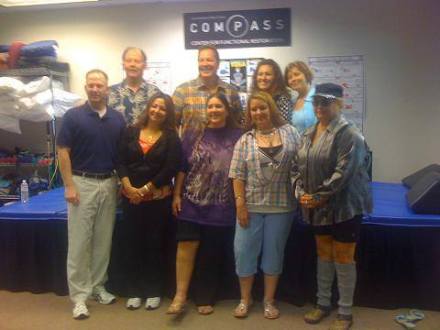
John C. Thomas, PhD, Rick Wurster MSG, MPT, ABP, BCIAC, Leticia Camarena M. A., Tatyana Yatsenko, Larry Lane, Patient, Patient, Twinkle VanFleet, Patient. Compass Center for Functional Restoration Graduation July 17, 2009

I began recording both my P & E. I tracked my “pain” level and my “emotional” level using the same Numeric Rating Scale. The 11 point 0 – 10 scale where 0 represents “no pain” and 10 represents “worse pain imaginable”, “as bad as I can imagine” or unimaginable. I don’t do this anymore because I’ve learned to have the awareness without tracking, but for example at the moment I logged, my E/emotions/stress was an 8 and my P/pain/physical was a 5, I would eventually learn that my pain level would most likely rise anytime. I had to use my cognitive tools right away to reduce my stressors in order to manage the physical pain. I discussed this concept at MDJunction.com when I was a group leader in the RSD Support Forum in 2009.

Life itself can be hard, add pain to it, and it’s even harder. It can be managed with the right tools. It’s never going to be perfect, but we can make it as comfortable or as tolerable as possible for ourselves. Removing or decreasing triggers that instigate pain have eased me. I can’t watch the internet all day. It’s not because I don’t love or care for everyone. It’s because there are pain triggers everywhere. When we see images, graphics, memes of illness or disease scrolling by, especially our own, a trigger can occur. I’ve learned over the years to recognize this. I have the awareness to understand that I can be a contributing factor in my own discomfort.

I never went to preschool and Kindergarten was only for a week or two. I started school in the first grade. I was taught at home and I was reading at advanced levels by the age of 5. My comprehension and spelling ability was always above average. While I either suppressed it or just didn’t care to acknowledge it, I did go to special classes in the first and second grade because I couldn’t pronounce the letter’s S and T in words and sentences properly. I was a critical thinker immediately in life. http://www.criticalthinking.org/pages/defining-critical-thinking/766

By the time I got to my 4th elementary school in the middle of the school year in the second grade, I didn’t have to tell anyone I went to the classes with the special ones. Those new kids and that neighborhood became the ones I grew up with until I left Sacramento in October of the 9th grade to move to L.A. County for my dad’s job. The rest of that year carried with it a bit of insecurity. I started Drama at my new high school and as a Junior I was in second year advanced drama, speech, debate and thespian clubs, involved in school plays, in chamber singers for a while, I swirled the baton too, but chose my priorities and kept to the one’s I still use today. By the middle of the 11th grade I was off to the high desert where my parents bought a home. I’ve been in 4 high schools, 2 Junior high’s due to the district split and several elementary. I learned to adapt young. I may not like it, but I do it fairly well. I’m a survivor of repeated childhood molestation and indirect physical and emotional abuse.

I’ve been an Empath http://themindunleashed.org/2013/10/30-traits-of-empath.html for as long as I can remember. I can vividly still remember leaving my teething ring on the back metal bumper edge of my dad’s best friend’s pickup truck and them driving away with it. I’m hypersensitive to people, places and things sometimes to my own detriment, yet I’m also a no-nonsense girl. I’m inclined to the natural order of things, including man and woman, but I’m not a doormat. I love my crazy and he does, too! Why? Because it’s really not all that crazy, I just like to have it appear so in the midst all the uncertainty in life. Laughing is the best medicine of all. If I can make you laugh, give you something to laugh at even if it’s at my own expense, I’m thrilled to have been of service.”

Empathy Vs Sympathy

http://www.diffen.com/difference/Empathy_vs_Sympathy

Sure there are times I think “Dang, no one gets it!” I don’t mean in everyday situations, I mean in my critical thinking. Those who are on the same page fear agreeing openly until my thought, reasoning, even an educated statement that I make is validated by someone with high education, authority or status. By that time I really don’t need the care, concern or acknowledgment. I might have needed it when I was no one to be acknowledged for. No one will ever know in these situations because I’ll not ever treat them any different and there isn’t any animosity, but there is recall. Why? Because everything we do or don’t do to another person makes an impact on them. Those impacts influence the rest of their lives by accumulation in decisions and choices. This includes my interaction with other people.

By the time I was in the 4th grade I was in the MGM program. At that time called Mentally Gifted Minds. My 9-year-old grandson is currently in the Gifted and Talented Education Program (G.A.T.E.).

During the 4th to 6th grade 2 of my class periods were reserved for tutoring the NES (Non English Speaking) students who just joined our Country from Vietnam, and other Southeast Asian communities. I was 8 years old when I began the 4th grade. These years were 1975-1977/78. Due to being bright enough to be a student teacher at such a young age, I missed normal class subject time; I began to fall behind in math studies. My mathematical education is only that of general knowledge. I held enough that I was promoted to General Manager for a Restaurant by the time I was 24.

I started college when I was 15 in the high desert of California. Law and Acting. I studied both Fundamentals of Crime and Delinquency and Theory and Practice of Acting. I loved being a minor, non-adult, in an adult law class. I loved that my mind was evolving, but it was at a pace others couldn’t keep up with. I loved learning by law enforcement mentors and the few things I participated in to grow and develop lifetime strategies for. I’ve been fond of the Law, Sociology, Philosophy, Theology, Theosophy, The Human Mind, Psychology, Enlightenment, Consciousness. Alternative Lifestyles, Natural Order and the last decade or so Pain Psychology. I like various other topics relating to each of these, too. When I indulge in a book these are the things I enlighten myself in.”  Excerpts from, Overcoming Challenging Obstacles by Twinkle VanFleet (Currently unpublished in its entirety) ©2015 Twinkle VanFleet, Overcoming Challenging Obstacles. All rights reserved.

(Several paragraphs have been removed from the original for this share)


It really is a multi-disciplinary approach to pain care and taking an active role in our own overall well-being that makes the difference between making it or breaking it. Even if we have to fake it to make it to get there.

~Twinkle

In Memory of Mary LaBree – An Original RSD Advocate

One of our original RSDS Advocates, Mary LaBree, passed away on October 15, 2015 due to complications from Reflex Sympathetic Dystrophy (RSD). Mary exemplified commitment to the RSD community for over 3 decades. As the Director of the New England RSDS Coalition since 1990, Mary sought to educate and bring awareness to the public and private sectors for the disease that was virtually unheard of back then. Originally from Leicester, Massachusetts, she was formally educated at Worcester State University in Worcester, Massachusetts.


Mary secured the JULY Proclamation for RSDS To urge all of the citizens of the Commonwealth to take cognizance of this event and participate fittingly in its observance. Given at the Executive Chamber in Boston, the twenty-fourth of June in the year two thousand and eleven, and of the Independence of the United States of America, the two hundred and thirty forth.” Massachusetts Bill # 5938


She worked both locally in Massachusetts and Nationally.


Mary formed and lead seminars, attended others, developed awareness events, distributed information and educational materials. She spoke with patients, caregivers, physicians, hospitals, insurance companies, fellow educators, universities, other peer groups, and those with an interest to learn about Reflex Sympathetic Dystrophy. She was involved with grants, research and fundraising.


When Mary LaBree began advocating for RSD in the 1980’s the term Complex Regional Pain Syndrome hadn’t been created. While other names had been used previously to describe Reflex Sympathetic Dystrophy (Syndrome) it was most often referred to as RSDS.


In 2012, she reached out to me and a friendship formed. We shared phone calls, messages and correspondence by snail mail. Mary sent me a copy of the photo of she and other’s of the original signing of her proclamation and a copy of the verbiage used to secure her proclamations. I’m privileged to know what Mary looks like. For now, I’ll not share those, nor have I ever. She shared with me 30+ years of everything. How she started, how she educated, how other RSD organizations began, her children, grandchildren, colleagues, the strength it takes to endure; not just in living with pain, but being a part of it.


If you pray, why worry…  If you worry, why pray?  


I had plans to meet her in person twice. The first time she had to return home early. I was supposed to meet her again toward the end of October or into mid-November. I had just spoken to her less than a week before her passing.


  • October 8

10/8, 4:04pm

Mary LaBree

I was in the hospital yesterday, I had an accident with my wheelchair when I tried to back it up ( standing in front of it. ) (Stupid me )when I pushed the button to back it up.. I pushed it the wrong way..And ran over my LEDs from the ankles to the knees. I was really blessed when the ER Dr. Asked what other problems did I have, & when I explained CRPS He said oh Chronic Regional Pain Syndrome , I said yes. He treated me with kindness & care. I’m going to send him a thank you card. He was really kind. You don’t always find a kind caring Dr..pls pray for me to recover. I have a lot of CRPS work to do. I will be leaving for CA in a few weeks. Ty.M

  • October 9

10/9, 5:22pm

Twinkle Wood-VanFleet

You’re always in my thoughts and prayers for your health, and your work, Mary. I do hope to meet you in November. xx

  • October 10

10/10, 10:07pm

Mary LaBree

Hi, Yes I’m looking forward to meeting you as well. I leave Oct 23 on. Friday. A lil less then 2 wks.I will call u sometime on the weekend after I arrive, hugs & lots of love.M

  • October 12

10/12, 7:04pm

Mary LaBree

I’m sorry I had a mistake that I didn’t want to have a group pls forgive me, as I pressed the wrong thing, & didn’t realize it until someone told me.


The next message on Oct 12, I missed due to being away and my IM being flooded and then she was gone. I was on the road to and from the Stanford Transplant Clinic for our daughter on the 15th and in the Emergency Department on the 16th due to my cervical spine. Trying to save the puppies life all in between.

The last message was in reference to an accidental group IM.

I had been wondering if she would want to make the plans to meet at the NERVEmber, West Coast Pain Forum for Power of Pain Foundation on November 14th. All I knew for certain is she planned to be here in Northern California on the 23rd of October and would call me.


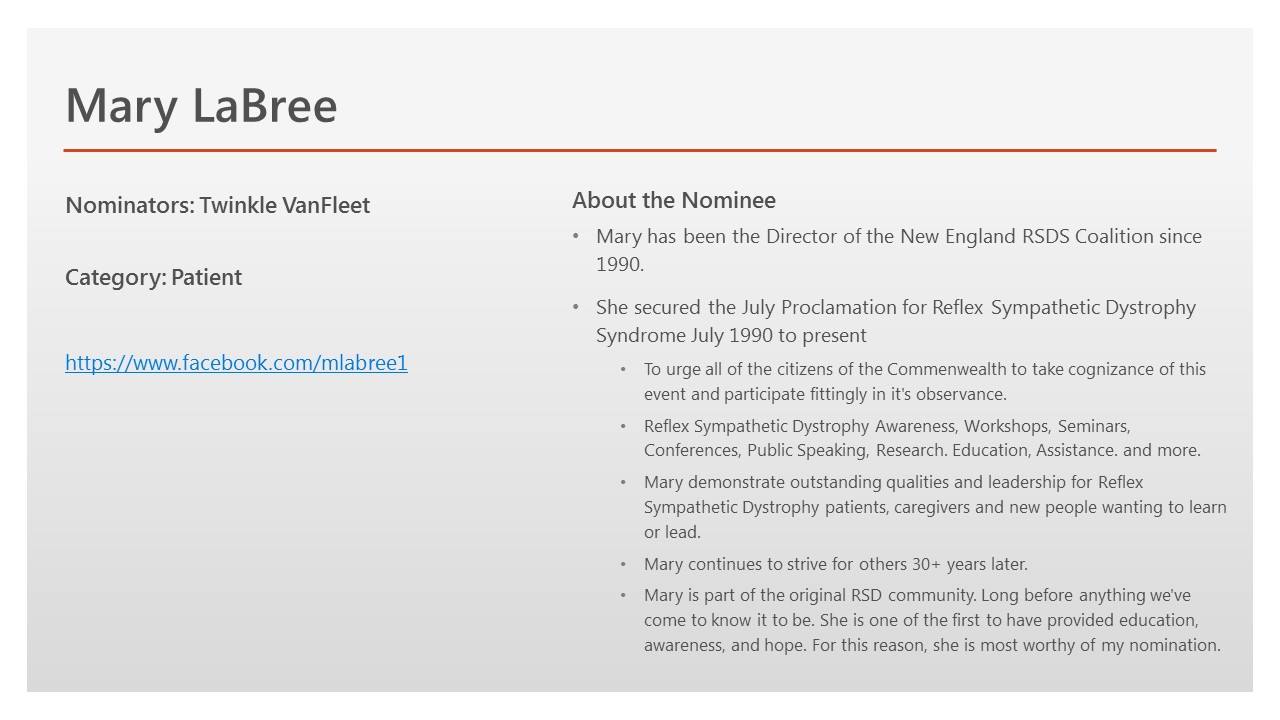
Mary LaBree Melanie McDowell Awareness and Advocacy Award Nomination 2015 Slide property of @powerofpain

Permission granted and sent from the Power of Pain Foundation to share in Mary’s memory. Melanie McDowell Awareness and Advocacy Award Nomination 2015


I wish she would have received more nominations, but mine was the only one for her.  She was most deserving.


We never know for certain where our conversations go even when we chit-chat on the phone or when we think they are in confidence. I don’t know what Mary ever spoke of me to others, but I know that she must have believed in me enough with what she did share with me to know I would keep it to me and if she didn’t know for sure when she told me she knew as time went on because I’ve never told it.

She asked me sometime in 2013 to consider being trained by her for her Coalition and new endeavors. While I was most honored, I respectfully declined as I was already committed to Power of Pain.

Our conversations also consisted of but weren’t limited to life, color, ethnicity, race, the olden days, differences, equality, change and today. She shared with me uncertainties about people, places and things, and I eased her in certain fear and prejudices. Please don’t misunderstand me, I’m not at all implying Mary was prejudice, in fact, she’s not, though conversations were simply sometimes deep. Mary listened and she learned. She watched, listened to gossip, dismissed it, listened more, read, picked it apart, put it together, and ultimately decided for herself. She wasn’t afraid to speak her mind or share a maybe, what if, what do you think or did you know.


I’m humbled to have been accepted, acknowledged, taught and even loved by her.


Mary was so proud of the New England RSDS Coalition, she was thrilled that the healthcare community was finally beginning to know what RSD (CRPS) is. She was pleased that patients had informational materials to seek out and be provided. She was happy that educational events were provided free to the public.


She told me the story behind July and why her proclamations are for the month of independence and not November. As I stated Mary began educating RSD over 30 years ago. July was chosen for freedom, freedom from pain. It wasn’t until many years later that a national color evolved, and then our month of recognition. Mary was grateful for her closest friends. I know she loved her beautiful friend, advocate and poet, Jane (Gonzales).


I prayed for her health and I prayed for her to achieve her life’s work, her mission to create awareness and educate on RSD, her purpose to continue doing so, and her hope for our future.


You did Mary! You really did! You achieved them all to the last breath.


And I thank you!


With gratitude, hugs and lots of love,


Miss you, won’t forget you,

~T


Mary’s Facebook page:    Pro image ML  https://www.facebook.com/messages/mlabree1


Lets not forget the ones who started the path that gave way for us to do what we do.  ~Twinkle V.


On behalf of all of us this one’s for you!


(Originally written at the end of October and updated today)


Reference to Mary’s favorite quote shared above. The above is shared the way she said it.


“If You Pray Don’t Worry… If You Worry Why Pray” sermon by Levi Wright


Family, Indie, Pain

Squirrel! But it really was. I’ve been staring out the window watching it for 30 minutes now. Running along the back fence, through the branches of the large tree that’s limbs cover the roof above my bedroom. It’s green, brown and yellow-gold leaves scattered about the ever-changing arms of fall. I gazed over as the quick little animal hurried over the Tuff Shed, back along the other side of the fence and eventually disappeared again. And then I was reminded of all the distractions.

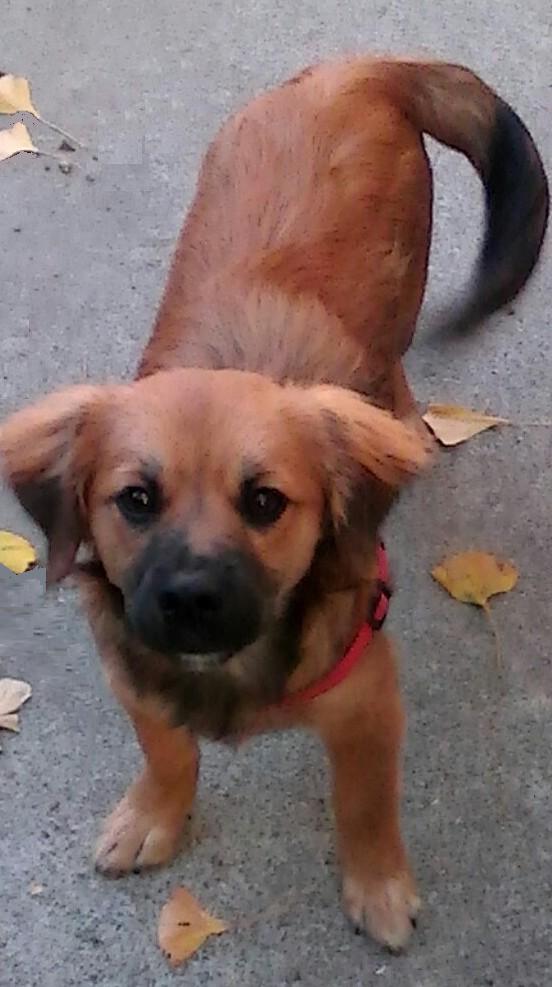
The day before we left for the Stanford transplant center on behalf of our daughter for the second time in a month, my 6 month old puppy Independence stopped eating, drinking, became lethargic, ceased playing. No more kisses, no more loves, no greets. He’s always extremely perky, playful and active. He loves his ropes, always tugging with me, but not anymore. This was on Wednesday, the 14th that this began. We’ve already spent $2,000 saving one puppy many years ago from Parvo, nearly lost another that I was able to save by IV home care I’m not sure what’s the matter with Indie. I know, take him to the vet, but unfortunately it’s not an option. If you’ve been following any of my story relating to our daughter, no matter how much I want to and wish that I could I’m just not able.

Independence (Indie) October 6, 2015

Independence (Indie)
October 6, 2015
Before he became sick.

I started force feeding him sugar-water on the 14th. Other than in the A.M. I was gone all day on the 15th and didn’t get home until nearly midnight from Palo Alto, CA. Our daughter seen her specialist and had a pre scheduled MRI immediately after. Her doctor added a brain scan as well. We drove another 20 minutes to the imaging center and learned that the scans hadn’t been authorized by the insurance. I could understand the second not being yet as it was just added, but the first hadn’t been either and had been scheduled 3 weeks prior. We signed the papers to take financial responsibility still hoping that the insurance would be approved or that we could appeal if all together denied. She has to have these scans. She was taken back and came out 15-20 minutes later in her gown into the lobby. They wouldn’t proceed without a $10,000 down payment. Oh my! Then we learned none of her Stanford appointments have been covered. Nothing we could do. She went to change and we drove back home to Sacramento.

When we got home Indie short for Independence was in the same condition as when I left. I gave him more sugar water. He wouldn’t even look at food or water. His head was droopingI rested a bit, I was exhausted, I hadn’t been feeling well, I’ve been in a flare, but my arms were hurting too much, numb, losing feeling, difficult to raise, electric shocks, my chest aching. I started researching all that I could on sick puppies. I gave him a dose of RFD Liquid Wormer for puppies and dogs and comforted him. I already had it on hand. I finally fell asleep about 4:00 a.m.

When I woke, I could barely lift my head, I couldn’t feel my arms, I could barely carry myself my back was so heavy, hate is a strong word, but I really hate the word pain, it really hurt, my collarbone area, the side of my face, my lips were having spasms and sharp spikes. All in addition to my lower back and bilateral CRPS. I was diagnosed with Fibromyalgia in 2003 also, but I know that pain enough to differentiate it from CRPS and what’s going on here. For me, Fibro feels like I’ve been run over by a truck. Really deep muscle pain. Or if I haven’t worked out in a long time, and did for a day, it’s similar to the next days muscle burn pain we get from it. My arms first started doing this a couple of years ago, lasting for over 6 months straight at one point, all day and night long in the seize and release. The only way I’ve been able to describe it is that it feels like my spinal cord stimulator is in my arms for seconds at a time. Being turned on, increasing in intensity until it reaches its peak, locks my arm up, in whatever position my arms are at the time it occurs, until the buzzing/intense tingling/shocking eases down and releases. I suppose if I didn’t have an SCS, I couldn’t describe it this way and maybe because I do I had been accidentally misleading doctors in my description. The only way to describe accurately is to truthfully describe as something feels. It’s really painful. Bringing me to tears more than a few times. I really hold back crying over my CRPS pain, I hide pain fairly well, including pain behaviors and guarding, but this has caused tear drops to rain on their own accord. Automatic. It feels like a line running through the side of my head and continuing down my neck into my arms. Worse on the right,  though both are effected. And the headaches, disorientation. Phew! By the way it’s not possible for the actual stimulation from my SCS to be in my arms. Plus, back when it first occurred, I inquired to the possibility just to be sure.

Barely being able to make it down the hall because evening out my spine wasn’t an easy task, I got my coffee, and tended back to Indie. I’ve found him in the backyard twice and that scares me. I know animals often go away to pass on. He’s not an outside dog like that and because it’s not part of his normal routine it makes me uncomfortable.

I got everything ready I asked my husband to get from the store the night before. I’m bound and determined to make him better. Today is the 5th day since he’s not eaten. My husband brought back Pediatric Electrolyte, Karo Syrup, and 4 containers of chicken and rice baby food. All day long, I’m giving him a 3 ml syringe of the PediaE, 3 x each time, every hour at least. I have to pry his jaws, or attempt into the back side of his cheek between his teeth. He’s that sick. I rub the Karo on his gums to raise his blood sugar. I used a spoon to force feed him the baby food. It was messy. On the 3rd day, he finally drank water from his own bowl, but he vomited it up on my bed. Laundry! He did drink too much for not having drank in 3 days, I think. I’ve been watching for blood, there hasn’t been any that I know of. He didn’t drink any water again yesterday and he still hasn’t eaten any food and is still inactive. My 9-year-old grandson just said to me as he pet to soothe the puppy laying beside me “I miss when Indie was all hyper”.

Last evening, I added Tylenol into his daily care. I didn’t have baby Tylenol, so I put one of my Acetaminophen into a water bottle cap with a few drops of water to let dissolve. The Tylenol is a OTC 500 mg. Once liquid, I pulled approximately 150 mg of it into the syringe with the rest PediaE, shook it up, opened his mouth, and shot it down his throat and gave him 2 more 3 ml PE.

He’s so skinny.

It’s hard when you have to make choices, or rather, you don’t have any, but there are options and I’ve used my knowledge, past experiences, and the research to do as much as I can for him, as I do for the rest of my family. I hope I’m not prolonging his survival to cause him suffering but instead saving his life with all the love and compassion within me. I really don’t give up, not even on a pet.

Today I started using the syringe to get the baby food down him. Too many days have gone by. I pray I’m doing something right, he’s still hanging on.

Friday night I was diagnosed with Cervical Radiculopathy, previously diagnosed as only Paraesthesia. As long as I’m not going to drop dead of a stroke, I can figure out a way. And nope, wheels (wheelchair) are still not an option at this time. I’ve already beat being in one permanently by 10 years due to my lower extremities, not letting my upper body steal the good hard fight. Nope, not yet.

It’s taken me 2 hours to type this. A bit of a setback.

… But only a setback.

#StrongerThanPain

Making Complex Regional Pain Syndrome Simple For a Jury

MAKING COMPLEX REGIONAL PAIN SYNDROME SIMPLE FOR A JURY

A start-to-finish strategy for proving the chronic pain and resultant damages of CRPS

When God was testing the faith of Job, the worst punishment was physical pain…. He lost his lands and property, his family – but it was not until physical pain was inflicted that Job broke. (Job 16:6).

A case dealing with chronic pain can be difficult to prove due to the subjective nature of pain itself. This is especially true for Complex Regional Pain Syndrome cases (“CRPS”). CRPS, formerly known as Reflex Sympathetic Distrophy Syndrome (“RSD”), is an incurable chronic pain condition that is often debilitating. For trial lawyers and their clients, this disorder is especially troubling because of the controversy surrounding its diagnosis and treatment. As its very name implies, the disorder is “complex” in nature, is routinely misdiagnosed, and as such, is difficult to explain and prove to a jury.

Take a recent case that had a mixed diagnosis: Some doctors thought it was CRPS, while some did not. In the end, what mattered was our client had severe pain that would likely afflict him for the rest of his life. This was something the jury understood, whether we called it CRPS or not. The primary purpose of this article is to explain the basics of CRPS, highlight some of the challenges in dealing with a CRPS case, and discuss some useful strategies from a recent trial.

CRPS – WHAT IS IT?

CRPS is a chronic pain condition most often affecting one of the limbs (arms, legs, hands, or feet), in which the pain is out of proportion to thc injury. There are two designations of CRPS: Type I and II. Typc I, which this article will focus on, is a result of trauma. Type II stems from a specific injury to a nerve.

Some researchers have said CRPS is potentially the worst chronic pain disorder a human being could endure. Doctors describe the severe cases of CRPS as being higher on the pain scale than childbirth and amputation. However, over the years, pain management practitioners were overzealous in diagnosing chronic pain patients with CRPS. In the early 1990s, “RSD” cases were popping up everywhere, perhaps in part due to the unclear diagnostic criteria at the time. Now, after the hype has calmed and thorough research has flushed out a more clear understanding of the disorder, CRPS cases can and should command the same attention as other severe injuries such as brain and spinal cord injuries.

To begin with, CRPS arises typically after an injury or trauma to the affected limb. For example, a seemingly simple fracture to the ankle eventually causing a severe pain disorder in that limb. The most frightening aspect of the disease is that it often initially begins in an arm or a leg and often spreads throughout the body. In fact, according to the National Institute of Health, 92 percent of patients state that they have experienced a spread, and 35 percent of patients report symptoms in their whole body.

CRPS is characterized by prolonged or excessive pain and mild or dramatic changes in skin color, temperature, and/or swelling in the affected area. These signs can be subtle in nature, or dramatic, depending on the severity of the CRPS.

CRPS symptoms vary in severity and duration. The key symptom is prolonged pain that may be constant and, in some people, extremely uncomfortable or severe. The pain may feel like a burning or “pins and needles” sensation, or as if someone is squeezing the affected limb. The pain may spread to include the entire arm or leg, even though the precipitating injury might have been only to a finger or toe. Pain can sometimes even travel to the opposite extremity. There is often increased sensitivity in the affected area, such that even light touch or contact is painful (called allodynia).

People with CRPS also experience constant or intermittent changes in temperature, skin color, and swelling of the affected limb. An affected arm or leg may feel warmer or cooler compared to the opposite limb. The skin on the affected limb may change color, becoming blotchy, blue, purple, pale, or red. As discussed in more detail below, due to the complexity of the disorder, CRPS cases are often overlooked, misdiagnosed, and not properly worked up.

VETTING A CRPS CASE

As trial lawyers, we appreciate that many of our clients do not have the type of medical treatment and insurance required to get a complete medical workup and diagnosis. Often, an injury like a brain bleed or spinal fracture might go misdiagnosed. With a disorder such as CRPS, this is truly one of the injuries that often require an attorney’s eye and attention to appreciate the client’s dilemma.

The following are a few points to consider when interviewing a client to determine if he or she potentially has CRPS:

• An injury causing pain which is out of proportion to injury,

• Changes in skin texture on the affected area; it may appear shiny and thin,

• Abnormal sweating pattern in the affected area or surrounding areas,

• Changes in nail and hair growth patterns,

• Stiffness in affected joints,

• Problems coordinating muscle movement, with decreased ability to move the affected body part, and,

• Abnormal movement in the affected limb (most often fixed abnormal posture, or tremors of the affected limb).

For a full CRPS potential case checklist, please contact the author.

Find out more about:

What Causes CRPS?

CRPS Diagnosis and Prognosis

How to Deal with Conflicting CRPS Diagnoses

Voir Dire Tips in a Pain Trial

Experts: Get the Dream Team

Dealing with the Defense “Expert”

Making it Simple

via Making Complex Regional Pain Syndrome Simple For a Jury.

COMPLEX REGIONAL PAIN SYNDROME

THE RELENTLESS PURSUIT OF JUSTICE

Complex Regional Pain Syndrome: The Relentless Pursuit of Justice

Causes

Symptoms

Diagnosis and Risk Factors

Prognosis and Treatment

Lawsuits and Damages

Spencer Lucas is a trial lawyer at Panish Shea & Boyle and specializes in complex catastrophic personal injury, products liability and wrongful death cases.  He has extensive experience in cases involving traumatic brain injuries, spinal cord injuries, and chronic pain.

Panish Shea & Boyle, LLP

11111 Santa Monica Blvd #700, Los Angeles, CA 90025

PHONE 877.800.1700

FAX 310.477.1699

Brain alterations and neurocognitive dysfunction in patients with complex regional pain syndrome

April 2015

Highlights

  • Significant cortical thinning in the prefrontal cortex was observed in CRPS patients.
  • Patients with CRPS made significantly more perseverative errors on the WCST.
  • Patients with CRPS showed significantly longer stop-signal response time.
  • The alterations may explain executive dysfunction and disinhibited pain perception.

Abstract

Few studies have examined the involvement of specific sub-regions of the prefrontal cortex in complex regional pain syndrome (CRPS). We analyzed cortical thickness to identify morphological differences in local brain structures between patients with CRPS and healthy control subjects (HCs). Furthermore, we evaluated the correlation between cortical thickness and neurocognitive function. Cortical thickness was measured in 25 patients with CRPS and 25 HCs using the FreeSurfer method. Pain severity and psychiatric symptoms were assessed using the Short Form McGill Pain Questionnaire and the Beck Depression and Anxiety Inventories (BDI and BAI), respectively. Neurocognitive function was assessed via the Wisconsin Card Sorting Test (WCST) and the stop-signal task (SST). The right dorsolateral prefrontal cortex (DLPFC) and left ventromedial prefrontal cortex (VMPFC) were significantly thinner in CRPS patients than in HCs. CRPS patients made more perseveration errors on the WCST and had longer SST reaction times compared with HCs. Although BDI and BAI differ significantly between the groups, they were not correlated with cortical thickness. Our study suggests that the pathophysiology of CRPS may be related to reduced cortical thickness in the DLPFC and VMPFC. The structural alterations in DLPFC may explain executive dysfunction and disinhibited pain perception in CRPS.

Read more-

via Brain alterations and neurocognitive dysfunction in patients with complex regional pain syndrome.

Article in Press (see also)

Brain alterations and neurocognitive dysfunction in patients with complex regional pain syndrome

http://www.jpain.org/article/S1526-5900(15)00599-4/abstract