The Body, Mind, and Spirit; Humanizing the Soul
By Twinkle VanFleet
I often refer to Quality of Life (QOL) when supporting or opposing legislation and/or certain topics aimed at the chronically ill or intractable pain patient . Quality of life is important! What is it though? I knew what I meant, but did others? Did those people I spent time with exchanging bits and pieces of personal belief and philosophies understand what it really was that I was referring to, or was it simply 3 words that had been tossed around in the vast world of healthcare and patients alike that had just become a more familiar reference term over time?
Somebody understood, someone had already knew precisely what I meant and what I had attempted to relay to others for decades. I didn’t know until after I returned home from being honored with The Bakken Invitation Award which recognizes outstanding contributions of service, volunteerism, and leadership. Each year, selected Honorees earn a $20,000 grant from Medtronic Philanthropy to direct to a charity of their choice. I didn’t realize until I opened one of the books that had been gifted to me as a 2015 Bakken Invitation Honoree by the man who most likely didn’t choose me solely, but who presented it to me at one of my weakest and most vulnerable public moments ever. As I began to read through “One Man’s Full Life” by Earl E. Bakken, co founder of Medtronic, I knew.
I knew that the man who had invented the world’s first wearable battery operated external pacemaker in a garage in northeast Minneapolis while everyone else was recovering from WW2, knew also. There was 46 years between his birth and mine, but someone else understood long before I ever could.
Health Related Quality of Life is the meaningful intent and purpose of giving a part of the self to another. A warm smile, soft caress, compassion. Anyone can want, need or desire quality of life. This quality is based on what we do with our lives, where we want to take it, and if we can sustain that quality we want or crave by what we’ve utilized from all that we have and that which we don’t. It’s really dependent not on the self, but the ego. Upbringing, teachings, education, competition, and lacking commitment to anything or anyone else.
Health Related Quality of Life is what we need to survive. There is no quality of life without a health related quality of life. Health related quality of life had become technology, pills, and sending a person on their way. The real intent of health related quality of life is the human experience. Humanizing patients will help their mind and spirit overcome challenges in the body.
Shrug someone off, remove their dignity, you also remove the very reason for fighting against disease and pain that our own minds already know how to achieve. Our mind is part of our brain it isn’t the brain itself. It’s our conscious, and sometimes unconscious being, yet never the less our higher being, our spirit. Break the spirit, you will break the body. Liven the mind and the spirit, you induce a will to “be“.
All these years, all the doctors and medical professionals, some my own physicians, others colleagues, above me in degrees, educational establishments, influence, and knowledge. I knew I knew, but now it was validated by a man who’s invented, done and given more in his lifetime than anyone else I could ever come to know.
It doesn’t take a degree to “get it“. All it’s ever taken is an understanding and belief in the human spirit and what it’s truly capable of, if not thrown away. I think I’m finally proud enough to say with my head held high, instead of my eyes lowered, that I don’t have a degree, I didn’t attend any fancy universities, I’m certainly not the sharpest tool in the shed, but I am brighter than the average bear. This is all I was ever suppose to be. All I was meant to do is validate those who came before me for those who come after me.
We’ve become a world that belittles at the first opportunity and blames others for what’s in our own power to change or make better. Instead, a people who hold back because they think they lack worth. You’re worth it, I promise! Some are still trying to teach it, still trying to proffer care in kindness and mercy above and beyond themselves, opening eyes and fluttering hearts, enlightening those who haven’t quite seen the light yet.
It doesn’t take a degree to be enlightened above the self and know a little better than the one‘s who tell you, you don‘t..
As I get ready to fly to Kona, Hawaii for the Medtronic Bakken Awards, I’m trying to help myself overcome challenges related to traveling, weight bearing, pulmonary and sleep disorder issues. My breathing has been unstable this week, my head, neck, arms, and even female troubles have poked me in the side.
I had my appointment with my PMD yesterday to ask for considerations that might help me through as it’s becoming harder and harder to stay up on my own and maintain pain levels. I already put in for ADA assistance during the travel and at the hotel. Yet, I won’t allow myself to be confined to a wheelchair while there, so I’m carefully pacing myself so that my legs carry me. My Medtronic Spinal Cord Stimulator has been my pill for 10 years. I’ll be able to adjust for optimum relief, but to do so also means that I have to either not be on my legs/feet at that time or not raising my settings for added comfort. I learned a long time ago how to get the best out of it for me. I’ve also learned that there are times I have to trade relief for walking and I can’t always have both at the same time. I can set my stim to numb me, but because I am one of the lucky ones whose stimulation does reach the toes, increasing this setting can knock me off my legs. I reserve this for non weight bearing pain relief. This is not an adverse effect, but a plus and benefit that has to be noted and chosen to best fit my time and place.
My Auto Servo Ventilator is too big and quite heavy to carry, so I may have to go without it. Still working on that. Otherwise I’d be traveling with 2 medical devices and have little room for anything else.
At this time next week, we’ll have already landed and be apart of the meet and greet with each honoree, Medtronic and so many others. I’m looking forward to representing Power of Pain Foundation as the new International Pain Foundation, myself as honoree, each honoree for what they have also accomplished and given, advocacy, volunteering, my family, my closest friends, and Dr. Earl Bakken and Medtronic Philanthropy.
There are a few wonderful people and establishments I want to say thank you to for being apart of this with me.
The International Pain Foundation (IPF) #iPain – Previously known as the Power of Pain Foundation. http://powerofpain.org/
Sacramento Pain Clinic – Dr. Michael Levin – Since 2004. Not just a Pain Management Doctor, but a patient advocate going above and beyond his own job for his patients.)
(Jacob has been part of my surgical team. He’s also adjusted me as needed. When I had my 9 year battery replaced I donated back to Medtronic my carrying bag, handheld stim (my stim) case, charger, hip straps, antenna, and manuals so that someone who needed these items in whole or in part could have them. Jacob came to my home to pick it up. Amazing man.)
(Katie has worked to fine tune me, too.) I’ve no longer needed the 3 programs I started with many years ago, sitting, walking, sleeping. I use a single program with pulse. Wonderful lady.)
(The center that taught me all there is about pain, physically, emotionally and psychologically. How to live with it using the mind, spirit and body to overcome flareups and maintain a modicum of sanity. Because of them I’ve been able to teach others what they taught me and find some joy and laughter in pain.)
Western Dental – Elk Grove Florin Road, Elk Grove, California
Dr. Tooloei, Staff.
You did great. Thank you for trying before I left for Hawaii. Trying meant enough to me.
Trudy Thomas, Featured BlogTalkRadio Host of the Living with HOPE Radio show on the Body, Mind and Spirit Network.
http://www.blogtalkradio.com/thebodymindandspiritnetwork
So proud of you and all you’ve given, selflessly. Happy that we have each other and our friendship survives the things we can’t do anymore.
Honored to have been both your co-host and guest speaker and warmed that you will always be family. Thank you for being all that I can count on as honorific leader/admin of my group. I love you!
Roy, MD Junction – http://www.MDJunction.com (Honored to have lead your Reflex Sympathetic Dystrophy Support Group for years.
Glad to have lead the ADHD support group on behalf of the children and parents who needed someone to oversee it. Pleased to still be a Senior Member and
MDJ Advocate. Love you all!)
Barby Ingle, www.BarbyIngle.com
(Together we can! Together we will! And together we are! Through MDJ and Trudy we found each other. I’ll forever remember the ones who cherished me for cherishing them. All 3 of you! Onward I go with #iPain. I love you!)
My Mom and Dad(s) (I know my dad is watching over. Gone since I was 22. My mom and dad was married 25 years when I closed his eyes. My mom and dad have been married 20 years and dated prior to that. So Mr. Don Tresca has been my father just as long as my birth dad was. I pray I’ve honored them all evenly and fairly as their daughter. I love you!)
Erik, Kharisma, Rikki, Kurtis and De’Mantai (my 5 lights). (Awards and recognition is great but not if they are seemingly meaningless to those that it should have mattered most, too.
There’s so much I’ve advocated for on your behalf’s that you’ve never even seen. I know that it all gets stale at some point but if you only knew it was never more for someone else than it was for you. Seek and you shall find. love you! Ohana.)
I’m so glad Daddy saw, felt, and knows now. Sometimes it takes a miracle and that miracle came. It’s all good. Ask him ~winks
Annie-Marie Garcia (30 years! Time in between where we had gaps because life does that with work and loss. We don’t want to add burden to those we love or stomp on someone else’s, okay. That’s what we tell ourselves at least. I’m glad I got you now in the illness you should have never ended up with. I wish I was there when you were first going through it and if only I had known. Lets never let anything separate us again. For you and I, we have something special, we can see each other every day, or have weeks, months or years go by, but we always know that when it comes down to it, we are the ride or die. I love you!)
Maryann Kupidlowski Stafford (My sister since our babies were babies. Young teen daughters. If we weren’t there together we would have never met. Your curiosity, my extended learning, teaching. We both did, and we both gave, mine was just for extending natural order A decade? 12, 13. Time flies. Here we are moving forward in light, love and tomorrow. I love you!)
PK Saint-Amour (Bruja, pain, strength and the sight. Light and the “F’off. I so love you for being courageous in all of it. I’m so glad that you’re my sister in knowledge and fight. I love you!) https://www.facebook.com/groups/InvisibleWarriors/
Eileen McCready (A long time now too, background, foreground, compassion and understanding beyond pain. Sister of mine, always. I love you!)
Saskia Hubelmeijer (My international sister who does all she can in the Netherlands despite pain and hardship, and for America, too. Who’s assisted in leading my group since 2011, as formal admin and informal I love you!)
Billy Rose (Thank you brother for leading light and love above pain and hurt for all people. You demonstrate what the world needs more of and you are providing the change needed to overcome it all again) I love you!
The Council (We are who we are and one day when the earth is over, or death takes us, we’ll still be us, together, teaching, giving, inspiring, awakening those asleep all in their own time) I love you all. http://www.councilofenlightened.org/
(In memory of IRJR http://www.irjr.com/, a great man, friend, Clamper, who many years ago when founded Widders Web honored me with his chat program instead of the one I was using for us, I used his to then honor what he started years previous to that. http://www.irjr.com/widderschat/ While the pages are currently not found and the chat needs updating, I wanted to thank him again. Mr. IRJR is no longer with us.
SPPAN (State Pain Policy Advocacy Network) (I hope we continue on)
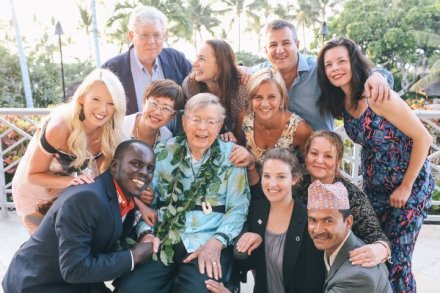
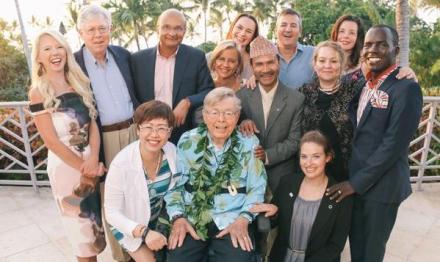
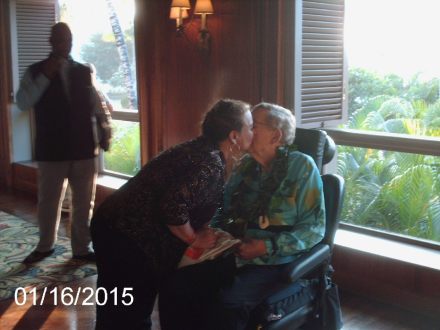
Twinkle VanFleet, 2015 Bakken Invitaton Honoree, Sacramento CA, #iPain, with Dr. Earl Bakken Medtronic Co-Founder, Kona Hawaii. Awards reception. January 16, 2016.
I’m not sure how I should present this. Do you want it kind, sincere, and respectful, or do you need it blunt, open and firm? Do you want it me for you, or you against me, us? Do you want it white or black? Love, care and light or a little profanity to remind you that the world isn’t one way or the other?
You can judge me, you already have. Maybe you need something to judge me for. I refuse to allow you to add me to any negative category. I’m not a little kid anymore and I won’t be silenced because you think your ideals are above someone else’s. I’m heading on 50.
I’ve been on and off opioids since I was 22. Just because my life sucks and I’ve dealt with surgery after surgery, procedure after procedure, diagnosis after diagnosis, and I’ve been intractable for 15 years doesn’t mean I chase the pain to get the medication. I haven’t. There has not been a single time that I went seeking medication I shouldn’t have. My random pee tests are clean and prior to ever being injured my work took my hair, follicles that went back a year for drug testing. And while it’s none of your business in situations like this, where the anti opioid groups are stead fast against that kind of pain relief, I’m compelled to tell my business to justify my reason for taking it and the reason the physician prescribed it.
My pill is my SCS Spinal Cord Stimulator. It has been since 2006. I use a single low dose partial agonist and partial antagonist pain medication. There is no high. I take nothing for break through. I take Zonegran 100, 2x and Cymbalta 30, 1x. Nuvigil (Sleep disorders- Central Sleep Apnea with Cheyne Stokes, + Obstructive. Mixed/Complex/Auto Servo Ventilator (ASV) and maintenance for high blood pressure, Lisinopril, Hydralazine and Lipitor. There you go, now you know it!
If you’re a physician you have to know that blood pressure can be compromised by pain levels. Well.. at least that is what I am always told by physicians unrelated to one another, my blood pressure is too high because of physical pain.
Interesting right? Maybe not.
Dr. Andrew Kolodny replied to my post on Twitter, stating, paraphrasing, not a direct quote, education and personal responsibility doesn’t make opioids more effective or deter abuse.
Really? Then why is there a CDC work group to attempt just that? I’m not going to go into specifics because you can all find it for yourself, and I’m not going to give the run down of the call because it’s public record. I was on that call. See the Federal Register.
One physician shared that she prescribed not knowing? For real? You didn’t know with your education and training that prescribing opioids were… .um opioids? (Where was your education and common sense on that one and if you weren’t educated as you claimed, why didn’t you seek it for the benefit and well being of YOU and YOUR patients) Okay, so… that was your attempt to show the call how horrible the opioid is and minimize PERSONAL RESPONSIBILITY. Backfire!
Education is crucial. Point made.
Hate me yet?
Dr. Kolodny states that personal responsibility doesn’t matter. Really Doctor? That’s a lie! Because when someone falters you, yours or someone you’re advocating for it absolutely matters.
My nature is to say I’m sorry, I’m sorry for all of you who’ve lost. Lost to addiction, and death. But I cannot be sorry that I’m fair, even, and compassionate for the suffering AND regardless of what they are suffering with or for. hm, well I don’t want to call persons weak, just unable to hold back heading for another, whether it be a chemical hook or simply choice.
Is it bad word time? For fuck sake be responsible for you and yours! If your child was a minor at the time of receiving medications that turned out to be harmful, you were responsible. You, the parent, or guardian! If the child was an adult of legal age in their jurisdiction, they are then responsible. And.. parents know better than anyone, more than a physician, more than a pharmacist, that something is up or wrong with their offspring. Minor or adult, we know, and if we claim we never did we’re not only lying to others but we’re deceiving ourselves. If you never saw the signs? Ouch, you just didn’t care to look for it. And if you couldn’t see it? Have a little compassion, how could you ever expect the doctor to see it? Because he is a doctor? Not true, we’re parents. 15-30 minutes a doctor visit at best compared to our lifetime with our kids. Minutes upon minutes, hours, days, weeks, months, years.
Hate me yet?
If my child went to the doctor, claimed pain, and I don’t even care at this point in writing this if the kid was in pain or wasn’t, but took the Rx, filled it, took the medication as prescribed, misused it,…and then decided to throw back (you know, toss some alcohol)
My child is to blame. Not the physician! We seek care from doctors, they do not seek us out. We tell them what we tell them and they base the prescription of the truth or shit we give them. We do not have to take that Rx to the pharmacy, we do not have to fill it and we certainly don’t have to put it in our body. It’s not fair to call them pushers. How can they push, when a person went to them? A pusher is someone who seeks another out to push a drug on them.
Does it even matter after all this if the medication was taken as prescribed? Nope! Because the only way to overdose is to misuse. If the doctor prescribed a medication adverse to another medication the patient is already taking I would be advocating for you and the error. Dang, I feel bad for back hands I’m going to get for this, but doesn’t anyone get it?
Maybe no mix, maybe no alcohol, great! Good job! Still the only way to overdose is to misuse unless another adverse complication was present.
I’m disgusted by a world that rather blame someone else than accept the consequences of their own actions. Oh and yes I’ve been hurt. Damaged in fact from other’s irresponsibility and I do advocate for that change but I don’t harm others on behalf of myself.
According to Dr. Kolodny, personal responsibility doesn’t matter. Does this apply then to vehicles, officers, surgeons, pilots? I think I know his answer, of course, but he’s already let them off the hook. And hey that’s okay! After all, why should anyone be responsible for anything they do. Blame it on the traffic, the felon, the patient, or the passengers.
Contrary to what it may seem, I do respect the Doctor. I’m not inclined to agree with his adamant perception of placing all people who use opioid relief as addicts, or heading for addiction. Sorry, don’t care what a few images of the brain or a poll might indicate. There’s billions of people in the world, millions on medications, and a fraction to insinuate possibility or potential from dependency to addiction.
Pain in general causes advocacy. Loss instigates the passion to make a wrong right. So while chronic pain patients are being punished, ridiculed, humiliated, stigmatized, belittled, what about your pain? Your mental pain urged the controversy against opioid managed pain care versus loss of livelihood.. Ours is physical, yours is mental and emotional.
I have a hard time understanding why any of you care what we take when you won’t be there if we overdose or commit suicide. You’re not there to tell someone striving to make it, good job, proud of you. I have a hard time being used to make your point and profits.
I have a hard time with you looking down at us, when you don’t even know us. You don’t even want to walk in our shoes to feel us. But you want us to walk in yours and feel you.
Maybe, instead of saying “people” which implies all (It is the plural form) how about some, many or most (in your opinion) otherwise you are separating us from you. You make it as if everyone is horrible, addicted, heading for addiction, stronger meds, etc. Everyone but you and yours (your groups).
Then we speak out and you become holier than thou against us whiny, complaining, lazy, drug seeking, pain complaining “people”.
Guilt is the hardest human emotion to overcome.
All we had to do was work together, all we had to do was listen to one another. We could have cared for each other. And in the long run, the children might have truly been educated to know better.
When we get a physician as Dr. Kolodny implied stating education is meaningless? I have to disagree. Education educates, I’m trying not to roll my eyes because he kinda dummied himself down on that. No disrespect intended.
You may dislike me, think I’m a b*tch, judgmental, or talking too much (not true, you’ve already judged me/us… and quite vocally I might add, news, columns, etc ) and I’ve only just begun, but…
I still love all of you and would fight for YOU if no one else did.
Twinkle was diagnosed in 2003 with Complex Regional Pain Syndrome/Reflex Sympathetic Dystrophy Syndrome (CRPS/RSD), a painful, debilitating and often progressive central nervous system disorder. A spinal cord stimulator has helped manage her pain, and she has expanded her advocacy efforts on behalf of those with neuropathic pain disorders from online to in-person events. As advocacy director and executive board member for the Power of Pain Foundation, Twinkle works on policy efforts, patient awareness and many other aspects of chronic pain.
I learned in September that I was chosen as a 2015 Bakken Honoree. It didn’t seem real. My pill is my Spinal Cord Stimulator. It has been since 2006. So when I’m advocating for pain medication, I’m not advocating for me, I’m advocating for options and for those who need them to be able use them safely. I don’t disagree that there is a problem with abuse or misuse, but I don’t agree that it’s due to the reasons put forth in the mass push that one thing leads to another. It isn’t always so.
When I say, we, or us, I’m including myself to not dismiss someone else from me. I’m no better than the person who needs the pain reliever to survive and I’m no less than the one who doesn’t.
Only 2 of the 12 Honorees are from the United States. I’m one of those 2. Each honoree has an amazing story to share and is living with a form of medical technology. I advocate for these options as well. Without force or mislead intentions, options are what allow us hope and survival. It isn’t about Pharmaceuticals, invasive treatments, or the non-invasive it’s about what relieves each individual. What might work for me, may not assist another and what may not assist me, may respond to someone else.
I could have removed the body piercings from my life. I could have. They didn’t evolve from nothing other than pain in the first place. Each piercing multiplied as a diversion to pain during the time when I was left in medical limbo. They were my self-medication. No! Not everyone becomes an addict. Not everyone in unrelenting pain seeks more and not everyone turns to heroin. I’ve taken enough in my lifetime and I’m not nor have I ever been in the classification of this epidemic. I leave the piercings so that you will judge me. Falsely judge me. It’s your mistake, not mine. It’s your perception, what you create and believe in your mind. I chose to fight pain, and learn from it. I chose to use the tools provided to me in the multidisciplinary approach and in the Medtronic Spinal Cord Stimulation and I choose to maintain the lowest dose of a single type of pain medication in order to allow me to function enough to get out of the home a few times a year, weight bare enough to feed my dogs, not be confined to a wheelchair, advocate with the Power of Pain Foundation, watch my grandson grow, be a part of my children’s lives and care give to my husband of nearly 30 years.
I’m not able to drive; I have to rely on someone else. I have to work around their time, schedules and life in order have that ride.
Sometimes it’s enough to want to give up, but I haven’t. The Power of Pain Foundation has honored me in my decline and ability as much as I have honored them in all that they do. It’s for this reason that they are the grant recipient for my award.
Only once in a lifetime are you recognized for something so humbling and it was for nothing more than using my new life to live on and give on because that is what I’ve done.
Excerpts from, Overcoming Challenging Obstacles by Twinkle VanFleet below.
The past few years have been a test of strength, endurance, and possibilities amidst constant setbacks to overcome. 5 years after the injury that led to my CRPS, I did go back to school for a degree in Corporate Publishing. At the end of 2006 I took leave to have my permanent Spinal Cord Stimulator implanted and I returned approximately 10 weeks later. Due to not being able to drive any longer, my husband took me and picked me up in between his own full-time work schedule. By 2007, I wasn’t able to keep up any longer. My grandson was born in 2006, too. My husbands first heart attack when he was 37, 2 stent placements, his Diabetes diagnosis, he only used accumulated vacation time for it and returned to work in a weeks time. In 2007, we bought or first home, but he also lost his 13 year career and stability when his company C.S.A.A. (AAA) relocated out of California. I continued to raise awareness for chronic pain, met Trudy Thomas, became a leader at MD Junction’s RSD Support and remained for 3 years. My own support group which I began on My Space in 2003 was moved to Facebook, yet I didn’t move the members with it. I like for people to find us rather than to send out invites or notify. I met Barby through Trudy. My son had a traumatic brain injury in August of 2011 and my husband had a second heart attack within a year. I stayed in the PICU with Ozra for 10 days. In December of 2012 I stayed at the hospital with my husband for the entire 9 days during his quadruple bypass surgery, the first few days I slept in the van. In 2012, I had Gall bladder surgery and in 2013 I had another Gall bladder surgery which included the removal of part of my liver and multiple hemangioma’s. https://rsdadvisory.com/2013/07/17/gall-bladder-fiasco-continued-and-hopefully-the-final-chapter/
2014 my daughters liver disease, our sons birth defect diagnosis from Shriners Children’s Hospital unrelated to his TBI and my surgery to have my SCS battery replaced. Piece of cake, mostly. 2015 started with a bang and 3 weeks of hard Cymbalta, Zonegran, and Clonazapam withdrawal due to WC delaying Rx refills. The other 2 weren’t filled either, but really no effects from them as much as the other 3. I no longer take Clonazapam or get the Lidoderm. It hasn’t been easy, especially when Clonazapam did help and pain management medication was and is already at the lowest minimum. I already do all that I can to minimize my own agony and I practice these coping strategies each and every day. My husband just had surgery to repair a torn shoulder a few months ago and we just learned by MRI he has another tear in his knee. We’re still learning all we can at Stanford for our daughter. Rikki is managing well. My purpose is in helping others, it’s all I’ve ever done one way or another, but it isn’t my passion. I’ve come to realize it can’t be. It’s not the fire flickering about the dancing flames that motivates my spirit to fly. My bucket-list goal survives all this. It’s not writing, I have that. It’s not policy, POP gave me that opportunity again. It’s much deeper than that, at least for me. Our son and oldest daughter are moving in together on the 1st. My man and I will have our home to ourselves. January 26th begins my 16th year. I’m not sure where 2016 will take us, I just know I take a lickin’ and keep on tickin’ … for mine.
Functional restoration afforded me lessons and insight to be able to push on. Sometimes we already realize these lessons for someone else, but when it’s us, we don’t recognize it the same, we change, unless we change us back.
It’s a daily process to overcome additional challenges brought on by chronic or intractable pain. It’s moment by moment at times. Having to stop something suddenly to practice breathing exercises to decrease a stress situation brought on by either emotion or a spike in pain, bring a rise in blood pressure down, use focal points, imagery or going to my “happy place” in my mind to ease myself.
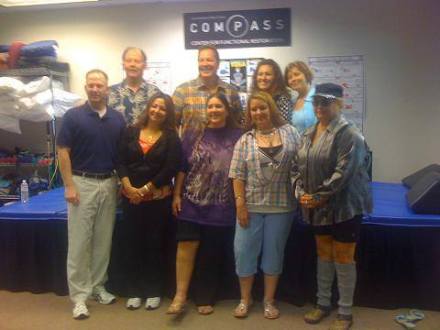
John C. Thomas, PhD, Rick Wurster MSG, MPT, ABP, BCIAC, Leticia Camarena M. A., Tatyana Yatsenko, Larry Lane, Patient, Patient, Twinkle VanFleet, Patient. Compass Center for Functional Restoration Graduation July 17, 2009
I began recording both my P & E. I tracked my “pain” level and my “emotional” level using the same Numeric Rating Scale. The 11 point 0 – 10 scale where 0 represents “no pain” and 10 represents “worse pain imaginable”, “as bad as I can imagine” or unimaginable. I don’t do this anymore because I’ve learned to have the awareness without tracking, but for example at the moment I logged, my E/emotions/stress was an 8 and my P/pain/physical was a 5, I would eventually learn that my pain level would most likely rise anytime. I had to use my cognitive tools right away to reduce my stressors in order to manage the physical pain. I discussed this concept at MDJunction.com when I was a group leader in the RSD Support Forum in 2009.
Life itself can be hard, add pain to it, and it’s even harder. It can be managed with the right tools. It’s never going to be perfect, but we can make it as comfortable or as tolerable as possible for ourselves. Removing or decreasing triggers that instigate pain have eased me. I can’t watch the internet all day. It’s not because I don’t love or care for everyone. It’s because there are pain triggers everywhere. When we see images, graphics, memes of illness or disease scrolling by, especially our own, a trigger can occur. I’ve learned over the years to recognize this. I have the awareness to understand that I can be a contributing factor in my own discomfort.
I never went to preschool and Kindergarten was only for a week or two. I started school in the first grade. I was taught at home and I was reading at advanced levels by the age of 5. My comprehension and spelling ability was always above average. While I either suppressed it or just didn’t care to acknowledge it, I did go to special classes in the first and second grade because I couldn’t pronounce the letter’s S and T in words and sentences properly. I was a critical thinker immediately in life. http://www.criticalthinking.org/pages/defining-critical-thinking/766
By the time I got to my 4th elementary school in the middle of the school year in the second grade, I didn’t have to tell anyone I went to the classes with the special ones. Those new kids and that neighborhood became the ones I grew up with until I left Sacramento in October of the 9th grade to move to L.A. County for my dad’s job. The rest of that year carried with it a bit of insecurity. I started Drama at my new high school and as a Junior I was in second year advanced drama, speech, debate and thespian clubs, involved in school plays, in chamber singers for a while, I swirled the baton too, but chose my priorities and kept to the one’s I still use today. By the middle of the 11th grade I was off to the high desert where my parents bought a home. I’ve been in 4 high schools, 2 Junior high’s due to the district split and several elementary. I learned to adapt young. I may not like it, but I do it fairly well. I’m a survivor of repeated childhood molestation and indirect physical and emotional abuse.
I’ve been an Empath http://themindunleashed.org/2013/10/30-traits-of-empath.html for as long as I can remember. I can vividly still remember leaving my teething ring on the back metal bumper edge of my dad’s best friend’s pickup truck and them driving away with it. I’m hypersensitive to people, places and things sometimes to my own detriment, yet I’m also a no-nonsense girl. I’m inclined to the natural order of things, including man and woman, but I’m not a doormat. I love my crazy and he does, too! Why? Because it’s really not all that crazy, I just like to have it appear so in the midst all the uncertainty in life. Laughing is the best medicine of all. If I can make you laugh, give you something to laugh at even if it’s at my own expense, I’m thrilled to have been of service.”
Sure there are times I think “Dang, no one gets it!” I don’t mean in everyday situations, I mean in my critical thinking. Those who are on the same page fear agreeing openly until my thought, reasoning, even an educated statement that I make is validated by someone with high education, authority or status. By that time I really don’t need the care, concern or acknowledgment. I might have needed it when I was no one to be acknowledged for. No one will ever know in these situations because I’ll not ever treat them any different and there isn’t any animosity, but there is recall. Why? Because everything we do or don’t do to another person makes an impact on them. Those impacts influence the rest of their lives by accumulation in decisions and choices. This includes my interaction with other people.
By the time I was in the 4th grade I was in the MGM program. At that time called Mentally Gifted Minds. My 9-year-old grandson is currently in the Gifted and Talented Education Program (G.A.T.E.).
During the 4th to 6th grade 2 of my class periods were reserved for tutoring the NES (Non English Speaking) students who just joined our Country from Vietnam, and other Southeast Asian communities. I was 8 years old when I began the 4th grade. These years were 1975-1977/78. Due to being bright enough to be a student teacher at such a young age, I missed normal class subject time; I began to fall behind in math studies. My mathematical education is only that of general knowledge. I held enough that I was promoted to General Manager for a Restaurant by the time I was 24.
(Several paragraphs have been removed from the original for this share)
It really is a multi-disciplinary approach to pain care and taking an active role in our own overall well-being that makes the difference between making it or breaking it. Even if we have to fake it to make it to get there.
The West Coast Pain Summit was held on November 14, 2015 at the Elk Grove Public Library Conference Room. In attendance was Lynn Green – Pain Therapist, Medtronic INC (Medtronic.com), Jacie Tourart – PA-C, Spine & Nerve Diagnostic Center (spinenerve.com), MarLeice Hyde – Erasing Pain (erasingpain.com) and Michael Connors, LVN. Harmony Home Care (harmonycareathome.com). We had local and out-of-town attendee’s join us. Our Power of Pain Foundation Delegates Erik and Kharisma VanFleet assisted as needed and 9-year-old ‘Tai Howard offered a friendly smile and a well-behaved demeanor.
Mr. Clete Dodson won our Power of Pain Long Sleeve Shirt chosen from the in person drawing. Monique Maxwell was chosen for our #NERVEmber silent drawing.
My presentation included, but was not limited to:
<Begin>
Welcome to the First Annual West Coast Pain Forum hosted by the Power of Pain Foundation.
This year hosted and sponsored by both the Power of Pain Foundation and Medtronic Neuromodulation.
Our topics today include Access to Care, Advocacy and Neuromodulation with Medtronic Pain Therapies from Medtronic.com and TameThePain.com
Access to Care
Patient Rights
There are 8 key areas to the Patients’ Bill of Rights
You have the right to accurate and easily understood information about your health plan, healthcare professionals, and health care facilities.
You have the right to your choice of providers and plans.
You have the right to emergency services. (Emergency department, urgent care)
You have the right to take part in treatment decisions.
You have the right to respect and non-discrimination
You have the right to confidentiality. (Privacy of healthcare information)
You have the right to file complaints and appeals.
You have the right to your consumer responsibilities. (Take an active role in your own health and well-being. Doctors are only a tool, too. )
Patient Communication
Understand your symptoms
Communicate with caregivers and healthcare professionals
Communication is essential.
Become an expert in your pain
Be prepared when attending your doctor’s visit.
Keep a pain journal.
Write down your questions.
Do you have concerns about your medication, or treatments?
Take notes.
Have a shared understanding of your pain and symptoms.
Get emotions under control.
Be assertive, but listen to others.
Describe your pain. (Don’t just say its pain. Does it burn, stab, pinch, tingle. Does it feel like cutting, aches, or throbbing? Is it localized or all over? Is it instigated by stress, depression, emotions?) Your doctor can’t help you if you’re not able to communicate.
Take someone with you to your appointments.
Take responsibility in reaching goals.
Caregivers: Be mindful and assertive in caregiving. According to the Department of Pain Medicine and Palliative Care at Beth Israel Hospital in New York, a family caregiver is “anyone who provides any type of physical and or emotional care for an ill or disabled loved one at home”. For this definition, “family” refers to a nonprofessional who is called “family” by the person who is sick. Sometimes, family is whoever shows up to help. (IN the FACE of PAIN, 5th edition, page 40)
Patients
Be easy on your caregiver without them you might not have any one to care for you. If you’re both a patient and a caregiver, be easy on each other. No one knows better than both of you.
Reducing Conflicts
Keep one network of physicians. One primary care provider, let referrals be given by only him or her.
Use only one pharmacy. Have medications sent to the same location. Pick them up from that location.
Don’t allow more than one physician to prescribe you an opioid pain medication.
The PDMP/ Prescription Drug Monitoring Program contains records of your prescribing history and is maintained and reviewed for changes in your habits.
When visiting ED’s describe your pain on the 0 – 10 NRS or Numeric Rating Scale which is most commonly recognized in emergency care. The NRS Scale for pain measures the intensity of your pain. It’s the 11 point numeric scale with 0 representing “no pain” and 10 representing “the worse pain imaginable”, “as bad as you can imagine” or unimaginable and unspeakable pain”.
Don’t tell the doctor your pain is an 11 or 20. You may be found unbelievable and your access to timely and proper care may be delayed, or in some instances even denied. You want them ready and willing to assist and care for you without second guessing.
*Adherence
Medications don’t work if we don’t take them. They’re prescribed to be taken as directed. Not doing so can lead to flare ups, increased pain, adverse reactions, withdrawal and misuse.
Examples of non-adherence
Not filling prescriptions
Not picking up filled prescriptions from the pharmacy
Skipping doses
Stopping medication before instructions say you should
Taking more than instructed or at the wrong time of day
*(IN the FACE of PAIN, 5th edition, page 16)
Potential setbacks
Many patients, including myself, have a severe Vitamin D deficiency in addition to the dystrophy caused by their diseases, or syndromes. Dystrophy is defined as – a disorder in which an organ or tissue of the body wastes away. This includes the bone and tissue in the mouth, jaw, teeth, and gums. Access to care can be a setback when our teeth decay, break away, or we’ve lost them as a result. Lacking dental insurance is an issue of its own. Judgement regarding addiction, misuse and drug seeking can hinder care until each time we prove otherwise. Additionally, BiPAP and CPAP use can contribute to dry mouth and decay. Moisture removed from the mouth is another price we pay just to breathe.
AB 374
The California Legislature approved a bill (Assembly Bill 374) the second week of September. Step Therapy required that a patient try and fail (fail first) a medication before being allowed to take the one their physician would have otherwise prescribed for them. AB 374 now allows providers in California to fill out a form to bypass step therapy requirements.
The PA Shuffle: Prior Authorization; information on our efforts can be found at our table, next to our ADF Policy efforts.
An energy assistance program is available through SMUD for qualifying patients who use specific medical devices. You can request the Medical Assistance Program Application by calling the Residential Inquiries number located on your bill.
Each of the above can assist in access and care. ( 7 min ) ^
–
Introduce
Pain Clinic (15 mins)
–
Break, meet and greet, #painPOP info
We’d love to have you take part in our #painPOP in the parking lot after the conference for photos and a bit of fun in raising awareness for National Reflex Sympathetic Dystrophy/Complex Regional Pain Syndrome Month. Our #painPOP campaign is participate or donate. Accept a challenge or donate to our cause.. I challenge all of you to raise awareness for the painful, debilitating and often progressive Neuro autoimmune illness that desperately needs a cure, an understanding for better quality of care, early diagnosis for stabilization or remission, and continued education and support materials, programs, free public educational events and conferences that we provide free to patients, caregivers, the healthcare community and the general public. We can’t do it without the help of awareness and funding. If you didn’t receive your raffle ticket joining us today, ask for one. Check NERVEmber.org tomorrow to see if you’ve got the winning numbers. You’ll be contacted to be sent your prize. Medtronic is up next with a demo, overview and a Q & A session. Enjoy each other!
–
Introduce
Medtronic
–
Advocacy
The Power of Pain Foundation Co-Sponsored SB 623 ( Abuse-deterrent Opioid Analgesics ) with Assemblyman Jim Wood and attended the live press conference held at the California State Capital on March 24, 2015. We will continue to support this bill in 2016. The bill will provide a safer alternative option to opioid medications by deterring several non-swallowing ways opioids can be abused.
Getting involved
You can join our international Delegates team by visiting: powerofpain.org/delegates-of-popf
We’re always looking for committed local volunteer advocates to support our legislative and policy efforts. The Power of Pain Foundation is a member of:
The Consumer Pain Advocacy Task Force (CPATF) which is comprised of national leaders and decision-makers from 16 consumer-nonprofit organizations that are dedicated to patient well-being and supporting the use of effective methods for pain treatment. The State Pain Policy Advocacy Network (SPPAN) first convened these leaders in March 2014 to organize a collective action effort to benefit people with pain. consumerpainadvocacy.org
SPPAN is an association of leaders, representing a variety of health care and consumer organizations and individuals, who work together in a cooperative and coordinated fashion to effect positive pain policy on the state level—policy that guarantees access to comprehensive and effective pain care for all people living with pain. Power of Pain Foundation is one of the original SPPAN partners. sppan.aapainmanage.org/
As POP Advocacy Director (POP 2011-12) and a SPPAN leader since 2013, locals would be working with me, as needed, to attend and represent us at the Capital.
We thank you all for attending today. We look forward to seeing you again next year. Please visit powerofpain.org for our education, awareness, advocacy and access to care missions.
<End>
#painPOP
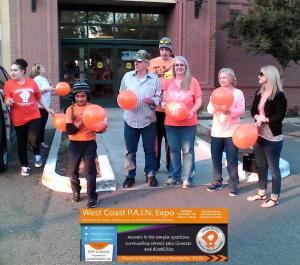
After the conference we popped the pain out of ’em! #painPOP
#painPOP with attendees from WCPS
Published on Nov 14, 2015
#painPOP with some of the attendees from the POP’s West Coast Pain Summit 2015 for neuropathy awareness in #NERVEmber #ihavethenervetobeheard #doyouhavethenervetobeheard #powerofpain http://PowerofPain.org/conditions #ShareAndMakeAware #ParticipateAndOrDonate
Additional photos can be found on the Power of Pain Foundation’s Facebook Page at facebook.com/powerofpain in the 2015 POP Events Album.
–
Lynn Green – Pain Therapist, Medtronic INC (Medtronic.com), Twinkle VanFleet – Advocacy Director (powerofpain.org) and Jacie Tourart – PA-C, Spine & Nerve Diagnostic Center (spinenerve.com).
The 8 key areas of the Patient’s Bill of Rights
Information for patients
You have the right to accurate and easily understood information about your health plan, health care professionals, and health care facilities. If you speak another language, have a physical or mental disability, or just don’t understand something, help should be given so you can make informed health care decisions.
Choice of providers and plans
You have the right to choose health care providers who can give you high-quality health care when you need it.
Access to emergency services
If you have severe pain, an injury, or sudden illness that makes you believe that your health is in danger, you have the right to be screened and stabilized using emergency services. You should be able to use these services whenever and wherever you need them, without needing to wait for authorization and without any financial penalty.
Taking part in treatment decisions
You have the right to know your treatment options and take part in decisions about your care. Parents, guardians, family members, or others that you choose can speak for you if you cannot make your own decisions.
Respect and non-discrimination
You have a right to considerate, respectful care from your doctor’s, health plan representatives, and other health care providers that does not discriminate against you.
Confidentiality (privacy) of health information
You have the right to talk privately with health care providers and to have your health care information protected. You also have the right to read and copy your own medical record. You have the right to ask that your doctor change your record if it is not correct, relevant, or complete.
Complaints and appeals
You have the right to a fair, fast, and objective review of any complaint you have against your health plan, doctors, hospitals or other health care personnel. This includes complaints about waiting times, operating hours, the actions of health care personnel, and the adequacy of health care facilities.
Consumer responsibilities
In a health care system that protects consumer or patients’ rights, patients should expect to take on some responsibilities to get well and/or stay well (for instance, exercising and not using tobacco). Patients are expected to do things like treat health care workers and other patients with respect, try to pay their medical bills, and follow the rules and benefits of their health plan coverage. Having patients involved in their care increases the chance of the best possible outcomes and helps support a high quality, cost-conscious health care system.
According to the presentation at the POPF Midwest PAIN Expo attendee’s learn the importance of the of the “Patient Bill of Rights” (“Patient Rights” 3). (et al.)
We look forward to seeing you next year!
Twinkle VanFleet, Sacramento resident and pain patient. Executive Board Member and Advocacy Director, Power of Pain Foundation.
Since 2012, the estimated rise in addiction and opioid related abuse was an astounding 26.4 to 36 million people throughout the world. The accidental overdose of prescription related deaths were 4 times the amount of similar deaths in 1999.[1] According to the National Survey on Drugs Use and Health, 70 percent of all people who abused prescription analgesics got them from friends or relatives while 5 percent got them from a drug dealer or the internet.[2] While most of the focus has been on patients abusing their medications we must not lose sight that the majority of these patients take their medication as prescribed. The negative innuendos influence the positive conclusion that long-term opioid treatment does in fact give quality of life to not only cancer patients, but non-cancerous chronic pain patients whose pain cannot be controlled any other way.
In an effort to deter abuse and/or misuse in patients, family, friends or associates, decrease the value in street sales, reduce the drug epidemic in certain populations, abuse deterrent formulations (ADF) are beneficial step forward in the diversion of the prescription drug issue.
OxyContin, Nucynta ER, Opana ER, Oxecta, Embeda, and Targiniq each contain abuse deterrent formulations (ADF) or tamper deterrent formulations (TDF). The most common form of abuse is by swallowing the medication. Other forms are chewing, swallowing, snorting, ingesting, inhaling, and injecting for the fast acting euphoric effect. Naloxone is a narcotic that reverses the effects of other narcotic medicines and can be used to treat drug overdose in emergency situations. Naltrexone hydrochloride blocks the effects of opioids by competitive binding (i.e., analogous to competitive inhibition of enzymes) at opioid receptors. Naloxone and Naltrexone are both opioid antagonists and each conclusively block the body from experiencing the opiate and related endorphins. This occurs by binding of the opioid receptors with higher than affinity than agonists, but do not activate the receptors.
TDFs will protect people who decide to modify the medication’s original form by removing the opioid for prompt use and abuse. Otherwise, extraction acts quickly and the time it takes to produce its effects can be immediate.[3]
ADF’s contain ingredients for safer distribution. Patients would continue to receive the management of pain and physicians would be less likely to stop providing access to pain care.
Not all patients should be diverted to ADF or TDF by their physicians. Patient Evaluation and Risk Stratification should be utilized to mitigate potential risks. Pharmacies and insurance companies should not be allowed to replace an Abuse Deterrent Formulation prescription opioid for a similar generic non ADF opioid. The prescription drug abuse issue has brought an adverse impression onto honest patients with incurable and intractable chronic pain syndromes and diseases and has left some pain professionals feeling perplexed.
With the continued development of these safer opioid medications we are contributing to the future of better health and pain care practices. Pain patients must remain a high priority in the midst of the current and ongoing concern that prescriptions will likely be misused or abused. It is imperative that patients be assessed on an individual basis and not as an assumption to the status quo.
We must find a balance that separates patients who truly need opioid medication to live productive lives and those who are abusing them. Responsible patients should not be punished in an attempt to crack down on prescription drugs and opioid abuse. Legislators, health care professionals and pharmaceutical companies must work together to stop opioid abuse while keeping the needs of chronic intractable pain patients in mind.
Patients are being labeled for their chronic pain identity. In the last year or more they have not been receiving their medication management either by their physicians, insurance or pharmacy. In one instance, I was informed that a patient with no history of abuse was being referred to what seemed a drug rehabilitation program in order to get her medication. If she did not comply, she would not receive.
Another gentleman, previously prescribed Suboxone for pain management, now cannot receive opioid managed care because the information in his Prescription Drug Monitoring Program insinuates prescription drug abuse.
Steps need to be taken to ensure that notes are added to the PDMP/CURES database on individuals. Suboxone itself is only an implication without verification for what the medication was prescribed for.
On behalf of those who need, not want, but need medication to sustain quality of life, I call upon our legislative leaders to be proactive in this area. Help stop the abuse without penalizing those of us who are able to live at least a modicum of life due to the effectiveness of these prescription pain medications.
Think about it, as if you’re needing to… no! really needing to, begging to, ease your Mama. Close your eyes and imagine.
I call on you to not make any compromises for a standard not yet met.
America’s Addiction to Opioids: Heroin and Prescription Drug Abuse. Nora D. Volkow, M.D. May 14, 2014.
Senate Caucus on International Narcotics Control. NIH National Institute on Drug Abuse
The first National Pain Strategy Chat was held on September 29, 2015. Hosted by the Power of Pain Foundation with formal guest speakers Bob Twillman, Executive Director of the American Academy of Pain Management, Lynn R Webster VP of Scientific Affairs, PRA HS, Former President of the American Academy of Pain Medicine, Author of The Painful Truth and Christin Veasley, founding member of the Chronic Pain Research Alliance, whose mission is to advance scientific research on prevalent, neglected and poorly understood pain disorders that frequently co-occur and disproportionately affect women.
“The Assistant Secretary for Health and Human Services (HHS) asked the Interagency Pain Research Coordinating Committee (IPRCC) to oversee creation of this resultant National Pain Strategy. Guided and coordinated by an oversight panel, expert working groups explored six important areas of need identified in the IOM recommendations—population research, prevention and care, disparities, service delivery and reimbursement, professional education and training, and public awareness and communication. The working groups comprised people from a broad array of relevant public and private organizations, including health care providers, insurers, and people with pain and their advocates.”
Excerpt from EXECUTIVE SUMMARY Page 3.
National Pain Strategy
A Comprehensive Population Health-Level Strategy for Pain
Attendee’s included but are not limited to, Women in Pain (@forgrace), Gina Salminen (@gnsalminen), American Academy of Pain Management (@AAPainManage), PAINS Project (@PAINSProject), The Pain Community (@PainComm), Fibro and Pain (@FibroAndPain), US Pain Foundation (@US_Pain), State Pain Policy Advocacy Network SPPAN (@SPPAN1), The American Chronic Pain Association (@ACPA), Reflex Sympathetic Dystrophy Association RSDSA (@RSDSA), Community Pain Center (@Our_CPC), Bob Twillman (@BobTwillman), Lynn Webster (@LynnRWebster), Christin Veasley (@CPRAlliance_org), Power of Pain Foundation (@powerofpain), Barby Ingle (@barbyingle), Consumer Pain Advocacy Task Force CPATF http://consumerpainadvocacy.org/twitter-chat/
While I participated to send out Questions, and re-share answers, I used the opportunity to listen instead of voice any thought at this time.
In closing, The Power of Pain Foundation asked – We’ve covered quite a bit today. Would you be interested in a future chat about NPS—if yes, on what? #CPATF #NPSChat
My response- Yes. Q and A’s educate to form solutions and partnerships. Chats provide opportunity for involvement.
This was my only contribution. For those who haven’t read the National Pain Strategy, I encourage you to do so now. We often want to be involved and voice our opinions, we want to help make change, or be there to advocate for our loved ones, or ourselves, yet too often we rely on others to tell us what something is, what it says, or what it’s all about. You have to read it for yourself, otherwise, you’re only receiving pieces and parts and from another’s perspective. I’m not embarrassed to admit a one time read isn’t enough. Neither is the second re-do. It’s in-depth and complex.
Future chats are important for all of us to come together to discuss the report.
After the NPSChat I was asked “@rsdcrpsfire @powerofpain Do you believe Sean Mackey cares? or NIH cares?”
I did exchange further conversation with the person who asked and replying to other questions. And I hope Mr. Mackey does care as my own daughter is now in the care of Stanford, both transplant center and pain management. His job is above caring though. Learning that Dr. Mackey’s parents both live with chronic pain didn’t really impact me. It only means that he does in fact have a personal connection to pain in addition to his education and experiences. It doesn’t mean at all that it will influence him either way. Of course my heart goes out to his parents.
It’s like saying “my best friend is black” to appease a situation of color. Stating a family member has chronic pain is like attempting a nudge toward acceptance. It doesn’t make any difference to me. Actions speak louder than words, so we’ll see and I do mean that with the utmost respect.
For the sake of the NPS and those of you who support it, I support it for you at this time. I’m not entirely certain of its benefits or that it will be implemented properly. Like most strategies, guidelines, and law the benefits are often dismissed when they matter most.
Having been apart of change and implementation for the current California Pain Management Guidelines I’m not naive to opioid prescribing, risks or need.
There are too many guidelines being developed. The CDC, government and state levels. The only people who are going to suffer are those who are labeled with “pain”.
Opioids don’t kill, being irresponsible does. The double-edged sword in under treated pain and prescribing.
Take Our Survey About the CDC Opioid Guidelines September 29, 2015 By Pat Anson, Editor
American Academy of Pain Management’s Executive Director, Bob Twillman, PhD discusses opioid prescribing and regulations on PBS’s Newshour
Forty-six people die every day in the U.S. after overdosing on prescription painkillers, causing some states to crack down. Are tighter laws creating new problems? Judy Woodruff gets views from Bob Twillman of the American Academy of Pain Management and Dr. Andrew Kolodny of Physicians for Responsible Opioid Prescribing.
TRANSCRIPT (Partial)
JUDY WOODRUFF: Each day, 46 people die in this country after overdosing on prescription painkillers. In 2012 alone, the CDC says 259 million prescriptions were written for painkillers, enough to supply every American adult with a bottle of pills.
Now many states are pushing back, including New York, Tennessee, Kentucky, Florida, and Washington State. Three of those states now require doctors to check a patient database before writing a prescription. This year, Massachusetts, Rhode Island, Georgia, and Texas are also considering tighter laws.
But some physicians and patient advocates say this crackdown is creating new problems.
We get two views now.
Dr. Andrew Kolodny is the director of Physicians for Responsible Opioid Prescribing. He’s also chief medical officer for the Phoenix House Foundation. It’s a national nonprofit addiction agency. Bob Twillman is the executive director of the American Academy of Pain Management and also a clinical psychologist at the University of Kansas Medical Center. Mr. Twillman was caught in a traffic jam tonight. He couldn’t make it to the studio, so he joins us by telephone.
Read the rest of the transcript and listen to the podcast-
As the Committee Chairwoman for Advocacy, I would like to emphasize the importance of connecting a unified populace for better access to care.
Our community constitutes a commonwealth of patients with various diseases and who are in various stages of their illness. The Power of Pain Foundation
advocates for several different distinctive medical conditions.
I am now seeking applicants from those interested in joining my committee. These are all volunteer positions. Since I am diverse, I prefer those choosing to
work with me to be also. I appreciate diversity and so does the Power of Pain Foundation.
If you are ready to help work on access to care, abuse deterrent formulations, prior authorizations, specialty tier’s, step therapy/fail first and other
issues that we can tackle together, please contact me.
I am passionate about my role as Advocacy Director. I am seeking 7 individuals who aren’t afraid to raise their voice when needed.
1- Legislative and Advocacy Assistant (National)
1- Research (National)
1- CRPS/RSD (National)
2- Neuropathy/Nerve (National)
2- Help oversee my Region. Region 1 (NW) including Alaska, California (Northern), Idaho, Montana, Oregon, Utah, Washington, Wyoming
While a pain related illness with experience and knowledge is a plus, it is not necessary.
With the position you are interested in, Tell me about yourself and how can we help each other to help others?
List any experience. Please don’t over-think it.
Together, we can!
~Twinkle VanFleet
Executive Board Member/Advocacy Director Power of Pain Foundation


 Caregivers: Be mindful and assertive in caregiving. According to the Department of Pain Medicine and Palliative Care at Beth Israel Hospital in New York, a family caregiver is “anyone who provides any type of physical and or emotional care for an ill or disabled loved one at home”. For this definition, “family” refers to a nonprofessional who is called “family” by the person who is sick. Sometimes, family is whoever shows up to help. (IN the FACE of PAIN, 5th edition, page 40)
 After the conference we popped the pain out of ’em! #painPOP
 Lynn Green – Pain Therapist, Medtronic INC (Medtronic.com), Twinkle VanFleet – Advocacy Director (powerofpain.org) and Jacie Tourart – PA-C, Spine & Nerve Diagnostic Center (spinenerve.com).
 The 8 key areas of the Patient’s Bill of Rights


 RSD Advisory- Where Chronic Pain & Depression Collide