Overcoming Challenging Obstacles

Excerpts from, Overcoming Challenging Obstacles by Twinkle VanFleet below.

The past few years have been a test of strength, endurance, and possibilities amidst constant setbacks to overcome. 5 years after the injury that led to my CRPS, I did go back to school for a degree in Corporate Publishing. At the end of 2006 I took leave to have my permanent Spinal Cord Stimulator implanted and I returned approximately 10 weeks later. Due to not being able to drive any longer, my husband took me and picked me up in between his own full-time work schedule. By 2007, I wasn’t able to keep up any longer. My grandson was born in 2006, too. My husbands first heart attack when he was 37, 2 stent placements, his Diabetes diagnosis, he only used accumulated vacation time for it and returned to work in a weeks time. In 2007, we bought or first home, but he also lost his 13 year career and stability when his company C.S.A.A. (AAA) relocated out of California. I continued to raise awareness for chronic pain, met Trudy Thomas, became a leader at MD Junction’s RSD Support and remained for 3 years. My own support group which I began on My Space in 2003 was moved to Facebook, yet I didn’t move the members with it. I like for people to find us rather than to send out invites or notify. I met Barby through Trudy. My son had a traumatic brain injury in August of 2011 and my husband had a second heart attack within a year. I stayed in the PICU with Ozra for 10 days. In December of 2012 I stayed at the hospital with my husband for the entire 9 days during his quadruple bypass surgery, the first few days I slept in the van. In 2012, I had Gall bladder surgery and in 2013 I had another Gall bladder surgery which included the removal of part of my liver and multiple hemangioma’s. https://rsdadvisory.com/2013/07/17/gall-bladder-fiasco-continued-and-hopefully-the-final-chapter/

2014 my daughters liver disease, our sons birth defect diagnosis from Shriners Children’s Hospital unrelated to his TBI and my surgery to have my SCS battery replaced. Piece of cake, mostly. 2015 started with a bang and 3 weeks of hard Cymbalta, Zonegran, and Clonazapam withdrawal due to WC delaying Rx refills. The other 2 weren’t filled either, but really no effects from them as much as the other 3. I no longer take Clonazapam or get the Lidoderm. It hasn’t been easy, especially when Clonazapam did help and pain management medication was and is already at the lowest minimum. I already do all that I can to minimize my own agony and I practice these coping strategies each and every day. My husband just had surgery to repair a torn shoulder a few months ago and we just learned by MRI he has another tear in his knee. We’re still learning all we can at Stanford for our daughter. Rikki is managing well. My purpose is in helping others, it’s all I’ve ever done one way or another, but it isn’t my passion. I’ve come to realize it can’t be. It’s not the fire flickering about the dancing flames that motivates my spirit to fly. My bucket-list goal survives all this. It’s not writing, I have that. It’s not policy, POP gave me that opportunity again. It’s much deeper than that, at least for me. Our son and oldest daughter are moving in together on the 1st. My man and I will have our home to ourselves. January 26th begins my 16th year. I’m not sure where 2016 will take us, I just know I take a lickin’ and keep on tickin’ … for mine.


Overcoming Challenging Obstacles

“Pain isn’t in our head, but it is in our brain, and our minds. Pain is sent from the spinal cord, sending messages to our brain, back to our spinal cord and up and down those nerve pathways. Pain signals reach our endorphins, limbic system, https://www.dartmouth.edu/~rswenson/NeuroSci/chapter_9.html hypothalamus, where they then affect our emotions and other bodily functions. http://www.medicinenet.com/script/main/art.asp?articlekey=10812

Functional restoration afforded me lessons and insight to be able to push on. Sometimes we already realize these lessons for someone else, but when it’s us, we don’t recognize it the same, we change, unless we change us back.

It’s a daily process to overcome additional challenges brought on by chronic or intractable pain. It’s moment by moment at times. Having to stop something suddenly to practice breathing exercises to decrease a stress situation brought on by either emotion or a spike in pain, bring a rise in blood pressure down, use focal points, imagery or going to my “happy place” in my mind to ease myself.

“I will walk, when I cannot walk I will carry myself, when I cannot carry myself, I will fly” ©2009-2015 Twinkle VanFleet/@rsdcrpsfire Written while attending Compass Center for Functional Restoration
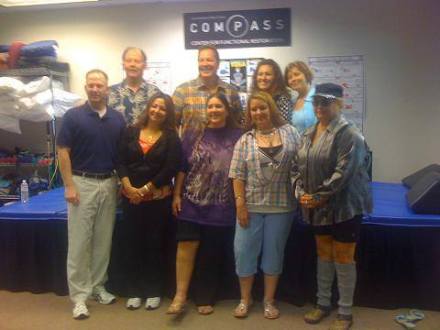
John C. Thomas, PhD, Rick Wurster MSG, MPT, ABP, BCIAC, Leticia Camarena M. A., Tatyana Yatsenko, Larry Lane, Patient, Patient, Twinkle VanFleet, Patient. Compass Center for Functional Restoration Graduation July 17, 2009

I began recording both my P & E. I tracked my “pain” level and my “emotional” level using the same Numeric Rating Scale. The 11 point 0 – 10 scale where 0 represents “no pain” and 10 represents “worse pain imaginable”, “as bad as I can imagine” or unimaginable. I don’t do this anymore because I’ve learned to have the awareness without tracking, but for example at the moment I logged, my E/emotions/stress was an 8 and my P/pain/physical was a 5, I would eventually learn that my pain level would most likely rise anytime. I had to use my cognitive tools right away to reduce my stressors in order to manage the physical pain. I discussed this concept at MDJunction.com when I was a group leader in the RSD Support Forum in 2009.

Life itself can be hard, add pain to it, and it’s even harder. It can be managed with the right tools. It’s never going to be perfect, but we can make it as comfortable or as tolerable as possible for ourselves. Removing or decreasing triggers that instigate pain have eased me. I can’t watch the internet all day. It’s not because I don’t love or care for everyone. It’s because there are pain triggers everywhere. When we see images, graphics, memes of illness or disease scrolling by, especially our own, a trigger can occur. I’ve learned over the years to recognize this. I have the awareness to understand that I can be a contributing factor in my own discomfort.

I never went to preschool and Kindergarten was only for a week or two. I started school in the first grade. I was taught at home and I was reading at advanced levels by the age of 5. My comprehension and spelling ability was always above average. While I either suppressed it or just didn’t care to acknowledge it, I did go to special classes in the first and second grade because I couldn’t pronounce the letter’s S and T in words and sentences properly. I was a critical thinker immediately in life. http://www.criticalthinking.org/pages/defining-critical-thinking/766

By the time I got to my 4th elementary school in the middle of the school year in the second grade, I didn’t have to tell anyone I went to the classes with the special ones. Those new kids and that neighborhood became the ones I grew up with until I left Sacramento in October of the 9th grade to move to L.A. County for my dad’s job. The rest of that year carried with it a bit of insecurity. I started Drama at my new high school and as a Junior I was in second year advanced drama, speech, debate and thespian clubs, involved in school plays, in chamber singers for a while, I swirled the baton too, but chose my priorities and kept to the one’s I still use today. By the middle of the 11th grade I was off to the high desert where my parents bought a home. I’ve been in 4 high schools, 2 Junior high’s due to the district split and several elementary. I learned to adapt young. I may not like it, but I do it fairly well. I’m a survivor of repeated childhood molestation and indirect physical and emotional abuse.

I’ve been an Empath http://themindunleashed.org/2013/10/30-traits-of-empath.html for as long as I can remember. I can vividly still remember leaving my teething ring on the back metal bumper edge of my dad’s best friend’s pickup truck and them driving away with it. I’m hypersensitive to people, places and things sometimes to my own detriment, yet I’m also a no-nonsense girl. I’m inclined to the natural order of things, including man and woman, but I’m not a doormat. I love my crazy and he does, too! Why? Because it’s really not all that crazy, I just like to have it appear so in the midst all the uncertainty in life. Laughing is the best medicine of all. If I can make you laugh, give you something to laugh at even if it’s at my own expense, I’m thrilled to have been of service.”

Empathy Vs Sympathy

http://www.diffen.com/difference/Empathy_vs_Sympathy

Sure there are times I think “Dang, no one gets it!” I don’t mean in everyday situations, I mean in my critical thinking. Those who are on the same page fear agreeing openly until my thought, reasoning, even an educated statement that I make is validated by someone with high education, authority or status. By that time I really don’t need the care, concern or acknowledgment. I might have needed it when I was no one to be acknowledged for. No one will ever know in these situations because I’ll not ever treat them any different and there isn’t any animosity, but there is recall. Why? Because everything we do or don’t do to another person makes an impact on them. Those impacts influence the rest of their lives by accumulation in decisions and choices. This includes my interaction with other people.

By the time I was in the 4th grade I was in the MGM program. At that time called Mentally Gifted Minds. My 9-year-old grandson is currently in the Gifted and Talented Education Program (G.A.T.E.).

During the 4th to 6th grade 2 of my class periods were reserved for tutoring the NES (Non English Speaking) students who just joined our Country from Vietnam, and other Southeast Asian communities. I was 8 years old when I began the 4th grade. These years were 1975-1977/78. Due to being bright enough to be a student teacher at such a young age, I missed normal class subject time; I began to fall behind in math studies. My mathematical education is only that of general knowledge. I held enough that I was promoted to General Manager for a Restaurant by the time I was 24.

I started college when I was 15 in the high desert of California. Law and Acting. I studied both Fundamentals of Crime and Delinquency and Theory and Practice of Acting. I loved being a minor, non-adult, in an adult law class. I loved that my mind was evolving, but it was at a pace others couldn’t keep up with. I loved learning by law enforcement mentors and the few things I participated in to grow and develop lifetime strategies for. I’ve been fond of the Law, Sociology, Philosophy, Theology, Theosophy, The Human Mind, Psychology, Enlightenment, Consciousness. Alternative Lifestyles, Natural Order and the last decade or so Pain Psychology. I like various other topics relating to each of these, too. When I indulge in a book these are the things I enlighten myself in.”  Excerpts from, Overcoming Challenging Obstacles by Twinkle VanFleet (Currently unpublished in its entirety) ©2015 Twinkle VanFleet, Overcoming Challenging Obstacles. All rights reserved.

(Several paragraphs have been removed from the original for this share)


It really is a multi-disciplinary approach to pain care and taking an active role in our own overall well-being that makes the difference between making it or breaking it. Even if we have to fake it to make it to get there.

~Twinkle

Making Complex Regional Pain Syndrome Simple For a Jury

MAKING COMPLEX REGIONAL PAIN SYNDROME SIMPLE FOR A JURY

A start-to-finish strategy for proving the chronic pain and resultant damages of CRPS

When God was testing the faith of Job, the worst punishment was physical pain…. He lost his lands and property, his family – but it was not until physical pain was inflicted that Job broke. (Job 16:6).

A case dealing with chronic pain can be difficult to prove due to the subjective nature of pain itself. This is especially true for Complex Regional Pain Syndrome cases (“CRPS”). CRPS, formerly known as Reflex Sympathetic Distrophy Syndrome (“RSD”), is an incurable chronic pain condition that is often debilitating. For trial lawyers and their clients, this disorder is especially troubling because of the controversy surrounding its diagnosis and treatment. As its very name implies, the disorder is “complex” in nature, is routinely misdiagnosed, and as such, is difficult to explain and prove to a jury.

Take a recent case that had a mixed diagnosis: Some doctors thought it was CRPS, while some did not. In the end, what mattered was our client had severe pain that would likely afflict him for the rest of his life. This was something the jury understood, whether we called it CRPS or not. The primary purpose of this article is to explain the basics of CRPS, highlight some of the challenges in dealing with a CRPS case, and discuss some useful strategies from a recent trial.

CRPS – WHAT IS IT?

CRPS is a chronic pain condition most often affecting one of the limbs (arms, legs, hands, or feet), in which the pain is out of proportion to thc injury. There are two designations of CRPS: Type I and II. Typc I, which this article will focus on, is a result of trauma. Type II stems from a specific injury to a nerve.

Some researchers have said CRPS is potentially the worst chronic pain disorder a human being could endure. Doctors describe the severe cases of CRPS as being higher on the pain scale than childbirth and amputation. However, over the years, pain management practitioners were overzealous in diagnosing chronic pain patients with CRPS. In the early 1990s, “RSD” cases were popping up everywhere, perhaps in part due to the unclear diagnostic criteria at the time. Now, after the hype has calmed and thorough research has flushed out a more clear understanding of the disorder, CRPS cases can and should command the same attention as other severe injuries such as brain and spinal cord injuries.

To begin with, CRPS arises typically after an injury or trauma to the affected limb. For example, a seemingly simple fracture to the ankle eventually causing a severe pain disorder in that limb. The most frightening aspect of the disease is that it often initially begins in an arm or a leg and often spreads throughout the body. In fact, according to the National Institute of Health, 92 percent of patients state that they have experienced a spread, and 35 percent of patients report symptoms in their whole body.

CRPS is characterized by prolonged or excessive pain and mild or dramatic changes in skin color, temperature, and/or swelling in the affected area. These signs can be subtle in nature, or dramatic, depending on the severity of the CRPS.

CRPS symptoms vary in severity and duration. The key symptom is prolonged pain that may be constant and, in some people, extremely uncomfortable or severe. The pain may feel like a burning or “pins and needles” sensation, or as if someone is squeezing the affected limb. The pain may spread to include the entire arm or leg, even though the precipitating injury might have been only to a finger or toe. Pain can sometimes even travel to the opposite extremity. There is often increased sensitivity in the affected area, such that even light touch or contact is painful (called allodynia).

People with CRPS also experience constant or intermittent changes in temperature, skin color, and swelling of the affected limb. An affected arm or leg may feel warmer or cooler compared to the opposite limb. The skin on the affected limb may change color, becoming blotchy, blue, purple, pale, or red. As discussed in more detail below, due to the complexity of the disorder, CRPS cases are often overlooked, misdiagnosed, and not properly worked up.

VETTING A CRPS CASE

As trial lawyers, we appreciate that many of our clients do not have the type of medical treatment and insurance required to get a complete medical workup and diagnosis. Often, an injury like a brain bleed or spinal fracture might go misdiagnosed. With a disorder such as CRPS, this is truly one of the injuries that often require an attorney’s eye and attention to appreciate the client’s dilemma.

The following are a few points to consider when interviewing a client to determine if he or she potentially has CRPS:

• An injury causing pain which is out of proportion to injury,

• Changes in skin texture on the affected area; it may appear shiny and thin,

• Abnormal sweating pattern in the affected area or surrounding areas,

• Changes in nail and hair growth patterns,

• Stiffness in affected joints,

• Problems coordinating muscle movement, with decreased ability to move the affected body part, and,

• Abnormal movement in the affected limb (most often fixed abnormal posture, or tremors of the affected limb).

For a full CRPS potential case checklist, please contact the author.

Find out more about:

What Causes CRPS?

CRPS Diagnosis and Prognosis

How to Deal with Conflicting CRPS Diagnoses

Voir Dire Tips in a Pain Trial

Experts: Get the Dream Team

Dealing with the Defense “Expert”

Making it Simple

via Making Complex Regional Pain Syndrome Simple For a Jury.

COMPLEX REGIONAL PAIN SYNDROME

THE RELENTLESS PURSUIT OF JUSTICE

Complex Regional Pain Syndrome: The Relentless Pursuit of Justice

Causes

Symptoms

Diagnosis and Risk Factors

Prognosis and Treatment

Lawsuits and Damages

Spencer Lucas is a trial lawyer at Panish Shea & Boyle and specializes in complex catastrophic personal injury, products liability and wrongful death cases.  He has extensive experience in cases involving traumatic brain injuries, spinal cord injuries, and chronic pain.

Panish Shea & Boyle, LLP

11111 Santa Monica Blvd #700, Los Angeles, CA 90025

PHONE 877.800.1700

FAX 310.477.1699

Advance Directives – End of Life Issues – California Medical Association

In California, Advance Health Care Directives are the legally recognized format for “living wills.” An Advance Health Care Directive enables individuals to make sure that their health care wishes are known in advance and considered if for any reason they are unable to speak for themselves. An advance directive also allows a patient to appoint a health care “agent” who will have legal authority to make health care decisions in the event that patient is incapacitated, or immediately upon appointment if the patient expressly grants such authority.

For more information, see CMA’s Advance Health Care Directive kits. The kits, available in English and Spanish, include legal forms and wallet identification cards, and answer many of the most frequently asked questions about these issues.

Frequently Asked Questions About Advance Directives

The following are answers to commonly asked questions about Advance Health Care Directives.

What is an Advance Health Care Directive?

An Advance Health Care Directive is the best way to make sure that your health care wishes are known and considered if for any reason you are unable to speak for yourself. Completing a form called an “Advance Health Care Directive” allows you, under California law, to do a number of things:

First, you may appoint another person to be your health care “agent.” This person (who may also be known as your “attorney-in-fact”) will have legal authority to make decisions about your medical care if you become unable to make these decisions for yourself. Although you are not required to appoint a health care agent, CMA recommends that you do so. Appointing a particular person as your health care agent ensures there will be someone you trust to actively participate in the decisions surrounding your health care.

Second, you may write down your health care wishes in the Advance Health Care Directive form, for example, a desire not to receive treatment that only prolongs the dying process if you are seriously ill. Your doctor and your agent must follow your lawful instructions within the limits of generally accepted health care standards. Third, an Advance Health Care Directive allows you to express your wishes about organ and tissue donation.

Is an Advance Health Care Directive different from a “living will”?

The Advance Health Care Directive is now the legally recognized format for a living will in California. It replaces the Natural Death Act Declaration. The Advance Health Care Directive allows you to do more than the traditional living will, which only states your desire not to receive life-sustaining treatment if you are terminally ill or permanently unconscious. An Advance Health Care Directive allows you to state your wishes about refusing or accepting life-sustaining treatment in any situation.

Unlike a living will, an Advance Health Care Directive also can be used to state your desires about your health care in any situation in which you are unable to make your own decisions, not just when you are in a coma or are terminally ill. In addition, an Advance Health Care Directive allows you to appoint someone you trust to speak for you when you are incapacitated.

You do not need a separate living will if you have already stated your wishes about life-sustaining treatment in an Advance Health Care Directive. The Advance Health Care Directive form in CMA’s Advance Health Care Directive Kit includes an optional living will statement that you can select if it reflects your desires.

Is an Advance Health Care Directive different from a “Durable Power of Attorney for Health Care”?

The Advance Health Care Directive has replaced the Durable Power of Attorney for Health Care (or “DPAHC”) as the legally recognized document for appointing a health care agent in California. The Advance Health Care Directive allows you to do more than a DPAHC. An Advance Health Care Directive permits you not only to appoint an agent, but to give instructions about your own health care. You can now do either or both of these things in the same document.

Additional questions, answers and kits –

via Advance Directives – End of Life Issues – California Medical Association.

Commentary-

If you haven’t already, I urge you to complete your directive. Your end of life choices will be honored and upheld. You have the opportunity to add additional wishes regarding your healthcare. Choose your agent(s) wisely. That person will uphold your hopes in the event you are incapacitated for any reason, short term, or long term. Your written word really is your living will.

You can also register your Directive with the Advance Health Care Directive Registry at: 

http://www.sos.ca.gov/registries/advance-health-care-directive-registry/

Please keep a hard copy in a safe place if you haven’t used the registry.

You may also want to consider:

Donate Life California

Mission Statement

“Donate Life California saves lives by inspiring people to sign up with the state organ, eye and tissue donor registry”. – See more at: http://donatelifecalifornia.org/

“One person can save eight lives and enhance 50 others through organ and tissue donation”.

In Your State | Compassion & Choices

Recent Developments

California

Compassion & Choices (C&C) California is campaigning for the End of Life Options Act, which was introduced in the state legislature by Senators Bill Monning and Lois Wolk on January 21, 2015, dramatically accelerating C&C’s 5-year plan to make aid in dying an open, accessible and legitimate medical practice in California. C&C California continues to build bottom-up support at the city and county levels and is driving the grassroots to press for statewide aid-in-dying legislation. At an emotional press conference with lawmakers announcing the bill, powerful C&C advocates spoke out for end-of-life options, including Jennifer Glass, Anita Freeman, and Brittany Maynard’s family – mother Debbie Ziegler, widower Dan Diaz and his brother, Adrian – who returned home to California after Brittany’s death in Oregon.

Read more Recent Developments-

via In Your State | Compassion & Choices.