CRPS/RSD and Chronic Pain: Should We Stop Living Because It Hurts?

We should not stop living because it hurts! I’ve heard so many times if so and so has Complex Regional Pain Syndrome/Reflex Sympathetic Dystrophy or Chronic Pain in general if they go out for the evening, wear a certain type of clothing, shoes, accessories, move their bodies they can’t possibly hurt that bad. Wrong! It means they are not letting the pain and disability rule their lives. They want to live, laugh, enjoy a moment, make new memories, perhaps experience some of the old.

Too often we become trapped in the cycle of isolating ourselves. Maybe even feeling sorry for ourselves. It’s okay to feel that way from time to time it’s not okay to let the illness take over our lives and that which we love. Family, children, goals, dreams and wishes for ourselves.

If you see someone doing something you wouldn’t do or your body isn’t capable of doing please don’t judge them. Maybe all it means is that they are pushing past the pain for a few minutes, a few hours, or a few days. Granted there are people in the world that like to be sick, they crave attention and pity, but not all Chronic Pain Survivors have this mentality. It is not fair to group them into one category. One size does not fit all and it never will.

Some of us use medication to try to survive, other’s have gone off of all medication and use alternative strategies for coping and managing pain, other’s use a combination of both as I do. Just because someone can survive without medication doesn’t mean they feel better than you do it only means they have learned to manage their pain a different way.

If you love to dance as I did, dance! I do! I may last 20 seconds, I might make it through a half of a song, I already know my body is going to pay for it, so why should I hold back because I might end up down for a week after? I shouldn’t and you shouldn’t either! If you love to garden, do it! Pace your activities so you can enjoy your time. If after a half hour you can’t do anymore, don’t. There is a fine line between doing too little and doing too much! Learn you and what you are able to achieve. It doesn’t matter that the next person only lasted 5 minutes or another person lasted an hour. You are you!

Make daily goals. Lists can be helpful. I often have 5 things on my list, my goal is to be able to mark off 3 of them. If I can mark off all 5 it’s just a plus for me and if I only make it to 2 I’ve learned to let myself know it’s okay. Don’t put yourself down for not completing a task just move the one you missed to the top of the list and start again.

I tell myself “I will” instead of “I’ll try” it’s just something I’ve found quite useful after completing my Functional Restoration Program back in 2009. The word “Try” sets me up for possible failure from the moment I say it to myself. “I will” motivates me! There is no pass or fail here. We can or we can’t. We will or we won’t. We are not only individuals but individuals in our own pain,  depression and mindset also.

Many of us deal with depression and/or anxiety secondary to our chronic pain. Close your eyes, relax and go to your happy place. Using imagery can be helpful. Don’t forget to laugh and laugh with others. Laughter produces endorphin’s and endorphin’s decrease physical pain.

Physical pain and depression can be a vicious cycle in itself. Depression causes pain to increase and the pain causes the depression to worsen. Living, smiling, loving, practicing appreciation and gratitude goes a long way in helping us overcome and survive the diagnosis’ we’ve been handed.

While there are times I suffer, I know we all do, I do not consider myself a sufferer, but instead a survivor. I am surviving this! I am alive! It’s been said that pain is that one reminder that we truly exist and for me I believe it. I am reminded every moment of the day that I am living, I am alive.

Be good to yourselves!

Don’t stop living because it hurts, survive the pain and go on.

~Twinkle VanFleet

A New Beginning: My Life with RSD

A New Beginning: My Life with RSD.

The above blog belongs to featured Blog Talk Radio Host Trudy Thomas.

The Living with HOPE Radio Show is Sponsored by the Power of Pain Foundation.


Living with HOPE began in 2007 under the original title Living with RSD. It was Trudy’s hope to learn more information about her own health issue, the debilitating and painful illness RSD/Reflex Sympathetic Dystrophy and with that a show was born. Trudy interviews doctors, therapists, caregivers, and patients; both traditional and alternative practitioners with expertise that runs from prevention to cutting edge technology.

Trudy empowers, informs and educates her listeners with information that may not be readily available in their local area. Through the power of the internet she has the ability to communicate with and speak to some of the most knowledgeable doctors and researchers in the world.

Some Topics have included: Meditation, Biofeedback, Guided imagery, Relaxation techniques, Breathing exercises, Holistic healing, Coping strategies, Distraction, Depression, Spinal Cord Stimulation (SCS), Pain Management, Medications, Chronic Pain Treatments, Ketamine, Calmare (Scrambler Therapy), Cortical Integrative Therapy (CIT®), Mirror  therapy (Mirror Box), DMSO, Low Light Laser Treatment Therapy (LLLT), Functional Restoration, IVIG, Neuropathies, RSD/CRPS, Neuro Inflammatory Disease (NID) and much more.

For more information on how you can listen or even call in please click HERE.

—————————————————

Listeners are encouraged to call in to ask questions of the guests during the show 1-347-884-9691, and if you miss the show you can listen later by clicking on the play button or downloading the shows archive. If you are on the go, you can call into the show through your home phone or cell phone at the above number and listen live. To speak with the host or ask the guest a question press 1, you can still listen to the show while waiting to go on the air, don’t hang up! Your questions and comments are important! A chat room is also available during the live show.

Living With Hope is broadcast live on Monday’s 4:00 p.m pacific and Friday’s 9:oo a.m pacific.

You can post your questions in the chat room to be answered on air. If the time is not convenient to stop by the live shows, you can listen to the archives at any time on the radio page.

Savy Seniors, Trudy’s newest show is live on Wednesdays 3:00 p.m PST. with co-host, Sharon Rowell covering all the latest news about health, medicine, safety, care taking and programs that are available to help seniors live a fun, productive and long life.

And, for fun of course Trudy does a Saturday show, 3:00 p.m PST,  with readings from spirit given by Seers of the Soul and lots of fun music from the 50′s-80′s. Oldies but goodies.

If you are interested in being a guest on any of these shows, please email Trudy at goldfield_nv@hotmail.com.


FAQ: Reflex Sympathetic Dystrophy | The Dr. Oz Show

FAQ: Reflex Sympathetic Dystrophy | The Dr. Oz Show.


Philip Getson, D.O. • Yesterday (July 25, 2013) “I was given the honor of having a post on RSD featured on droz.com Please feel free to comment on it” 
“I am delighted to get the disease the exposure it so deserves”. “Here is the link for the RSD post” These above are the personal words of Dr. Getson, I have quoted. 
http://www.doctoroz.com/videos/faq-reflex-sympathetic-dystrophy


I am delighted that Q & A’s regarding CRPS/RSD (Complex Regional Pain Syndrome/Reflex Sympathetic Dystrophy) made it back to Dr. Oz. via Dr. Getson.

In addition, the differences between CRPS/RSD and Fibromyalgia were touched on.

Paula Abdul tried to do her part in sharing the debilitating outcome this illness causes, but as some of us know television editing can leave a lot out.

Even so I think Paula made her point. There were some people that tried to convince me of how terrible she did, I re watched that segment I can’t tell you how many times and the bottom line is she did great! How much can you do in so little time. It wasn’t an RSD specific show in the first place it was to showcase a vitamin line of healthier living. So yep, good job for what she had to work with.

For Dr. Philip Getson who has been educating and treating CRPS/RSD for decades, I am honored to have spoken to him briefly via email and look forward to again. I also look forward to the P.A.I.N. SUMMIT hosted by the Power of Pain Foundation during Pain Awareness month where he will be Guest Lecturing. I would love to meet him in person and attend the conference in Arizona but if not, I will still be attending via UStream and have already registered.


~Twinkle V.

Gall Bladder Fiasco Continued and hopefully the Final Chapter!

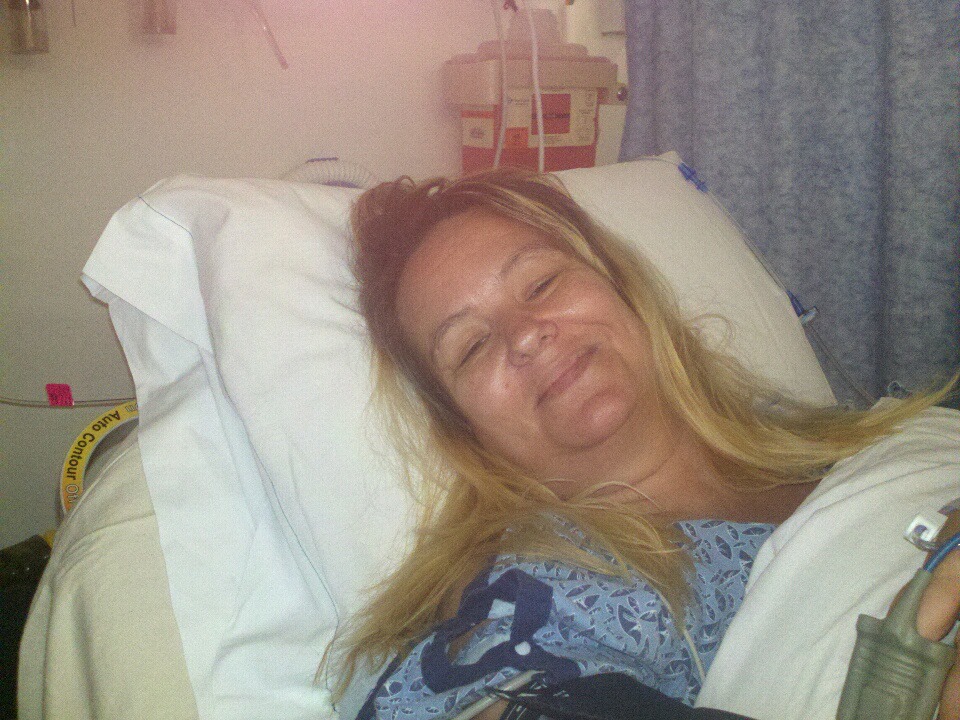
twinklev2ncgallbladdersurgery1

The first part of this story can be found here https://rsdadvisory.com/2013/05/18/endoscopic-retrograde-cholangiopancreatography-52113-due-to-gall-bladder-removal-fiasco/ shared May 18th. I had my ERCP that showed I had Gall Stones hanging out over by the piece of Gall Bladder that was adhered to my liver since March of 2012 when I originally had it removed. The test also showed the lining of my stomach and surrounding areas were severely inflamed. I was given another diagnosis of Gastritis. So of course I waited to see the surgeon again and get my surgery date scheduled. It was scheduled for July 10th, 2013. 1 week ago today!

The surgeon told me that he would try to remove it first like the last time. I would have 4 small incisions. If he couldn’t get it he would have to do a larger cut. I was scheduled for a Laparoscopic Completion, Cholecystectomy, Possible Open, Possible Cholangiagrams. I signed the forms! I had to arrive at Mercy General Hospital at 5:30 a.m that morning for 7:30 a.m surgery. The surgeon told my husband to give him 4 hours, but that he could be done in an hour and a half, but not to worry until the 4th hour. I headed into the OR.

Now I have to laugh about this because I felt my hand zing and then zing again. They were putting me to sleep! But I didn’t go to sleep. So the Anesthesiologist ask me what I did for a living and I went on to babble about RSD/CRPS awareness, educating, working for the Power of Pain, I just chatted them right up and I know they were waiting for me to go down, even gave me more a few seconds or so before, I felt it. I remember looking off and thinking I’m going to go to sleep now and started to say it, but then I woke up in recovery with worse pain than the first time.

TwinkleVMercyGeneralJuly102013

I still have swelling, a lump above my top incision that hasn’t gone down yet. When my doc called me the day after my surgery to check up on me, I told him about it, he said it was because that’s where he beat me up the worse. Funny! I laughed! That is where he had to use the tools and manipulate inside me to peel that piece off my liver, he said it should go down in a few days. I hasn’t yet though. I tried to drop the pain medication yesterday and switch to OTC NSAIDS but when I woke this morning I was hurting so bad from the top incision/lump to the side ones. A feeling of being inner bruised. Understandable really. So I’ve switching back and forth from Norco 10/325 to 4 OTC Ibuprofen. The Ibuprofen will help the inflammatory more than Norco will. Tylenol doesn’t touch that type of pain for me.

I was also mentioned to me that I have Crohn’s Disease. It’s a lot to process. My Gastrointestinal problems have become so bad that it seems the likelihood of internal CRPS is more my situation. I’m not going to mention all the symptoms right now, I’ve mentioned some of them in my group, on my facebook timeline, I just really need to find a doctor, a GI or Internal Medicine that is educated in RSD/CRPS, not one who has only heard of it. That was my experience with this surgery, a few heard of it, no one “knew” about it. My own primary doesn’t know “about” it. I had to educated him with just pieces as there is never enough time for it all.

I’m lucky to keep food down, even things to drink, I have to pick and choose carefully, the doc did also send me home with the generic for Prilosec to take a half hour before I eat anything first time each day. I either have diarrhea or can’t potty at all for weeks.

It seems the surgery has eased the pain over under my ribs on the right, but so far the mid back pain and other pain is still here. I had my SCS checked 2 days before my surgery by my Medtronic Specialist. It’s fine!

When the surgeon removed that piece of Gall Bladder it was full of fluid and was growing new tissue. He was able to remove several stones from that same area. The pathology is already back and it was negative for any cancerous cells.

On Monday when I had a follow up to my OBGYN due to inflammation found on my Uterus and the cyst(s) found on my right ovary which is larger than my left side and includes scar tissue as does my lower belly from left side to the entire right from an ectopic and exploratory surgery many moons ago.  I opted for what I believe is called Nexplanon. I could have also tried the Depo or an IUD. Never again to an IUD for that is how I conceived my Ectopic twins. And I’ve tried Depo Provera  and didn’t believe since these were my only options it was right for me. Normally the implant with is a small flexible tube is used as a form of birth control which can last up to 3 years and it stops the menstrual cycle. Yay! It was implanted beneath my inner left arm. The reason I opted for this was that my other option was a full Hysterectomy. This option buys me some time. I am not ready for more surgery yet. If at all. First of all it’s not safe for those of us with RSD/CRPS and secondly repetitive surgeries just aren’t safe for any of us. We always have to decide in the end what is best for us by weighing the pros and cons to it all.

If your doctors aren’t aware of your RSD/CRPS, please educate them. I do in pieces and portions but we only have so much time in each appointment. If need be take information and have it put in your file. In fact, that is exactly what I’m doing for my 24th follow-up with my surgeon and when I see the other’s next, same for them. My surgeon seems really great and caring. To call my husband at home to check on me and then asked to speak with me for a few moments even though I was resting, I respect that. You don’t get that much now a days. I think he will be appreciative, not upset or offended. Not the people should be, yet sometimes they are, especially when the info comes from no medical degree persons like myself. Some become quite offensive, also. They assume we think we’re know it all’s! Farthest from the truth! So I’ll hand off the info which will include more than 1 source and see which one actually has a broader perspective the next time I see him.

While I’m sure it’s happened before, no one from my surgical team had heard of it and no one from my doctor’s offices had heard of it…

Nor from my own communities online and off, family or friends.

I actually gave birth to a Gall Bladder twice! Just different sizes!

So glad it’s over and I’m on the path to healing again.

One down!

~Twinkle VanFleet

CRPS Survivor

Seeking Photos for the Video Slide Show Presentation “People Striving to Make a Difference in the Lives of Those Suffering and Surviving CRPS/RSD”

People Striving to Make a Difference in the Lives of Those Suffering and Surviving CRPS/RSD.

Hi everyone!

I’m seeking Photos for a future video that will feature those of you who strive to make a difference in the lives of those with Complex Regional Pain Syndrome/Reflex Sympathetic Dystrophy.

Once all photos are in it will be fairly decided who will be featured in the video. Space will be shared with other’s who work just as hard yet has either never been or has rarely been recognized for their efforts. September is Pain Awareness Month and if all goes well this video will debut during that month.

Your photo can either be a head shot or a body shot. Send up to 2 photos, if you like!

Along with your photo, in the email body, please include:

1. Name, Foundation, Organization, Website Name, Blog Name, Radio Station, Etc. (You can also list all of the above)
2. City and State. (Or  Province/ Country) (This video is not limited to the United States)
3. A brief bio on what you do (or have done) to make a difference in the lives of those suffering to survive CRPS/RSD. If the bio is too long it may be edited for space.

If you are a Mother or Father taking care of your CRPS/RSD diagnosed child, you are making a difference in the life of someone. If you are a child (adult or minor) of someone with CRPS/RSD and you are caring for your parent, you are making a difference, too.

In your email please add that you are giving me permission to use your photo and info. (I, (your name/organization), hereby give my permission to Twinkle VanFleet and RSD(S)-CRPS Advisory to use my photo and enclosed information for the Video Slide Show Presentation People Striving to Make a Difference in the Lives of Those Suffering to Survive CRPS/RSD that will be made public via YouTube.

I have personally invited a few people to be featured. If you do not get a personal invite from me this does not at all mean that I would not love to feature you. Please don’t feel shy or as if you aren’t good enough or haven’t done enough. You are just as important! This will be an annual project! No one will know from me if I’ve contacted you or if you sent on your own. That will be your business to disclose or not! ~smiles

Deadline– August 15, 2013. If you need a few day extension due to pain, please let me know before the deadline.

Please send to: submissions@crpsadvisory.com

If you have any questions, don’t hesitate to ask. 🙂

Thank you!
~Twinkle VanFleet

Independent RSD/CRPS Patient Advocate, Spokesperson, and Educator.

California Ambassador at the Power of Pain Foundation

Cortical Integrative Therapy with Dr. Victor M. Pedro on Living with HOPE Radio Show with Featured Host Trudy Thomas

Living with HOPE Radio Show with Host Trudy Thomas LogoThe following information has been taken from notes as a listener to the show and research, nearly all the words themselves belong to Dr. Victor M. Pedro. I take no credit for these. My goal is to get this non invasive seemingly promising information out so that other’s may find it a hopeful treatment program in their journey with CRPS/RSD, Chronic Pain, TBI’s and other illnesses and conditions.

Yesterday on the Living with Hope Radio show with Featured Host Trudy Thomas and Co Host Barby Ingle . Dr. Victor M. Pedro discussed Cortical Integrative Therapy (CIT®) a technique he uses and developed.

The entire show can be listened to here: http://www.blogtalkradio.com/thebodymindandspiritnetwork/2013/05/29/living-with-hope-with-host-trudy-thomas  The Living with HOPE Show is Sponsored by the Power of Pain Foundation.

Dr. Victor M. Pedro’s career began as a Chiropractor and continued on with a Post Graduate in Functional Neurology. He says ” it was a very good starting point for brain function and innovative treatments that could begin to make a difference in peoples lives. He was fortunate enough to receive grant funding from the Rhode Island Legislature which permitted him to do a variety of studies and to study with significant people to get a more in depth and cutting edge picture of what was available in Neurology and how the brain functioned.

Trudy asked ” Does this therapy work for other conditions other than RSD? Dr. Pedro stated Yes! What he wanted his contribution to be is the person credited with creating an algorithm for understanding where in the nervous system to intervene.”

There are plenty of resources that will explain what a brain dysfunction is or pathology is, disease process or diagnostic procedure to figure out what folks are complaining about.

The rehabilitative model is where the challenge for the future lies.

Barby ask’s “Does every patient have a different algorithm? Or do you find they are similar with the same condition? The doctors answer’s ” By algorithm I mean a process we go about to evaluate what the affliction is or what’s wrong with the patient.”

Reflex Sympathetic Dystrophy or Dysautonomias in general are a condition Dr. Pedro has a particular interest in. With this condition he tries to find out how the autonomic system is dis-regulated or not working well and then his team tries to decipher in the patients does this person have Reflex Sympathetic Dystrophy (RSD) because the Sympathetic Nervous System is too high and not being inhibited or is it the Parasympathetic System that’s undergone demise and not effective.

“The treatment is actually different and makes all the difference in the world to the patients outcome, Dr. Pedro say’s.”

Barby ask’s ” Similar to Traumatic Brain Injuries (TBI’s) Would there be a different protocol for that?

Dr. Pedro answer’s “A different protocol in terms of how we’re going to add on different diagnostic pieces to the evaluation. Then we begin to identify precisely which modalities the patient needs. A TBI patient may have a similar pathology of an RSD/CRPS patient, may have similar findings, however we may go about the treatment process slightly differently.”

One of Dr. Pedro’s patients and a good friend of Barby Ingle’s just did an interview which will be released in this Saturday’s (June 1, 2013) edition of Pain Pathway’s Magazine. Please look for it!

Physical, emotional and nutritional needs are also taught this during treatment.

The autonomic nervous system delivers fuel to the body and brain. The autonomic nervous system is the automatic part of the nervous system that controls your heart rate, size of arteries delivering blood or fuel to the body and into our brain itself. This part of the body can be evaluated through a series of tests.

Someone with a compromise in their sympathetic nervous system may not have as much profusion as should be present. The long term consequences are considered regarding how this is effecting the tissue and that’s why the trophic changes present in this pathology.

Barby ask’s “Is maintenance treatment required or is this a one time process?”

Dr. Pedro states “The evaluation process takes 2 to 4 hours depending on the patient.” Based not only on tests, but the patients ability to participate.”

At the end of the evaluation we attempt to draw for them what we believe is wrong in the nervous system and make an educated hypothesis as to where the dysfunction is and what can potentially be done to correct it. A series of windows of observation, sympathetic, autonomic windows of observation more appropriately. We identify these at the end of the initial observation and we give the patient a treatment to see if their pain level comes down significantly or at least appreciatively.

That signals to us they are a good candidate for our program.

Dr. Victor M. Pedro is founder and president of Rhode Island Integrated Medicine, located in Cranston, RI.  An accomplished, Board Certified Chiropractic Neurologist, Dr. Pedro pioneered the development of Cortical Integrative Therapy (CIT®)—a breakthrough, research-based treatment designed to address brain and neurological dysfunction in both children and adults.

After remarkable success using CIT® to treat school-age students diagnosed with speech, attention and learning disabilities, Dr. Pedro applied the treatment for use in patients with Reflex Sympathetic Dystrophy or CRPS, dysautonomias, and traumatic brain injury (TBI).

Over the years, Dr. Pedro has lectured extensively on CIT® as a non-invasive, cost-effective treatment for TBI, pain syndromes, dysautonomias, and other brain-related disorders.

Cortical Integrative Therapy (CIT®) has been successful in treating a wide range of painful and debilitating conditions including: ADD/ADHD; apraxia; ataxia; chronic pain; dystonia; dysautonomias; hypotonia; memory difficulties; movement disorders; Parkinson’s disease; Reflex Sympathetic Dystrophy (RSD)/Chronic Regional Pain Syndrome (CRPS); RLS; sciatica; traumatic brain injury; tremors; and vertigo, balance, and gait problems.   ©Rhode Island Integrated Medicine

Other keywords in the interview- Inhibitory system, Renshaw cells, Autonomics, Small diameter fibers, Dysautonomias, Limbic system, Antonio DeMazio

http://corticalintegrativetherapy.com/ Cortical Integrative Therapy Rhode Island Integrated Medicine- The Brain Rehabilitative Specialists

http://corticalintegrativetherapy.com/blog/ NBC 10 Health Check Special Report: TBI & CIT® March 04, 2013

~Twinkle VanFleet, California State Ambassador Power of Pain Foundation

If I have mis stated any facts or quotes please contact me at: caambassador@powerofpain.org  I will make any corrections immediately. Thank you!

RSD Patient Seeks Community Support

In a telephone interview yesterday May 14, 2013 a Reflex Sympathetic Dystrophy patient stated she has temporarily lost custody of her 16 year old son to Department of Services for Children, Youth and Their Families (DSCYF) and they are trying to remove her 9 year old daughter. The patient from Delaware shared that the vibrations and sensitivity to her hearing has been documented by her doctor and that children services believes she has a mental disorder.  Apparently a case worker for the State did a search for CRPS/RSD and found an article which included “Emotional Disturbance” as part of the condition and is using this against her.

Let me try to be more specific while CRPS/RSD can cause a number of secondary symptoms it absolutely does not mean everyone will have them. Unless your doctor has diagnosed you with a mental disorder I do not think this type of state worker is qualified to do so this way. And certainly not by Google search.

Jim Moret, Host of Inside Edition, Attorney and Author of The Last Day of My Life describes his own journey with his son’s CRPS diagnosis in When Pain Becomes the New Normal. 

Many of us already face the stigma involved with Complex Regional Pain Syndrome formerly known as Reflex Sympathetic Dystrophy first discovered during the civil war by Silas Weir Mitchell. It is not a mental disease or disorder. It is a physical condition which begins with physical characteristics and symptoms.  www.powerofpain.org  www.rsds.org

Because this illness is so misunderstood and because there are still so many that are uneducated regarding it’s existence patients face anything from “but you don’t look sick” to “you must be a drug seeker”.  This disease does not discriminate! Even children can develop it.

A very high percentage of us, I don’t have the exact statistics, yet I’d guess it to be in the high 90 percentile were active members of society, we worked, raised children, were active in our lives, if single parents raised children alone, some of us had everything, others like myself had enough to just be happy.

Now let me ask you this…

Why would we give all that up for this?

I admit I worry about the single mothers out there with CRPS/RSD who lack family support.  Especially when the family does not believe in the illness and when the patient is on disability and the family thinks the patient should be working. Again no education and understanding.

Many don’t even want to know. Do you know how many times I have listened to patients tell me how they tried to reach out to their families, spouses, children with educational material, videos etc, just to learn those people were not interested?

To me it’s no different than learning about Parkinson’s, Heart Disease, Diabetes or any other illness. Would you be interested in that?

This is why ongoing awareness for Complex Regional Pain Syndrome/Reflex Sympathetic Dystrophy is so very important and why the power of community is just as important.

There are many disabled parents out there in the world caring for their children.

Each CRPS/RSD patient should be treated on a case by case basis, we should not all be clumped together, one size does not fit all, but the diagnosis is the same.

Autumn asks for your help. She asks that anyone who can come forward to write a letter on her behalf, make a phone call or support her in any way to email her at: Autumn Stevens

~Twinkle VanFleet

RSDSA Integrated Solutions to CRPS Conference May 10, 2013- The Experience!

RSDSA Integrated Solutions to CRPS Conference May 10, 2013

The Experience by Twinkle Wood-VanFleet
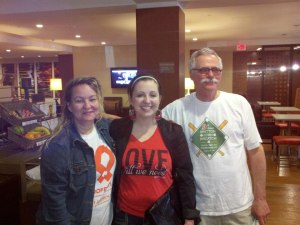
TwinkleVanFleet-KaitlynPintor-JimBroatch

My husband Erik and I left Sacramento California at approximately 5:15 a.m Friday morning to head to the Reflex Sympathetic Dystrophy Assocation’s Integrated Solutions to CRPS Conference located in San Francisco California at the Double Tree Hotel Burlingame.

I was attending on behalf of the Power of Pain Foundation as their California State Ambassador, CRPS/RSD Advocacy, New CRPS information, Solutions, Reviews, Community, Friendships and the RSDSA for without them coming to San Francisco I would have never made one of their conferences for years if ever.

We arrived shortly before 8:00 a.m for registration check-in. Everyone at the RSDSA check in table was kind and very helpful.

We located our seats and chose not to sit too close to the front, but on an isle so that I would have easier access to move about as needed. So that some do not misunderstand this was not only due to my CRPS, I am pre surgery for another issue as well.

As we were getting coffee, Kaitlyn Stevens Pintor of the Bay Area Support Group and Guest Speaker at the Conference found me and introduced herself. We know each other online, but this was our first in person meet. She called me beautiful on 2 separate occasions, which made me blush, since she is really the beautiful one. She was also very kind and upbeat.

I know that many probably did not expect for me to have so many body piercings. Specifically my face. While they are included in all my online photos I can not always be certain if they are noticed or not. Judgement did cross my mind but was hoping since most already knew me online I would be judged by that, if anything. I am not ashamed of the piercings. I will go on to explain why in a moment. One thing I am very embarrassed of however is the decline of my teeth. The severe injury that caused my CRPS type 2 was in January of 2001. My teeth were perfect! By 2004 I had lost a filling, now I will lose all of my top teeth and need a full denture. It’s not just that I will lose them but the condition of them is beyond awful. Between medications and the CRPS that is where I am at. Without funds I’m at a stand still.

Lets move on.

Dr. Pradeep Chopra MD began discussing the Nervous System, Central Nervous System, Glia Cells, Central Sensitization, The Peripheral Nervous System.

He discussed how all sensations eventually travel to the Central Nervous System.

Pain signals from the body are processed even before they reach the brain.

CRPS  is a dysfunction of the processing system.

In CRPS a barrage of pain signals from the body reach the spinal cord and a number of changes take place.

As the spinal cord and brain becomes flooded with this barrage of pain signals the nerves in these structures become hypersensitive.

NMDA receptors are activated

Glia Cells are activated.

Central Sensitization causes activation of certain receptors called NMDA receptors.

Decreased sensitivity to opioids.

Opioids, CRPS and Glia DO NOT get along.

Ketamine was approved in 1970 as an anesthetic.

Ketamine blocks NMDA receptors.

In CRPS it decreases central sensitization.

Rough estimates. 85% show improvement in their daily lives, reduction in their medication. It is not a cure! It helps the quality of life.

Low dose IV Ketamine administered over 4 hours. Increase based on response.

Follow up boosters on out patient basis as needed.

There is a sublingual (under the tongue or cheek) Ketamine Troche to be used in emergency flare up situation only.

Again Opioids and Narcotics are known to activate Glia though a receptor that is distinct from classical opioid receptors.

Dr. Peter Abaci MD and John Massey MD

Bay Area Pain and Wellness Center

Functional Restoration Program (FRP)

Pain can become a disease in itself!

Restore Function!

If you are from the Bay Area please look these doctors up.

Book- Pain Brain- Peter Abaci MD.

As many of you know I went to the Compass Center for Functional Restoration under Dr. Michael Levin MD of the Sacramento Pain Clinic and Director of Compass and Rick Wurster MSG, MPT, BCIAC who taught me so much at the program. I have life long support and can attend each Monday for the rest of my life. Please attend one if you can. It not only helps your physical body but all psychological aspects of pain. It can truly change your life.

Kaitlyn Stevens Pintor of the Bay Area Support Group

Building  Community, real and virtual, organizing support groups both online and offline, weekly, monthly, annual fundraising and much more. Commitment!

On to more

DMSO 50%

Vitamin C can prevent CRPS after fractures. 500 mg for 1.5 months. Incidents of CRPS dropped significantly. (It doesn’t hurt to try)

Neurotropin- Available only in Japan. It helps with Allodyna and hyperalgesia.   (It is in Clinical Studies here)

Service Dogs.

Inflammatory- Cytokines, Substance P, NGF, CGRP, TNF, IL-6

excite and sensitize pain receptors

Neurogenic inflammation

Inflammatory cytokines are associated with Central and Mechanical

Amplification

Hyperalgesia is an increase to sensitivity.

Allodynia is pain caused by non stimuli.

CRPS is associated with thermoregulatory problems.

Somatosensory Cortex

Body Distortion

Image Changes

The involved limb in perceived as larger.

The person can become hostile toward that limb.

They can disassociate themselves from their limb(s).

Changes are reversible and get better with time.

CRPS leads to substantial reorganization.

Primary Motor Cortex- Controls the voluntary movements of the body.

CRPS can lead to wide spread impairment.

Dystonia is involuntary movements of the body. (Changes in the motor cortex)

Brain Remapping. Example- Mirror Therapy (Mirror Box Therapy)

Avoidance/Fear Avoidance

Pain –> Fear–> Behavior Changes

Sharon Weiner- Don’t let RSD/CRPS define you and much more!

I also had the opportunity to meet Dr. Mark DeBruin of  DeBruin Medical Center in Sacramento Ca.

While all of the information above was taken by hand written notes at the RSDSA Conference the original information and credit belongs to Jim Broatch, The RSDSA, Pradeep Chopra MD, Peter Abaci MD, John Massey MD (Bay Area Pain and Wellness Center), Sharon Weiner, and Kaitlyn Pintor.

I had the opportunity to lead Group 3 of patients at the conference. The question was asked earlier in the day “What is the best advice you’ve ever been given (throughout your journey with CRPS). At first I was quite nervous, but once settled it all came quite natural. Thank you Kaitlyn! I brought up the idea to Kaitlyn about writing each patients answer down and we did that! They were turned in at the end of the conference. I was honored to be chosen to lead Group 3. Thank you so very much again! I loved meeting and talking on an individual basis with each and every one of them.

My own answer to this question was when I wake up each morning to not tell myself  how horrible or painful of a day it will be… when I have no way of knowing it yet.

I know it takes time to learn that one! So often we tell ourselves it’s just going to be that painful, but it doesn’t always have to be. Practice keeping those emotions down and your pain can be lower too.

Back to my piercings. I explained it during our group 3 session. I did not have these piercings pre injury/CRPS. I did it to divert my CRPS pain and while it only lasted hours to days it sidetracked me enough at the time. I was a late diagnoses. Again I was injured in Jan 26 of 2001, and while I went through the surgery to attempt to repair and another to remove the screw and 8.5 months of hard PT after etc etc, I was not diagnosed until 2003, did not get to Dr. Levin at Sacramento Pain Clinic until 2004 (second opinion and confirmation) and didn’t get a first block until 2006. That same year my trial spinal cord stimulator and permanent SCS were implanted. So I did a few stupid things including causing myself bodily harm. I no longer do those things but I can walk in the shoes of others who suffer. I suffered to survive. I hurt every day but I am alive! And now these piercings are me and I have to love me. Thank you to that group for understanding almost instantly however shocking it may have sounded initially.

And finally we were not able to stay for the 2nd day’s Cruise around the Bay, but at last minute did decide to stay the night. We did that for a couple of reasons. One was to get to know those present even more, another we were already so very tired having hardly slept the night before and up at 4 a.m for the trip, we rarely ever ever get out and about with others and it was mom’s day weekend. His gift to me! Along with baby roses he stashed here at home that he gave me today. I can plant them later.

We truly enjoyed our time with you, each staff member,  patients and caregivers.

The slide presentations are located at: http://www.rsds.org/education.html

~Twinkle Wood-VanFleet

California State Ambassador Power of Pain Foundation

Founder- RSD(S)-CRPS Advisory www.CRPSAdvisory.com

Founder- RSD(S)-CRPS Advisory Info & Support Group

https://www.facebook.com/groups/RSDCRPSAdvisory.InfoSupport

Founder- Help The Power of Pain Foundation Assist Those with RSD/CRPS and Other Neuropathic Conditions

Founder- Causes Page same name as above- http://www.causes.com/CRPSA4POPF

Founder- Voices Carry- Where Your Voice Is Heard

This is a CRPS/RSD and Health Information Resource!
A page dedicated to sharing all things related to Complex Regional Pain Syndrome (CRPS Type 2)/Causalgia and Reflex Sympathetic Dystrophy (RSD/CRPS Type 1) and Health Topics.

Power of Pain on Facebook https://www.facebook.com/powerofpain

If I have written or stated anything  offensive or in error, please contact me at:

If regarding the POPF:  Twinkle VanFleet caambassador@powerofpain.org

If in general:  Twinkle VanFleet Twinkle@crpsadvisory.com


A few photo’s of the conference itself, the evening after and the next morning. Each photo belongs to it’s rightful owner.


RSDSAConferenceSFMay102013PhotobyCaseyCashman_1


2013-05-10_LorieEnriquez.JoHewitt.TwinkleVanFleet.CarusCulver.RSDSA.ConferenceTakenbyErikVanFleetjpg

TwinkleVanFleet.KaitlynPintor.JimBroatch_FromKaitlynsAlbum1

TwinkleVanFleet.RSDSAConferenceSFMay102013PhotoByYongWooLee_12013-05-10_MaryandJon1

2013-05-11_YongWooLee.KaitlynPintor.JimBroatch.KaitlynsDaughter.CaseyCashman.RSDSAConferenceSFTakenbyTwinkleVanFleet 2013-05-10_BethandTwinkleRSDSAConferenceSFTakenbyErikVanFleet

TwinkleVanFlleet.LisaKaye.RSDSAConferenceSFMay102013PhotobyLisaKaye

2013-05-11_YongWooLee.JimBroatch.KaitlynPintor.CaseyCashman.RSDSAConferenceTakenbyTwinkleVanFleet

2013-05-10_BethandTwinkleRSDSAConferenceSFTakenbyErikVanFleet1 2013-05-11_ErikVanFleet.RSDSAConferenceSFBayDay2TakenbyTwinkleVanFleet 2013-05-11_TwinkleVanFleet.RSDSAConferenceSFBayDay2b

I will be attending the RSDSA’s Integrated Solutions to CRPS Conference on Behalf of the Power of Pain Foundation May 10, 2013

I am really excited to announce that in 4 days I will be attending the Reflex Sympathetic Dystrophy Assocation’s (RSDSA) Integrated Solutions to CRPS Conference at San Francisco California’s Airport and Double Tree Hotel.

I will be attending on behalf of the Power of Pain Foundation.

I am eager to learn all that I can while there so that my knowledge regarding CRPS/RSD continues  to expand.

I am very much looking forward to meeting the RSDSA team, listening to Guest Speaker’s, and meeting those attending from various Reflex Sympathetic Dystrophy (RSD) and Complex Regional Pain Syndrome (CRPS) Communities both online and offline.

I look forward to writing all about it after the conference.

Thank you Ken Taylor,  Barby Ingle and the Executive Board of the Power of Pain Foundation.

~Twinkle Wood-VanFleet

California State Ambassador- Power of Pain Foundation

CRPS/RSD and Suicide

Over the years we have heard that suicides for CRPS/RSD (Complex Regional Pain Syndrome/Reflex Sympathetic Dystrophy) patients is the highest of all suicide rates.

This may not be as necessarily true as it seemed. This also does not entirely mean it’s false.

The following is an excerpt by the Reflex Sympathetic Dystrophy Syndrome Association (RSDSA) –

Suicide and Complex Regional Pain Syndrome (CRPS)
On June 23, 2012, Jill Harkany-Friedman, PhD, spoke to the RSDSA Board of Directors and invited guests on the topic of CRPS and Suicide Prevention. Dr. Harkany-Friedman is the Senior Director of Research and Prevention for the American Foundation for Suicide Prevention (AFSP). RSDSA asked Dr. Harkany-Friedman to speak because of recent suicides in the CRPS community. She assured us that although most individuals have fleeting thoughts of ending one’s life, suicide is relatively rare (12 out of 100,000). Furthermore, 90% of those who die by suicide have a diagnosable mental disorder, i.e. depression, anxiety, alcohol or substance abuse, and a potentially treatable mental disorder. We are posting her PowerPoint® presentation for your information.

I respectfully give all credit to the RSDSA for the above information.

While I respect the educated view of Dr. Harkany-Friedman the thought presents itself that she seems to be stating that nearly all those CRPS related suicides indeed had and underlying mental disorder therefore was the reason they took their own lives. I am not certain though. The estimates were on an over all amount of suicide percentages rather than CRPS specific.

I do apologize in advance for any misunderstandings.

I have rarely ever used offensive language in my posts, but in order for the general masses to understand what I mean in a blunt manner, I will come right out and say it, “Chronic severe pain is a mind and head fuck”. It becomes mental. We all know, at least most of us do, in order for us to feel pain, our brain has to feel it first.

That’s why coping strategies, meditation, relaxation, bio feedback, breathing exercises, guided imagery, aroma therapy and so many other techniques are necessary tools for the management of pain.

I have a hard time believing each of the CRPS suicides also had a mental disorder. Of course we’re mental. That doesn’t mean we have a mental disease, also.

It’s not all in our heads it’s in our bodies!

This also bring up another thought and that is if those suicides were CRPS misdiagnosis’. I hate to bring this up but there are some people who desire to be sick, who seek attention, who thrive on pity, who watch and listen to others for their symptoms so they can take what they learn to their own doctors and claim the same illness. Those people would have mental disorders.

In these cases I would hope the doctor’s were watching the objective findings rather than only listening to the subjective.

A little example,

30 people on a plane

Someone starts coughing and gagging suddenly, itching themselves all over. Making a scene for all to notice.

The person gets out of his seat and stumbles into another passengers and coughs all over him.

That person begins to worry he is catching something. He starts to itch himself.

Suddenly others are doing the same.

Next thing you know every one is hacking, coughing, itching and going nuts.

They all think they’ve contracted some illness, epidemic..

The problem is no one has it’s all in their heads. They only believe it to be true.

The first person never had anything at all. It was just a test.

This only goes to show the power of suggestion.

For some reason I tend to think that if deaths were related to CRPS/RSD we wouldn’t know that it was. Somehow some way it would be found and reported that that there was a psychiatric condition present or un diagnosed and that was the reason behind the suicide. Since nearly all CRPS/RSD patients have been diagnosed with depression secondary their illness, I have a feeling the depression would be used as the cause and not the horrible pain itself.

Suicidal ideations would be almost natural for anyone going through a painful hardship. The mind tries to free itself from ongoing pain and turmoil. It may plan and think of ways out, do things it wouldn’t normally do when more at ease, may even harm, cause bodily injury and so much more.

Self harming, cutting and causing bodily injury isn’t always a sign of suicide or suicidal ideations, sometimes it’s just a diversion to the original pain one is constantly feeling.

I think most CRPS/RSD’rs who have suicidal thoughts don’t really want to die at all, on the contrary they want to live.

They just need help managing their pain and most of them aren’t getting it.

~Twinkle Wood-VanFleet