Discovery Channel: Pain Matters.
An important look into chronic pain by the Discovery Channel. I hope you find this as educational and as enlightening as I did. ~Twinkle V.
Discovery Channel: Pain Matters.
An important look into chronic pain by the Discovery Channel. I hope you find this as educational and as enlightening as I did. ~Twinkle V.
My Journey With Chronic Pain
By Sara Gilbert Nadler-Goldstein
When one lives their life on a daily basis, no one would ever imagine in the course of a second that it would change forever. I never thought that I would be victim of those very words. On May 24, 2003 I was in a car accident on a parkway and rear ended by two separate cars with two separate impacts. That day changed my life forever. I had been a medical social worker for well over fifteen years spanning the scope of practice from the acute care hospital setting to acute rehabilitation, and then a skilled nursing facility. I practiced in the role of case manager discharge planner. I knew how to navigate the medical system for others.However,you never think that you are going to be the patient. What followed was a year filled with many doctors visits involving many medical specialties including neurology, orthopedics, as well as pain management. I did receive two epidural injections and that did not provide the necessary relief that I needed.
In March of 2004 I saw my neurologist and after an M.R.I. was completed and films were reviewed he stated to me that my back was seriously injured and that I should go to New York Presbyterian Hospital-Columbia University Medical Center for a neurosurgical evaluation. At that point in time what followed was that I was given the name of world renowned neurosurgeon Dr. Paul C. Mccormick Director of The Spine Center at Columbia Presbyterian (Neurological Institute). Little did I know that this was the beginning of my good fortune. On March 30, 2004 my mother accompanied me to the Neurological Institute (Spine Center) where I had undergone this consultation. The Surgeon had told me that I had a herniated disc and that it was affecting various nerves in my spine. He reviewed my medical records, and films.
In addition he even showed us a model of the spine and explained the intended surgical procedure he was to perform. I than arranged to have my spinal surgery at Columbia Presbyterian on April 12,2004. After the surgery I was monitored by my neurosurgeon to evaluate my healing from the surgery,as well as my emotional well being. It was recommended by Dr. Mccormick that I see a pain management physician several months after surgery. He was suggesting this level of care for me as well as educating me on the role of a pain management physician. Dr. Mccormick was most detailed in explaining to me the definition of chronic pain. At that point I was not ready to accept that and I really thought that I could heal myself by means of medication, Physical Therapy, and my neurosurgeon stated that he would give me time to come to terms with the information of my diagnosis of chronic pain. During that time period I tried I tried medications as well as physical therapy. However,there was no improvement in terms of my pain. I was most desperate at this point to accept that I needed help. In May of 2005 I contacted my neurosurgeons office and was provided with the name of a highly regarded pain management physician that he wanted me to see at Columbia Presbyterian.Dr. Michael L. Weinberger Director,pain management center, Chief Division of pain and palliative medicine. Dr. Mccormick was going to communicate the necessary medical reports prior to my appointment. At that time little did I know this was the beginning of my good fortune. In June of 2005,when I presented myself to Dr. Weinberger at the pain center. I told him that I was in desperate need of help and that he was my last hope. I communicated to him that I wanted to live a full and normal life with no pain medications. After a through examination was completed and medical records were reviewed as well as films. Dr. Weinberger immediately presented me with a plan of care. He suggested that I consider a spinal cord stimulator as a modality for dealing with my chronic pain. That day he sent me home with a tape about spinal cord stimulation as well as reading material to educate me on this possible treatment option. However, he didn’t initially put me on a regime of medications to determine if it would help me. On my follow up visit several weeks later, I reported to him that these medications were sedating as well as leaving me with no desire to eat,and so dizzy that I could not drive my car and that was not an option for me. At that point the decision was made to go ahead and start the process for a spinal cord stimulator which is an implanted battery pack with leads and electrodes that target the areas of pain with electrical pulses and a vibrating,tingling sensation that reverses the brains signal from perceiving pain to a pleasurable tingling sensation. The process was completed over the period of several months staring with the psychological evaluation to proceeding with the trial. My trial was in October of 2005 with Dr. Weinberger he did an excellent job in mapping out my areas of pain prior to the trial. After the surgery for the trial. I remember being in the recovery area after surgery,and I was crying Dr. Weinberger expressed much concern and I said to him that I am crying for happiness and that for the first time in a year I had no pain. At that time I was instructed to test the device at home for a week (the leads were not permanently implanted,and I had a hand-held device similar to that of a remote control) I was instructed to keep a journal for a week to monitor my pain patterns. A week later I returned to see Dr. Weinberger and his team of fellows and residents at that time,and I reported to them that I had greater than seventy-five percent pain relief and if you can duplicate this for the permanent implantation than I would like to proceed with this method of treatment. I was most determined as Dr. Weinberger knew to live a full an independent life,and to be able to drive to Long Island where my mother resides. In December 2005 I had my permanent implantation of my spinal cord stimulator with Dr. Weinberger.I am most grateful to acknowledge that my goals were achieved not to be on any pain medications,and to engage in all activities for over seven years. This past December the day before the initial implantation, I went into Columbia Presbyterian to have surgery with Dr. Weinberger to replace my spinal cord stimulator battery as it had reached its end of life. I am fortunate enough to say that I have my new spinal cord stimulator battery, along with doing my daily spinal exercises to maintain the health and strength of my back,and attending the gym several times a week pain free. Dr. Weinberger has given me the most important gift and that is to live a full an independent life. It is also extremely important that the patient have an open and honest relationship with their pain management physician as well as the physician working with other physicians on the patients behalf (see Neurology Now Publication on line February 2013 Speak Up blog Collaboration of care at its finest). I was most privileged to have that level of care and continue to have that level of care nine years later. Dr. Weinberger is caring,compassionate,and understanding of the complexity of my medical conditions. He is an excellent listener and understands what my goals are and continues to understand my future goals. His clinical excellence has made these goals a reality for me. In addition Dr. Weinberger understands me as a whole person. That is significant in your treatment because medical health Chronic Pain affects your mental health as well as your outlook for the future,and how you will live your life. This may was the ten-year anniversary since the accident and in June I turned fifty. I could not have reached these major milestones in my life without the caring,compassion,and support that Dr.Mccormick, Dr.Weinberger, Dr.Blanco have demonstrated over the years,and continue to do so. Every day when I use my spinal cord stimulator I reflect to how grateful I am for the special gift that Dr. Weinberger has given to me. This past June I have been under Dr. Weinbergers care for eight years and when ever I thank him which is either at an office visit or a note, or telephone conversation his response is you did all the work I always say to him that I could not have done the work without a good foundation being built, and most certainly he did. The last ten years have not been easy for me there were surgeries, and they are well behind me, and learning and accepting to live a new normal. As a patient you must stay resilient, positive, and strong, and want to be well.
©2013 Sara Gilbert Nadler-Goldstein. All rights reserved!
We should not stop living because it hurts! I’ve heard so many times if so and so has Complex Regional Pain Syndrome/Reflex Sympathetic Dystrophy or Chronic Pain in general if they go out for the evening, wear a certain type of clothing, shoes, accessories, move their bodies they can’t possibly hurt that bad. Wrong! It means they are not letting the pain and disability rule their lives. They want to live, laugh, enjoy a moment, make new memories, perhaps experience some of the old.
Too often we become trapped in the cycle of isolating ourselves. Maybe even feeling sorry for ourselves. It’s okay to feel that way from time to time it’s not okay to let the illness take over our lives and that which we love. Family, children, goals, dreams and wishes for ourselves.
If you see someone doing something you wouldn’t do or your body isn’t capable of doing please don’t judge them. Maybe all it means is that they are pushing past the pain for a few minutes, a few hours, or a few days. Granted there are people in the world that like to be sick, they crave attention and pity, but not all Chronic Pain Survivors have this mentality. It is not fair to group them into one category. One size does not fit all and it never will.
Some of us use medication to try to survive, other’s have gone off of all medication and use alternative strategies for coping and managing pain, other’s use a combination of both as I do. Just because someone can survive without medication doesn’t mean they feel better than you do it only means they have learned to manage their pain a different way.
If you love to dance as I did, dance! I do! I may last 20 seconds, I might make it through a half of a song, I already know my body is going to pay for it, so why should I hold back because I might end up down for a week after? I shouldn’t and you shouldn’t either! If you love to garden, do it! Pace your activities so you can enjoy your time. If after a half hour you can’t do anymore, don’t. There is a fine line between doing too little and doing too much! Learn you and what you are able to achieve. It doesn’t matter that the next person only lasted 5 minutes or another person lasted an hour. You are you!
Make daily goals. Lists can be helpful. I often have 5 things on my list, my goal is to be able to mark off 3 of them. If I can mark off all 5 it’s just a plus for me and if I only make it to 2 I’ve learned to let myself know it’s okay. Don’t put yourself down for not completing a task just move the one you missed to the top of the list and start again.
I tell myself “I will” instead of “I’ll try” it’s just something I’ve found quite useful after completing my Functional Restoration Program back in 2009. The word “Try” sets me up for possible failure from the moment I say it to myself. “I will” motivates me! There is no pass or fail here. We can or we can’t. We will or we won’t. We are not only individuals but individuals in our own pain, depression and mindset also.
Many of us deal with depression and/or anxiety secondary to our chronic pain. Close your eyes, relax and go to your happy place. Using imagery can be helpful. Don’t forget to laugh and laugh with others. Laughter produces endorphin’s and endorphin’s decrease physical pain.
Physical pain and depression can be a vicious cycle in itself. Depression causes pain to increase and the pain causes the depression to worsen. Living, smiling, loving, practicing appreciation and gratitude goes a long way in helping us overcome and survive the diagnosis’ we’ve been handed.
While there are times I suffer, I know we all do, I do not consider myself a sufferer, but instead a survivor. I am surviving this! I am alive! It’s been said that pain is that one reminder that we truly exist and for me I believe it. I am reminded every moment of the day that I am living, I am alive.
Be good to yourselves!
Don’t stop living because it hurts, survive the pain and go on.
~Twinkle VanFleet
 |
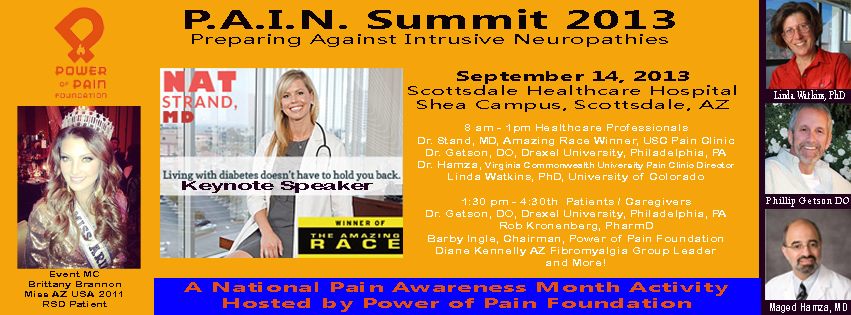
Scottsdale Healthcare Shea |
 |
The 7th Annual P.A.I.N. Summit hosted by the Power of Pain Foundation provides a great avenue for pain education for providers, patients and their caregivers. This year’s conference consists of an exhibit area and educational sessions that focus on better diagnosis and treatment options for pain patients, chronic pain issues (as a whole), prescription monitoring programs, and Proper Opioid Management. There will be breakfast, lunch and afternoon snack provided to attendees.
RSVP Required: http://painsummit2013.eventbrite.com/, Limited in-person space.
The event will be hosted by Brittany Brannon, Miss Arizona USA 2011, model, and RSD patient. The event will also feature two celebrity speakers, Dr. Natalie Stand, MD winner of theAmazing Race, and WWE star and professional wrestler, Raven.
The day will consist of two sessions.
8am – 1:00pm The morning sessions are focused for healthcare providers. This includes all areas of expertise; anesthesiologists, complementary medicine specialists, emergency room, general practitioners, internal medicine, neurologists, nurses, orthopedics, pharmacists, physiatrists, physician assistants, primary care physicians, psychiatrists, surgeons, and therapists. Any clinician who practices, or is interested in practicing, pain management from an integrative perspective, will benefit from the meeting. HCP’s will be introduced to the rapidly expanding field of diagnosis and treatment. This conference will proved attendees a greater awareness and understanding of the need to appropriately identify, diagnose (HCPs only) and treat/seek treatment of common types of pain, including fibromyalgia, painful diabetic peripheral neuropathy and other chronic pain conditions.
1:30pm – 4:30pm The afternoon sessions will be filled with patients and their family/ caregivers. This portion of the conference will provide attendees a greater awareness and understanding of the need to appropriately identify, and treat/seek treatment of common types of pain.
There is no charge to attend this conference.
Schedule (tentative)HCP Sessions8:00 am – 4:00 pm Ongoing Registration Breakfast served Hosted by Brittany Brannon
8:15 am – 9:00 am Keynote address: Preventing complications that arise from diabetes such as peripheral neuropathy (pain) Dr. Natalie Stand, MD, Amazing Race Winner, USC Pain Clinic
9:10 am – 9:55 am An Integrative Approach to Chronic Pain Dr. Philip Getson, DO, Drexel University, Philadelphia, PA
9:55 am – 10:40 am Cultural Competency and the Patient in Pain Dr. Maged Hamza, Virginia Commonwealth University Pain Clinic Director, Richmond, VA
10:40 am – 11:20 Evidence Based Chronic Pain Care Linda Watkins, PhD, University of Colorado
11:20 am – 12:00 Complementary Medicine and its role in Chronic Pain Management (TBD)
12:00 pm – 1:00 Open Discussion with the Speakers and Attendees Lunch is served, Exhibitors
Patient/ Caregiver Sessions1:30 pm – 2:30pm An Integrative Approach to Chronic Pain Dr. Philip Getson, DO, Drexel University, NJ
2:30 pm – 3:15 pm Prescription Drug Monitor program Explained Rob Kronenberg, PharmD
3:15 pm – 4:00pm The Patients Perspective; At Home Pain Coping Skills Raven WWE Wrestler, Barby Ingle Power of Pain Foundation, and Diane Kennelly AZ Fibromyalgia Group Leader, Dr. Tory McJunkin, Arizona Pain Specialists
If you are unable to attend in person, you can attend by watching our UStream Channel http://www.ustream.tv/channel/power-of-pain-foundation |
Over the years we have heard that suicides for CRPS/RSD (Complex Regional Pain Syndrome/Reflex Sympathetic Dystrophy) patients is the highest of all suicide rates.
This may not be as necessarily true as it seemed. This also does not entirely mean it’s false.
The following is an excerpt by the Reflex Sympathetic Dystrophy Syndrome Association (RSDSA) –
Suicide and Complex Regional Pain Syndrome (CRPS)
On June 23, 2012, Jill Harkany-Friedman, PhD, spoke to the RSDSA Board of Directors and invited guests on the topic of CRPS and Suicide Prevention. Dr. Harkany-Friedman is the Senior Director of Research and Prevention for the American Foundation for Suicide Prevention (AFSP). RSDSA asked Dr. Harkany-Friedman to speak because of recent suicides in the CRPS community. She assured us that although most individuals have fleeting thoughts of ending one’s life, suicide is relatively rare (12 out of 100,000). Furthermore, 90% of those who die by suicide have a diagnosable mental disorder, i.e. depression, anxiety, alcohol or substance abuse, and a potentially treatable mental disorder. We are posting her PowerPoint® presentation for your information.
I respectfully give all credit to the RSDSA for the above information.
While I respect the educated view of Dr. Harkany-Friedman the thought presents itself that she seems to be stating that nearly all those CRPS related suicides indeed had and underlying mental disorder therefore was the reason they took their own lives. I am not certain though. The estimates were on an over all amount of suicide percentages rather than CRPS specific.
I do apologize in advance for any misunderstandings.
I have rarely ever used offensive language in my posts, but in order for the general masses to understand what I mean in a blunt manner, I will come right out and say it, “Chronic severe pain is a mind and head fuck”. It becomes mental. We all know, at least most of us do, in order for us to feel pain, our brain has to feel it first.
That’s why coping strategies, meditation, relaxation, bio feedback, breathing exercises, guided imagery, aroma therapy and so many other techniques are necessary tools for the management of pain.
I have a hard time believing each of the CRPS suicides also had a mental disorder. Of course we’re mental. That doesn’t mean we have a mental disease, also.
It’s not all in our heads it’s in our bodies!
This also bring up another thought and that is if those suicides were CRPS misdiagnosis’. I hate to bring this up but there are some people who desire to be sick, who seek attention, who thrive on pity, who watch and listen to others for their symptoms so they can take what they learn to their own doctors and claim the same illness. Those people would have mental disorders.
In these cases I would hope the doctor’s were watching the objective findings rather than only listening to the subjective.
A little example,
30 people on a plane
Someone starts coughing and gagging suddenly, itching themselves all over. Making a scene for all to notice.
The person gets out of his seat and stumbles into another passengers and coughs all over him.
That person begins to worry he is catching something. He starts to itch himself.
Suddenly others are doing the same.
Next thing you know every one is hacking, coughing, itching and going nuts.
They all think they’ve contracted some illness, epidemic..
The problem is no one has it’s all in their heads. They only believe it to be true.
The first person never had anything at all. It was just a test.
This only goes to show the power of suggestion.
For some reason I tend to think that if deaths were related to CRPS/RSD we wouldn’t know that it was. Somehow some way it would be found and reported that that there was a psychiatric condition present or un diagnosed and that was the reason behind the suicide. Since nearly all CRPS/RSD patients have been diagnosed with depression secondary their illness, I have a feeling the depression would be used as the cause and not the horrible pain itself.
Suicidal ideations would be almost natural for anyone going through a painful hardship. The mind tries to free itself from ongoing pain and turmoil. It may plan and think of ways out, do things it wouldn’t normally do when more at ease, may even harm, cause bodily injury and so much more.
Self harming, cutting and causing bodily injury isn’t always a sign of suicide or suicidal ideations, sometimes it’s just a diversion to the original pain one is constantly feeling.
I think most CRPS/RSD’rs who have suicidal thoughts don’t really want to die at all, on the contrary they want to live.
They just need help managing their pain and most of them aren’t getting it.
~Twinkle Wood-VanFleet
 This poem is dedicated to all my RSD/CRPS brothers and sisters. It was written only a few months ago. For many years I had a popular poetry site called Golden Rainbow Poetry and became Golden Rainbow Poetry Creations as it evolved. I had a small business license back then under the same name.
Many of my poems have been lost, some have been found and others are hopefully backed up on a drive I have not located yet. From my earlier years of writing there is a journal type book somewhere that has dozens hand written in. I am hoping it is in the garage in a box.
Soon I will begin to share the ones I do have available. Some have been published in both hard print and audio, in hard bound compilations of 100’s of poets together in 1 book, 4 of my poems live inside those, others on various internet sites. I wrote a poem for 911 that is on audio. The project was published as both hard bound book with an audio CD, mine made it to the audio part.
Each of my poems have a mood, some in imagery that leaves the reader to wonder the meaning and also to connect with the words themselves.
Some of these poems could come from the reader themselves. It could be anyone, anywhere and at anytime.
It is still Nervember (November) National RSD/CRPS Awareness Month. I hope the poem above brings a bit of awareness to those who can’t seem to grasp the meaning of RSD/CRPS. Or… What it feels like.
A special thanks to Barby Ingle, Trudy Thomas, Chris Greulich, and the Power of Pain Foundation.
Thanksgiving is less than 2 days away. I have much thanks to celebrate. Especially for the having the very best husband in the world, my children, grandson and the fire in my flesh and bones I survive however hard.
I am thankful for those friends mentioned above. I am thankful for my mom, sister and extended family. I am thankful for being here to help others, I am thankful for those who help me.
Happy Thanksgiving!
Always be as well as you can be
Wishing each of you pain eased days and nights…
One of the hardest parts of living with CRPS is the not knowing. Not knowing when the fire will ease down, or the icy cold to run warm. Not knowing when the ache will settle or quality sleep will come. Not knowing if you’ll doze off, even when everyone else thinks you’re still awake because you appear to be. Not knowing why you’re being sent to a new doctor, or how the bills will get paid. Not knowing how to support your spouse the way you use to because you can’t work anymore.
Feelings of inadequacies and worthlessness often override feelings of joy and hopefulness.
Yet you still smile… try to make other’s laugh, you laugh yourself.
The title of this blog is just about right for this post. When chronic pain and depression collide we’re left with pain and despair crashing into one another. And a vicious cycle that if we don’t pull ourselves out of either by self or with help will just keep bouncing back and forth. There’s nowhere to go. Chronic pain often causes depression and in turn the depression causes even more pain. Stress will just exasperate the two. What might come of all this? A horrible Flare-up. What can we do? We have to break the cycle. Intervene!
My RSD CRPS fire burns steadily, when I have a Flare-up it becomes a raging inferno, so hot, like a steam burn. There have been times this fire has become visible to the eye. My skin has appeared to burn from the inside out leaving discoloration that very much looks like steam or hot water burns. My bones ache so deeply they are screaming.
An excerpt of an article/essay I first wrote in 2009 (Flare-ups and Flare up Protocol)
“I’ve learned to help myself during these times. Duration, frequency and intensity is something that I have to take control of. We all have to. We truly have to. The tools I use during these times are called my “Flare-up Protocol”. My flare up protocol includes the 3, 20’s.
The 3, 20’s are:
Exercise (ie, Yoga, stretching, walking, if able, light weights, activity, etc)
Modalities (ie, anything that can be placed on the body for pain relief, such as a tens, heat, hands, etc)
Distraction (ie, Memory master system, games, meditation, relaxation, fun, etc.
These can also be considered coping strategies.
My favorite is laughing.
The 3, 20’s mean 20 minutes of exercise, 20 minutes using modalities and 20 minutes of distraction.
These should be done whether or not one is experiencing a flare, but especially during. And up to 3 times a day.
While it’s easier said than done, the worse thing to do for a flare-up is to do nothing at all. Bringing us back to the use it or lose it theory which is quite accurate. Doing nothing can cripple us just as much as the pain itself.
I imagine a few of you might be thinking “You’ve got to be kidding me?! You want me to exercise when I’m hurting this bad? You must not understand” Oh but I do, I’ve said it and thought it a hundred times over myself.
While some will not want to take this to heart, we have to take responsibility for our own pain, everyone has to learn to and implement their own Flare-up protocols to get through these extra overwhelming, overbearing, debilitating flares.
As people we expect our doctors to take our pain away and we become discouraged when there aren’t any answers to satisfy our questions. We become depressed and insecure, yet We have to remember that RSD/CRPS is an incurable illness. Classified incurable because there isn’t a cure to it. There really isn’t anything the doctors can do to fix it. If the injury is correctable, it probably isn’t RSD. Our health care professionals can help us with medications and procedures, and that’s it really… just help us along.
We’re usually directed to pain management when our other doctors are at a loss. Pain management is just that, management. Again, not a cure. An area of practice that helps us manage our pain, not make it disappear. They are intended to help us live some sort of fulfilling life when nothing else can be done. Pain management is usually a last resort and the rest is up to us.
We might not like it but we have to take primary responsibility for managing our own pain because there isn’t enough knowledge or medical and scientific certainties out there to do it for us.
Flare ups are apart of having RSD/CRPS or a chronic pain condition. They’ll never go away, we have to learn to accept this. But, with practice, we can better learn to control them.”
http://crpsadvisory.com/rsdcrps_flareups_and_flareup_protocol.html
There have been many times I have used muscle relaxation, progressive muscle relaxation in place for exercise laying down. I do simple Yoga stretches. My right calf has had atrophy for 11 years now and continues to worsen. It’s important to help our bodies not waste away. My exercise is also listening to music and moving my body to it the best that I can even while sitting upon my bed.
So how do you survive it? Relax! Try removing worry from your life. Again easier said than done. I know, I continue to struggle with the same issues. The not knowing, the unknown. What will tomorrow bring. For one thing it’s best not to tell ourselves tomorrow will be an awful day. Why? How do we know yet? Tomorrow isn’t here. Positive self talk is helpful. I should practice more of what I preach. Learn how to get Freedom from Pain and Discover Your Body’s Power to Overcome Physical Pain.
I use my imaginary baskets. In my mind I have 3 baskets. 1 for important things, tasks, people, places, issues, etc, 1 for the moderate and 1 for it can wait a bit.
Everything is important to me. So this is difficult. I care so much about people. I often times care too much which causes me to carry much on my shoulders. I don’t know any other way to be. I serve, I give, I care and I love to.
I have to decide what is most important to put into the important basket. I need to learn to put more in the 3rd basket. By putting everything into my first basket I get behind, my moderate basket rarely has enough in it. I end up in a crash and burn. If it’s used right it really can work. Even with kids.
When we’re happy, everyone around us is happy. We all know that saying.
Deep breathing is helpful, meditation, relaxation, guided imagery, progressive muscle relaxation, distraction, modalities, I’ll leave out exercise 🙂 , support groups, not carrying the world on your shoulders alone, aroma therapy, bubble baths and soothing music, practicing appreciation, being thankful.
I’ve been scheduled to see a Pulmonary Specialist based on my sleep study results. No one has given me any specifics… “not knowing”. I admit I’m nervous as I don’t know why. All I was told is that it didn’t seem to show Sleep Apnea which I was tested for.
I do know one thing, regardless of how hard it all is..
I am, so far, surviving the fire…

and I hope you are too!

Please, Help fund this project in NERVEmber! 2012
Aunt Barby Hurts – A Children’s Book about Chronic Pain
A full-color story book that will improve the daily lives of families that deal with the struggles associated with Chronic Pain.
To understand the importance of this book, Watch the Video!
Go to http://www.indiegogo.com/aunt-barby-hurts to make a contribution to this great project.
Please make a contribution no matter how small, every dollar helps us reach the goal. This is a unique and worthy project to help our young population understand how to interact with those who experience some kind of chronic pain. Contributions can be as small as $1.00 and gifts will be given to the higher donations starting at only $10.00. Click on the image and see what its all about.
What we’re hoping to do, with your help, is create a children’s story book that deals with the topic of chronic pain. It will be a fully illustrated story; not merely an instructional handbook. And the goals of the book will be to introduce the idea of chronic pain, comfort children who know someone with chronic pain, and to help them learn ways of playing with, showing affection for and caring for that person.
What we’re hoping to do, with your help, is create a children’s story book that deals with the topic of chronic pain. It will be a fully illustrated story; not merely an instructional handbook. And the goals of the book will be to introduce the idea of chronic pain, comfort children who know someone with chronic pain, and to help them learn ways of playing with, showing affection for and caring for that person.
I was watching my son and his cousins interacting with their aunt Barby, who suffers with chronic pain. It was difficult for them to understand why they couldn’t give her hugs, or make loud noises. Looking at her, she doesn’t seem hurt; she doesn’t have a cast or even a band-aid. Chronic pain is often invisible, which makes it difficult for children to understand.
They would forget and sometimes play too rough with her. Sometimes that would hurt her and she would cry out; then they would feel guilty, as if they are the one that caused her to be in pain. They even started to think the best thing was to leave her alone and play somewhere out of her way. But Barby wanted to play with them, talk with them and show them how much she loved them.
Seeing this, I wondered how this might be playing out in other homes with family members who suffer from chronic pain. Over 116 million people in America have chronic pain. I thought there must be a good way to teach the children in these families all about it, how to help the family member cope, and how to play and have a great time with them: to have a normal full relationship. In talking with Barby, we agreed that a children’s story book would be the best way of dealing with this type of need.
Tim and Barby will work together to create an engaging story that directly addresses many of the daily challenges of living with Chronic pain and presents them to children in a gentle and natural way. Once the story is complete, Tim will develop the artwork to bring the story to life. Tim is a fully digital artist, who works in Photoshop with a Wacom tablet.
After the story and art are complete, they will be laid out for high-quality printing as well as developed into a digital app for phones and tablets.
We’d like to dedicate this project in honor of NERVEmber 2012, the month for Neuropathy Awareness.
Tim Ingle- Co Author and Illustrator
Barby Ingle- Co Author
This campaign will only receive funds if at least $13,999 is raised by Fri Nov 30 at 11:59PM PT.
It’s crucial that this project receives it’s funding by the deadline in order to proceed.
Most people don’t realize how far a dollar with go. If all of my friends, Barby Ingle’s friends, the Power of Pain Foundation’s friends, supporter’s of the Power of Pain Foundation, supporters of chronic pain and RSD/CRPS awareness can give a gift of $2 we could reach our goal.
I say “we” and “our’ because this project has the potential of changing lives. Making happier lives. Teaching children how to interact with those of us in pain and helping us care for them while hurting.
If you are a group, an organization, a business, please start a donation jar and donate no later than November 30th.
Please go to http://www.indiegogo.com/aunt-barby-hurts
I gave, will you give with me?

Microglia play a crucial role in the maintenance of neuronal homeostasis in the central nervous system, and microglia production of immune factors is believed to play an important role in nociceptive transmission. There is increasing evidence that uncontrolled activation of microglial cells under neuropathic pain conditions induces the release of proinflammatory cytokines (interleukin – IL-1beta, IL-6, tumor necrosis factor – TNF-alpha), complement components (C1q, C3, C4, C5, C5a) and other substances that facilitate pain transmission. Additionally, microglia activation can lead to altered activity of opioid systems and neuropathic pain is characterized by resistance to morphine. Pharmacological attenuation of glial activation represents a novel approach for controlling neuropathic pain. It has been found that propentofylline, pentoxifylline, fluorocitrate and minocycline decrease microglial activation and inhibit proinflammatory cytokines, thereby suppressing the development of neuropathic pain. The results of many studies support the idea that modulation of glial and neuroimmune activation may be a potential therapeutic mechanism for enhancement of morphine analgesia. Researchers and pharmacological companies have embarked on a new approach to the control of microglial activity, which is to search for substances that activate anti-inflammatory cytokines like IL-10. IL-10 is very interesting since it reduces allodynia and hyperalgesia by suppressing the production and activity of TNF-alpha, IL-1beta and IL-6. Some glial inhibitors, which are safe and clinically well tolerated, are potential useful agents for treatment of neuropathic pain and for the prevention of tolerance to morphine analgesia. Targeting glial activation is a clinically promising method for treatment of neuropathic pain.
Department of Anesthesiology, Brigham and Women’s Hospital and Harvard Medical School, Boston, MA, USA.
Management of chronic pain, such as nerve-injury-induced neuropathic pain associated with diabetic neuropathy, viral infection, and cancer, is a real clinical challenge. Major surgeries, such as breast and thoracic surgery, leg amputation, and coronary artery bypass surgery, also lead to chronic pain in 10-50% of individuals after acute postoperative pain, partly due to surgery-induced nerve injury. Current treatments mainly focus on blocking neurotransmission in the pain pathway and have only resulted in limited success. Ironically, chronic opioid exposure might lead to paradoxical pain. Development of effective therapeutic strategies requires a better understanding of cellular mechanisms underlying the pathogenesis of neuropathic pain. Progress in pain research points to an important role of microglial cells in the development of chronic pain. Spinal cord microglia are strongly activated after nerve injury, surgical incision, and chronic opioid exposure. Increasing evidence suggests that, under all these conditions, the activated microglia not only exhibit increased expression of microglial markers CD 11 b and Iba 1, but also display elevated phosphorylation of p38 mitogen-activated protein kinase. Inhibition of spinal cord p38 has been shown to attenuate neuropathic and postoperative pain, as well as morphine-induced antinociceptive tolerance. Activation of p38 in spinal microglia results in increased synthesis and release of the neurotrophin brain-derived neurotrophic factor and the proinflammatory cytokines interleukin-1β, interleukin-6, and tumor necrosis factor-α. These microglia-released mediators can powerfully modulate spinal cord synaptic transmission, leading to increased excitability of dorsal horn neurons, that is, central sensitization, partly via suppressing inhibitory synaptic transmission. Here, we review studies that support the pronociceptive role of microglia in conditions of neuropathic and postoperative pain and opioid tolerance. We conclude that targeting microglial signaling might lead to more effective treatments for devastating chronic pain after diabetic neuropathy, viral infection, cancer, and major surgeries, partly via improving the analgesic efficacy of opioids.
–

Sponsor/ Donation Request
In-Kind and Cash donations are Tax deductible
For Immediate Release: June 26, 2012
RE: Exhibitor at the Sacramento’s Convoy of Hope event
The Power of Pain Foundation (POPF) is hoping to become an exhibitor at the Sacramento’s Convoy of Hope event. The event will take place on September 15, 2012 at the Cal Expo. The Power of Pain Foundation is a nonprofit 501(C)(3) charity. All donations are tax-deductible. We really need your help! We must raise $2,000. We will be able to reach 20,000+ people who attend the event and distribute awareness information, provide resources to the community, host a balloon launch, and answer questions. We need donations now to raise funds to participate in this great event during September 2012 – National Pain Awareness month.
Our goal at the Convoy of Hope event is to inform the public that Reflex Sympathetic Dystrophy and other neuropathy conditions do exist, there is hope and help.
Please help us attend this event and reach Californians with this important information and resources. Donors of $25 or more will have their names listed on the Power of Pain Foundations Website with over 1,000,000 page views a year and our social media pages (Facebook, Twitter, Linked In), and our newsletter and email blasts, reaching over 8,000 direct people.
Thank you for your consideration.
Twinkle VanFleet
POPF California Ambassador
Media Contact Information:
Twinkle VanFleet
CAAmbassador@powerofpain.org
twinkle@crpsadvisory.com
916-850-0RSD (0773)
More on the Power of Pain Foundation
The Power of Pain Foundation (POPF) provides community based support services that address the needs of chronic pain patients with Neuropathy conditions such as RSD/CRPS, Post Cancer Pain, Lyme, MS, Fibromyalgia, Diabetic Neuropathy, and many more. Accordingly, beneficiaries include patients who are economically and socially affected by these invisible diseases. Whether you have Neuropathy pain or are a caregiver, family member, or friend of someone diagnosed, we help you face the challenges and life changes of chronic nerve pain, head on. The Power of Pain Foundation’s federal ID number is 65-1298571.
The POPF works throughout the United States to promote awareness for Neuropathy conditions. One such condition is Reflex Sympathetic Dystrophy, also known as RSD/CRPS, and Causalgia. More than 10 million people have been diagnosed with RSD in the United States alone. RSD has a score of 42 out of 50 on the McGill Pain Index, the highest of all medical conditions known to man. There is no cure to date.
More on the Sacramento Convoy of Hope event
“The Sacramento Convoy of Hope is a collaborative effort between dozens of local churches, businesses, social service organizations, local government and Convoy of Hope. This all-volunteer event mobilizes hundreds of area residents to serve and make a difference in their community. Strong participation by local businesses, churches, community agencies, and individuals is crucial to the success of this event. Bring your family and enjoy free services and entertainment, with more than 100,000 pounds of free groceries. There will be a health fair, job fair, free medical and dental screenings with local doctors, medical professionals and dentists, kid’s zone, free haircuts, dozens of free carnival games, inflatable’s and live entertainment. Also, free family portraits courtesy of local photographers, community services, dozens of local community service organizations and free BBQ lunch.”
213 Nottingham Drive, Colonial Heights, VA 23834, 804-657-PAIN(7246)
38556 N. Dave Street, Queen Creek, AZ 85240, 480-882-1342
A 501 (c) (3) not for profit organization – 65-1298571
www.powerofpain.org
Checks and Money orders from around the world can be sent to the address above. Please add Convoy of Hope to the memo. Or go to our website at: http://powerofpain.org/donate/ and choose your option.
Paypal account ID- donate@powerofpain.org
All donations go right back into serving you and the Convoy of Hope itself.
I can accept cash in person in Sacramento only. A receipt with both our signatures and information will be required to maintain proper records for the Power of Pain Foundation.
In addition, the Power of Pain Foundation is Hosting an Online Auction Fundraiser to help us become an exhibitor and the Convoy of Hope. We must raise funds to complete the mission of raising awareness and support for the conditions listed above.
We’re also seeking donations Sacramento area businesses who would be kind enough to offer us gift certificates, vacations, airline tickets, accessories, jewelry, hair salon certificates, spa’s, handmade items, etc for our auction.
We’re also seeking area residents who might have items to donate.
Again all items are tax-deductible.
Sponsors include: (updated daily)
Business Donors
Absolute Investigations
Individual Donors
Dani Meyers
VanFleet Family
Taylor Family
Convoy of Hope Fundraiser 2012
Facebook events Convoy of Hope Online Auction Fundraiser 2012
We would be grateful if you joined our event page and attended the auction.
Feel welcome to add me on Facebook- www.facebook.com/rsdcrpsfire
We look forward to serving you!
Thank you!
~Twinkle V.
Biology of addiction, current research on addictions and modalities of recovery
Improving global pain relief by achieving balanced access to opioids worldwide
Just a wretch saved by grace trying to do whatever I can to grow up.
Raising awareness for mental health disorders through a shared passion of video games, poetry and more.
motherhood - growth - living
Create a path of Light with your Life
Life Scripts of an INFJ
Finding Your Words
A safe place to talk openly about mental health & illness
Daydreaming and then, maybe, writing a poem about it. And that's my life.
Eu consegui. Você também pode!
Spreading The Truth About Kratom Mitragyna Speciosa
How our healthcare system is killing and harming us
A little something for you.
Nothing is impossible (at least that does not violate the laws of physics). When you can..violate the laws of physics!
Kavita Ramlal, Proudly South African
 RSD Advisory- Where Chronic Pain & Depression Collide