Gall Bladder Fiasco Continued and hopefully the Final Chapter!

twinklev2ncgallbladdersurgery1

The first part of this story can be found here https://rsdadvisory.com/2013/05/18/endoscopic-retrograde-cholangiopancreatography-52113-due-to-gall-bladder-removal-fiasco/ shared May 18th. I had my ERCP that showed I had Gall Stones hanging out over by the piece of Gall Bladder that was adhered to my liver since March of 2012 when I originally had it removed. The test also showed the lining of my stomach and surrounding areas were severely inflamed. I was given another diagnosis of Gastritis. So of course I waited to see the surgeon again and get my surgery date scheduled. It was scheduled for July 10th, 2013. 1 week ago today!

The surgeon told me that he would try to remove it first like the last time. I would have 4 small incisions. If he couldn’t get it he would have to do a larger cut. I was scheduled for a Laparoscopic Completion, Cholecystectomy, Possible Open, Possible Cholangiagrams. I signed the forms! I had to arrive at Mercy General Hospital at 5:30 a.m that morning for 7:30 a.m surgery. The surgeon told my husband to give him 4 hours, but that he could be done in an hour and a half, but not to worry until the 4th hour. I headed into the OR.

Now I have to laugh about this because I felt my hand zing and then zing again. They were putting me to sleep! But I didn’t go to sleep. So the Anesthesiologist ask me what I did for a living and I went on to babble about RSD/CRPS awareness, educating, working for the Power of Pain, I just chatted them right up and I know they were waiting for me to go down, even gave me more a few seconds or so before, I felt it. I remember looking off and thinking I’m going to go to sleep now and started to say it, but then I woke up in recovery with worse pain than the first time.
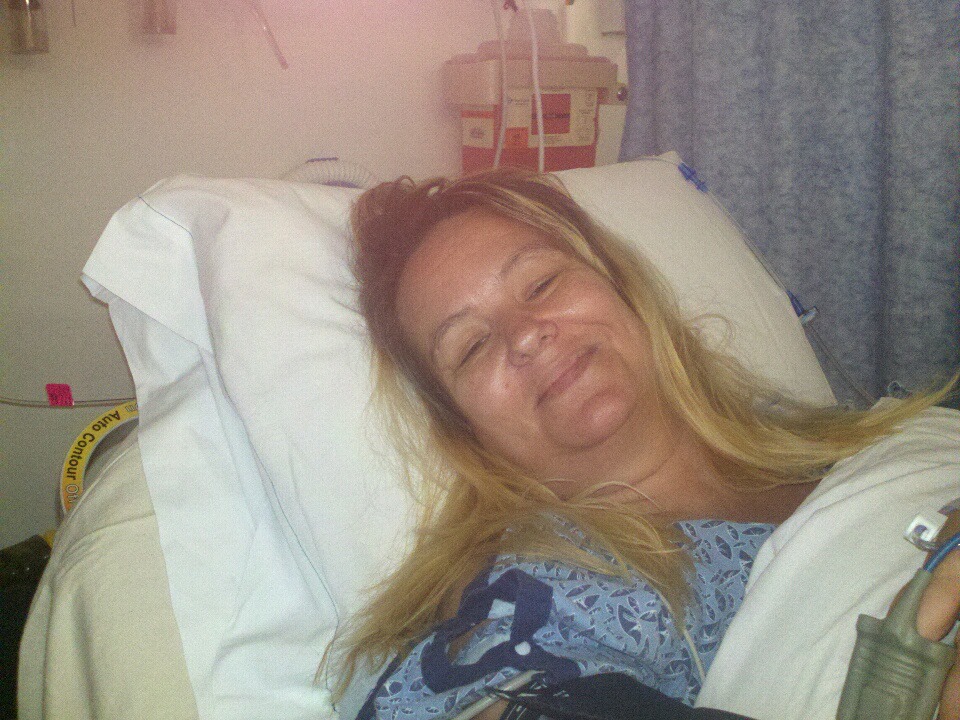
TwinkleVMercyGeneralJuly102013

I still have swelling, a lump above my top incision that hasn’t gone down yet. When my doc called me the day after my surgery to check up on me, I told him about it, he said it was because that’s where he beat me up the worse. Funny! I laughed! That is where he had to use the tools and manipulate inside me to peel that piece off my liver, he said it should go down in a few days. I hasn’t yet though. I tried to drop the pain medication yesterday and switch to OTC NSAIDS but when I woke this morning I was hurting so bad from the top incision/lump to the side ones. A feeling of being inner bruised. Understandable really. So I’ve switching back and forth from Norco 10/325 to 4 OTC Ibuprofen. The Ibuprofen will help the inflammatory more than Norco will. Tylenol doesn’t touch that type of pain for me.

I was also mentioned to me that I have Crohn’s Disease. It’s a lot to process. My Gastrointestinal problems have become so bad that it seems the likelihood of internal CRPS is more my situation. I’m not going to mention all the symptoms right now, I’ve mentioned some of them in my group, on my facebook timeline, I just really need to find a doctor, a GI or Internal Medicine that is educated in RSD/CRPS, not one who has only heard of it. That was my experience with this surgery, a few heard of it, no one “knew” about it. My own primary doesn’t know “about” it. I had to educated him with just pieces as there is never enough time for it all.

I’m lucky to keep food down, even things to drink, I have to pick and choose carefully, the doc did also send me home with the generic for Prilosec to take a half hour before I eat anything first time each day. I either have diarrhea or can’t potty at all for weeks.

It seems the surgery has eased the pain over under my ribs on the right, but so far the mid back pain and other pain is still here. I had my SCS checked 2 days before my surgery by my Medtronic Specialist. It’s fine!

When the surgeon removed that piece of Gall Bladder it was full of fluid and was growing new tissue. He was able to remove several stones from that same area. The pathology is already back and it was negative for any cancerous cells.

On Monday when I had a follow up to my OBGYN due to inflammation found on my Uterus and the cyst(s) found on my right ovary which is larger than my left side and includes scar tissue as does my lower belly from left side to the entire right from an ectopic and exploratory surgery many moons ago.  I opted for what I believe is called Nexplanon. I could have also tried the Depo or an IUD. Never again to an IUD for that is how I conceived my Ectopic twins. And I’ve tried Depo Provera  and didn’t believe since these were my only options it was right for me. Normally the implant with is a small flexible tube is used as a form of birth control which can last up to 3 years and it stops the menstrual cycle. Yay! It was implanted beneath my inner left arm. The reason I opted for this was that my other option was a full Hysterectomy. This option buys me some time. I am not ready for more surgery yet. If at all. First of all it’s not safe for those of us with RSD/CRPS and secondly repetitive surgeries just aren’t safe for any of us. We always have to decide in the end what is best for us by weighing the pros and cons to it all.

If your doctors aren’t aware of your RSD/CRPS, please educate them. I do in pieces and portions but we only have so much time in each appointment. If need be take information and have it put in your file. In fact, that is exactly what I’m doing for my 24th follow-up with my surgeon and when I see the other’s next, same for them. My surgeon seems really great and caring. To call my husband at home to check on me and then asked to speak with me for a few moments even though I was resting, I respect that. You don’t get that much now a days. I think he will be appreciative, not upset or offended. Not the people should be, yet sometimes they are, especially when the info comes from no medical degree persons like myself. Some become quite offensive, also. They assume we think we’re know it all’s! Farthest from the truth! So I’ll hand off the info which will include more than 1 source and see which one actually has a broader perspective the next time I see him.

While I’m sure it’s happened before, no one from my surgical team had heard of it and no one from my doctor’s offices had heard of it…

Nor from my own communities online and off, family or friends.

I actually gave birth to a Gall Bladder twice! Just different sizes!

So glad it’s over and I’m on the path to healing again.

One down!

~Twinkle VanFleet

CRPS Survivor

Cortical Integrative Therapy with Dr. Victor M. Pedro on Living with HOPE Radio Show with Featured Host Trudy Thomas

Living with HOPE Radio Show with Host Trudy Thomas LogoThe following information has been taken from notes as a listener to the show and research, nearly all the words themselves belong to Dr. Victor M. Pedro. I take no credit for these. My goal is to get this non invasive seemingly promising information out so that other’s may find it a hopeful treatment program in their journey with CRPS/RSD, Chronic Pain, TBI’s and other illnesses and conditions.

Yesterday on the Living with Hope Radio show with Featured Host Trudy Thomas and Co Host Barby Ingle . Dr. Victor M. Pedro discussed Cortical Integrative Therapy (CIT®) a technique he uses and developed.

The entire show can be listened to here: http://www.blogtalkradio.com/thebodymindandspiritnetwork/2013/05/29/living-with-hope-with-host-trudy-thomas  The Living with HOPE Show is Sponsored by the Power of Pain Foundation.

Dr. Victor M. Pedro’s career began as a Chiropractor and continued on with a Post Graduate in Functional Neurology. He says ” it was a very good starting point for brain function and innovative treatments that could begin to make a difference in peoples lives. He was fortunate enough to receive grant funding from the Rhode Island Legislature which permitted him to do a variety of studies and to study with significant people to get a more in depth and cutting edge picture of what was available in Neurology and how the brain functioned.

Trudy asked ” Does this therapy work for other conditions other than RSD? Dr. Pedro stated Yes! What he wanted his contribution to be is the person credited with creating an algorithm for understanding where in the nervous system to intervene.”

There are plenty of resources that will explain what a brain dysfunction is or pathology is, disease process or diagnostic procedure to figure out what folks are complaining about.

The rehabilitative model is where the challenge for the future lies.

Barby ask’s “Does every patient have a different algorithm? Or do you find they are similar with the same condition? The doctors answer’s ” By algorithm I mean a process we go about to evaluate what the affliction is or what’s wrong with the patient.”

Reflex Sympathetic Dystrophy or Dysautonomias in general are a condition Dr. Pedro has a particular interest in. With this condition he tries to find out how the autonomic system is dis-regulated or not working well and then his team tries to decipher in the patients does this person have Reflex Sympathetic Dystrophy (RSD) because the Sympathetic Nervous System is too high and not being inhibited or is it the Parasympathetic System that’s undergone demise and not effective.

“The treatment is actually different and makes all the difference in the world to the patients outcome, Dr. Pedro say’s.”

Barby ask’s ” Similar to Traumatic Brain Injuries (TBI’s) Would there be a different protocol for that?

Dr. Pedro answer’s “A different protocol in terms of how we’re going to add on different diagnostic pieces to the evaluation. Then we begin to identify precisely which modalities the patient needs. A TBI patient may have a similar pathology of an RSD/CRPS patient, may have similar findings, however we may go about the treatment process slightly differently.”

One of Dr. Pedro’s patients and a good friend of Barby Ingle’s just did an interview which will be released in this Saturday’s (June 1, 2013) edition of Pain Pathway’s Magazine. Please look for it!

Physical, emotional and nutritional needs are also taught this during treatment.

The autonomic nervous system delivers fuel to the body and brain. The autonomic nervous system is the automatic part of the nervous system that controls your heart rate, size of arteries delivering blood or fuel to the body and into our brain itself. This part of the body can be evaluated through a series of tests.

Someone with a compromise in their sympathetic nervous system may not have as much profusion as should be present. The long term consequences are considered regarding how this is effecting the tissue and that’s why the trophic changes present in this pathology.

Barby ask’s “Is maintenance treatment required or is this a one time process?”

Dr. Pedro states “The evaluation process takes 2 to 4 hours depending on the patient.” Based not only on tests, but the patients ability to participate.”

At the end of the evaluation we attempt to draw for them what we believe is wrong in the nervous system and make an educated hypothesis as to where the dysfunction is and what can potentially be done to correct it. A series of windows of observation, sympathetic, autonomic windows of observation more appropriately. We identify these at the end of the initial observation and we give the patient a treatment to see if their pain level comes down significantly or at least appreciatively.

That signals to us they are a good candidate for our program.

Dr. Victor M. Pedro is founder and president of Rhode Island Integrated Medicine, located in Cranston, RI.  An accomplished, Board Certified Chiropractic Neurologist, Dr. Pedro pioneered the development of Cortical Integrative Therapy (CIT®)—a breakthrough, research-based treatment designed to address brain and neurological dysfunction in both children and adults.

After remarkable success using CIT® to treat school-age students diagnosed with speech, attention and learning disabilities, Dr. Pedro applied the treatment for use in patients with Reflex Sympathetic Dystrophy or CRPS, dysautonomias, and traumatic brain injury (TBI).

Over the years, Dr. Pedro has lectured extensively on CIT® as a non-invasive, cost-effective treatment for TBI, pain syndromes, dysautonomias, and other brain-related disorders.

Cortical Integrative Therapy (CIT®) has been successful in treating a wide range of painful and debilitating conditions including: ADD/ADHD; apraxia; ataxia; chronic pain; dystonia; dysautonomias; hypotonia; memory difficulties; movement disorders; Parkinson’s disease; Reflex Sympathetic Dystrophy (RSD)/Chronic Regional Pain Syndrome (CRPS); RLS; sciatica; traumatic brain injury; tremors; and vertigo, balance, and gait problems.   ©Rhode Island Integrated Medicine

Other keywords in the interview- Inhibitory system, Renshaw cells, Autonomics, Small diameter fibers, Dysautonomias, Limbic system, Antonio DeMazio

http://corticalintegrativetherapy.com/ Cortical Integrative Therapy Rhode Island Integrated Medicine- The Brain Rehabilitative Specialists

http://corticalintegrativetherapy.com/blog/ NBC 10 Health Check Special Report: TBI & CIT® March 04, 2013

~Twinkle VanFleet, California State Ambassador Power of Pain Foundation

If I have mis stated any facts or quotes please contact me at: caambassador@powerofpain.org  I will make any corrections immediately. Thank you!